
He Pito Mata 2026
Early-career researchers are invited to join the Society’s 2-day national conference in Tāmaki Makaurau.
Registrations close 5pm Monday 31 August.
Get your ticket now!
Connect with other emerging leaders to tackle the real issues: how to secure funding, outsmart artificial intelligence, protect data sovereignty, and smash goals for research impact. Delegates can even become named authors through live research workshops, including on storytelling and on women in research.
The Society’s Early-Career Researcher Forum has planned the programme, based on the evolving landscape of research in Aotearoa New Zealand, with a strong focus on research impact, wellbeing, future opportunities, and connections across communities, industries, and stakeholders.
Join for inspirational keynote speeches, panel discussions, and interactive sessions that highlight the realities of early-career research and offer practical tools.
Speakers will offer insights on the current landscape in funding, international collaboration, leadership, and interdisciplinary research.
He Pito Mata will also address emerging challenges such as the role of artificial intelligence in research, Indigenous data sovereignty, and how to effectively communicate research results, and influence change.
Programme highlights | Hōtaka
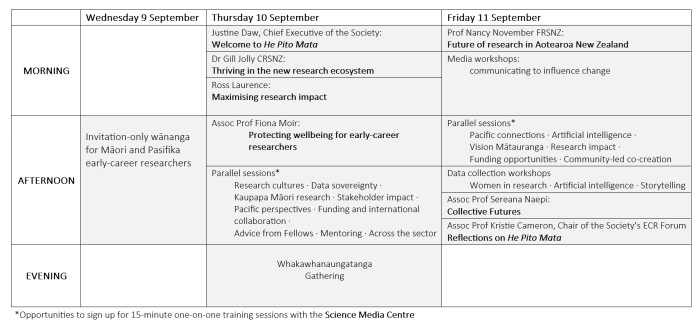
View He Pito Mata programme for 10-11 September.
Wānanga
Māori and Pasifika early-career researchers are also invited to a dedicated wānanga on the afternoon before the 2-day He Pito Mata gathering. This is an opportunity to tūhonohono (connect), explore Māori and Pasifika leadership in the research, science, innovation, and technology sectors, and to strategise for change.
View wānanga programme for 9 September.
Our speakers
 Prof Helen Moewaka Barnes FRSNZ (Te Kapotai, Ngāpuhi) is the Director of Whāriki and Co-Director SHORE and Whāriki Research Centre, Te Kunenga ki Pūrehuroa – Massey University. She is on the senior leadership Team of Ngā Pae o te Māramatanga Centre of Research Excellence, and works with hapū and iwi throughout Aotearoa. Her research areas include alcohol, online platforms, wairua, natural environments and health, life-course approaches to health and wellbeing, health promotion, health services research, parent and child health, and hapūtanga.
 Dr Sooalo Laupu’e Daisy Bentley-Gray is a Senior Lecturer, Pacific Academic Development Lecturer, and Interim Manager Pacific Success at Te Whare Wānanga o Wairaka Unitec. Since 2020, she has strengthened Pacific research culture at Unitec through leadership, collaborative research, and scholarly dissemination. She chairs the Unitec Pacific Research Fono, has led the Pacific research streams of symposia, and co-convened Te Pūkenga Vocational Education Pacific Research Symposium (2023). She has recently been honoured with the chiefly orator titles Sooalo and Laupu’e.
 Dr Riya Biswas is a Clinical Researcher at Vermillion Health Technologies, with expertise in biomedical research, clinical trials, and data analytics. She serves as an Associate Editor for Frontiers in Pain Research and a Review Editor for Frontiers in Pharmacology. She has contributed to the design, implementation, and evaluation of clinical studies investigating innovative technologies for chronic pain management. Her current work focuses on translating scientific research into healthcare solutions that improve patient outcomes.
Prof Karin Bryan FRSNZ is cross-appointed to the School of Environment and the Institute of Marine Science at Waipapa Taumata Rau, University of Auckland, focusing on nearshore and surf-zone oceanography. Her current interest is in geomorphology problems, using remote sensing (sub-aerial imagery) to detect patterns on beaches, water quality and nutrient dynamics, mangrove and saltmarsh evolution, and estuarine heatwaves. She has completed a Fulbright Scholarship, a Hanse Wissenschaftskolleg Fellowship, and research in France, Germany, and the United States of America.
 Dr Tania Cañas is a Postdoctoral Research Fellow at the Centre for Arts and Social Transformation at Waipapa Taumata Rau, University of Auckland. Her work and international collaborations span performance studies, memory, forced displacement, decolonial practice, and community-led research. She has been a Banting Postdoctoral Fellow, and is the Associate Editor of AlterNative: An International Journal of Indigenous Peoples, and a member of the Editorial Team for Performance Studies International. She co-edited the anthology Staging Asylum, Again.
Dr Shemana Cassim is a Senior Lecturer at the School of Psychology at Te Kunenga ki Pūrehuroa – Massey University. She was Co-Convenor of the Aotearoa Migration Research Network (2019–23) and an Executive Council Member of Contemporary Ethnographies Across Disciplines (2018–22), and is currently an Associate Editor of the Journal of Community and Applied Social Psychology. As Coordinator of the Enhancing Participation and Inclusive Change Collective, she works alongside migrant and ethnic communities to promote wellbeing, social justice, equitable outcomes, and flourishing.
 Dr Judy Ann Cocadiz of the University of Otago, Ōtākou Whakaihu Waka develops novel technologies to improve diagnosis and monitoring of cancer using circulating tumour DNA (ctDNA). Supported by a Postdoctoral Fellowship from the Cancer Society of New Zealand, she is leading the development of a small, portable device designed to enhance ctDNA capture directly from the bloodstream, enabling earlier cancer detection, improved treatment monitoring, and more equitable access to cancer care. She won the Falling Walls Lab Aotearoa New Zealand pitch competition in 2026.
Anna Edwards (Rongowhakaata) is a Business Manager for the Bioeconomy Science Institute’s Commercialisation team. For the past 5 years, she has built and maintained relationships between researchers and Māori businesses, whānau, and hapū, to enable opportunities that promote intergenerational wellbeing, thriving landscapes, and self-determined communities. She also contributed to developing best-practice protocols for the physical storage of samples of significance to Indigenous peoples, sharing this work through conference appearances and advisory roles.
 Ioane Aleke Fa’avae is a Senior Lecturer at the Pacific Centre, Unitec, an advocate for Niuean language, culture, education, and community development, and an active member of the Matala he Toumē Researchers Collective. He is Chair of the Mutalau Ululauta Matahefonua Trust, Deputy Chair of the Pacific Education Foundation, a Board Member of Pacific Dance NZ, and Cultural Advisor to the Vagahau Niue Trust. Recognition includes the Creative NZ Pacific Heritage Arts Award, the Ministry for Pacific Peoples’ Language Champion Honour, and the Inaugural Tagata Niue Honour.
 Assoc Prof Deborah Heke (Ngā Puhi, Te Arawa) is Director of the Ngā Wai a Te Tūī Māori and Indigenous Research Centre at the Manukau Institute of Technology and Unitec. Her research expertise spans Māori health, exercise physiology, psychology, and Mana Wāhine scholarship. She is the Rautaki Te Kupenga o MAI National Lead for Ngā Pae o Te Māramatanga’s network for Māori and Indigenous doctoral scholars. Her work explores pathways for connection, healing, and wellbeing for wāhine and kōhine.
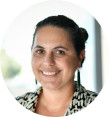 Dr Joanna Hikaka (Ngāruahine) is a Co-Director for the Centre for Co-Created Ageing Research (Co-Create Age) and a Senior Lecturer in Māori Health at Waipapa Taumata Rau, the University of Auckland. As Vice President of the NZ Association of Gerontology, she focuses on health and healthcare for older adults and Māori. Joanna’s research explores Māori experiences and expectations of care in residential care and community settings, and development and delivery of equitable health services.
 Dr Gill Jolly CRSNZ is Chief Science Advisor for the Ministry of Business, Innovation and Employment – at the interface between science, policy, and politics. A volcanologist from the United Kingdom, her international research ranged from magma physics to gold exploration, and from environmental geochemistry to monitoring active volcanos. In 2006, she began work at the Institute of Geological and Nuclear Sciences, now Earth Sciences NZ, where she led regional surveillance of volcanos, directed national responses to eruptions and earthquakes, and shaped long-term strategies for research on natural hazards.
 Dr Linda Johnson is Chief Scientist at the Bioeconomy Science Institute. An internationally recognised expert in plant–microbe interactions, fungal biotechnology, and agricultural innovation, she has led multidisciplinary research programmes spanning plant, microbial, and animal sciences. She led the team which won the Prime Minister’s Science Prize in 2024 for work on endophytes that has generated significant economic and environmental impact for New Zealand.
 Prof Bodo Lang of Te Kunenga ki Pūrehuroa – Massey University, in Auckland, has a career spanning academia and industry. His research focuses on marketing – communication, advertising, marketing of services, and social marketing. He has an interest in the interface of marketing and public health (or public good more broadly). He investigates how industry markets sugary beverages, alcohol, and vaping, and analyses corporate greenwashing, consumer behaviour, nutritional food labeling, and food waste. He engages with government, industry, the public, and the media.
 Ross Laurence is the Principal Advisor – Impact Strategy at the Bioeconomy Science Institute and Co-Chair of the Impact Planning and Evaluation Network, a collaboration between NZ’s Primary Research Organisations. He seeks to understand and address the systemic barriers to scientific impact, and to identify opportunities to generate tangible environmental, economic, and social outcomes. His work spans impact pathways, researcher capability, organisational systems, and strategies that help research deliver meaningful real-world value beyond academia.
 Dr Jordon Lima (Ngāti Porou, Te Aitanga a Hauiti, Ngāpuhi) was awarded a Postdoctoral Fellowship from the University of Otago, Ōtākou Whakaihu Waka, and is an Honorary Research Fellow at the Mātai Medical Research Institute in Te Tairāwhiti, where she explores tikanga and kawa for DNA tests to screen for and diagnose cancer. She aims to improve the experiences of cancer patients, their whānau, and their care providers, particularly in rural and remote communities, by designing innovative laboratory workflows, clinical protocols, and resources.
 Prof Ruggiero (Rino) Lovreglio is a Rutherford Discovery Fellow at the School of Built Environment at Te Kunenga ki Pūrehuroa – Massey University. He studies human behaviour in disasters – including disaster preparedness, simulations of evacuation, and safety training – using artificial intelligence, virtual and augmented reality, and building information modeling. He is an Associate Editor for four international scientific journals, and received the ‘5 Under 35’ Award from the Society of Fire Protection Engineers and Massey University’s Early Career Research Medal.
 Assoc Prof Fiona Moir is a Wellbeing Lead for the medical programme and wider faculty at Waipapa Taumata Rau, the University of Auckland, and a Director of Connect Communications, an education business which supports health practitioners with their professional wellbeing, clinical supervision, and communication skills. She has won a NZ Workplace Health and Safety Award for an initiative tackling bullying, harassment, and discrimination, and the University’s Butland Award for Leadership in Teaching and its Teaching Excellence Award.
 Dr Minh-Hieu Nguyen is a Senior Lecturer in Industrial and Organisational Psychology at Te Kunenga ki Pūrehuroa – Massey University, specialising in the intersection of social entrepreneurship, psychology, and sustainable development. She is a committed member of several international organisations and actively collaborates on research initiatives to address poverty and foster decent livelihoods. Recognised for enhancing regional and global research collaboration, she has organised Asia-Pacific seminars and co-leads Project SENSE (Social Enterprises for Sustainable Economies).
 Assoc Prof Byron Rangiwai (Ngāti Manawa, Ngāti Whare, Ngāti Porou, Ngāi Tūhoe), of Te Whare Wānanga o Wairaka – Unitec Institute of Technology, is also Adjunct Assoc Prof at Edith Cowan University in Australia. His Kaupapa Māori research examines Indigenous neurodiversity, disability, tertiary education, housing, health, wellbeing, identity, and Māori theology. He leads national research on Māori with Attention Deficit Hyperactivity Disorder and on digital education in kura kaupapa Māori. He won Unitec’s Research Excellence Award in 2025.
Dr Dan Richards is a Senior Researcher at the Bioeconomy Science Institute, leading research on Integrative Land Use Decisions. He is also Deputy Director of the International Research Laboratory for Climate, Modelling, and Agroecology, which the Institute coordinates with the Centre National de la Recherche Scientifique in France. A landscape ecologist and sustainability scientist, his research combines spatial modeling, remote sensing, and artificial intelligence to develop innovative tools to support resilient, multifunctional landscapes and better environmental decision-making.
Prof Ted Ruffman, of the Department of Psychology at the University of Otago, Ōtākou Whakaihu Waka, studies social understanding in infants, children, and older adults. He has a particular interest in empathic development in children, how children learn about others through talk with parents and the observation of everyday behaviours at home, and whether infants recognise mental states and emotions. He has been listed among the world’s top 2% of scientists.
 Prof Kathryn Sutherland of the Centre for Academic Development, at Te Herenga Waka—Victoria University of Wellington, has three main research areas: academic working lives, holistic academic development, and working in partnership with students to improve teaching and learning. Kathryn is a Principal Fellow of the Higher Education Academy, Chair of the Editorial Board for the Journal of Higher Education Policy and Management, and a member of the advisory board for the International Journal for Academic Development.
Prof Simon Thrush FRSNZ of Waipapa Taumata Rau, the University of Auckland, is a former Director of the Institute of Marine Science, and Director of the George Mason Centre for the Environment. His collaborative research includes studying marine ecology, evaluating the services provided by marine ecosystems, and monitoring the cumulative environmental effects of fishing, changes in land-use, sedimentation, and pollution including microplastics and urban contaminants, to inform resource management. The NZ Marine Sciences Society recognised his lifetime of achievements with its Mātai Moana Award.
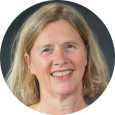 Annette van Lamoen has consulted on professional learning and development at Ako Aotearoa, the National Centre for Tertiary Teaching Excellence, and managed NZ’s National Centre of Literacy and Numeracy for Adults. She has specialised in education for high-needs learners. As a Teaching Fellow at the University of Waikato, Te Whare Wānanga o Waikato, she lectured and tutored in adult literacy and dyslexia. She codesigned NZ’s Dyslexia-Friendly Quality Mark and her recent work includes a report on neurodivergent-friendly workplaces.
Also see biographies of committee members of the Early-Career Researcher Forum.
Additional information
To better understand the needs, experiences, and priorities of early-career researchers in Aotearoa New Zealand, the Forum has planned three facilitated workshops to collect data on women in research, storytelling from a Māori perspective, and the use of AI in research. The outcome of each workshop will be an academic publication; delegates will be offered the opportunity to be named authors on an academic publication for each topic.
Questions? email rsnzecrforum@gmail.com
Useful links:
Check out some of the highlights from He Pito Mata 2023.
Join the mailing list and LinkedIn page for the Society’s ECR Forum.
ORGANISATION
Royal Society Te Apārangi
VENUE/DATE
Sir Owen G Glenn Building
12 Grafton Road, Auckland CBD, Auckland 1010, New Zealand
9:30am Thu 10 September, 2026 - 5:00pm Fri 11 September, 2026