
Tā te Tumuaki | Message from the Society’s President – Distinguished Professor Dame Jane Harding DNZM FRACP FRSNZ
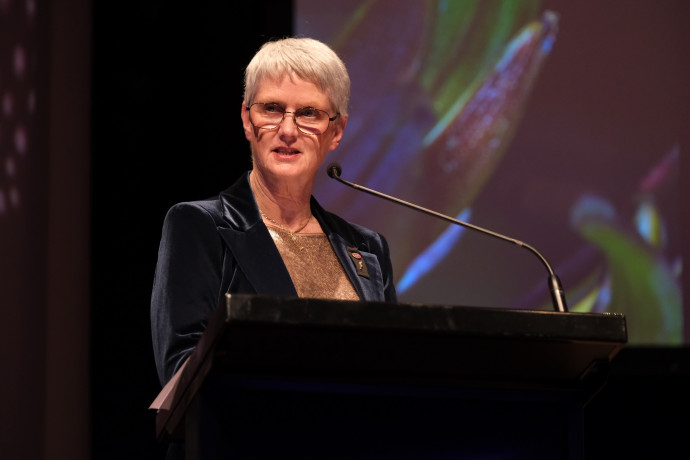
Distinguished Professor Dame Jane Harding DNZM FRACP FRSNZ shares her foreword as President of Royal Society Te Apārangi.
Tēnā koutou katoa,
Since I last wrote, the Government has announced the establishment of a new Board that will take over most decisions on research funding, including for the Marsden Fund, the Endeavour Fund, and the Strategic Science Investment Fund. The entire transition will be phased over 4 years, and just last week it was confirmed that this will incorporate health research, with disestablishment of the Health Research Council.
The Society was originally contracted to administer the Marsden Fund to ensure that investment decisions could be made apolitically, through robust, transparent, and fair processes. We are immensely proud to have achieved this for 30 years, delivering a range of benefits for Aotearoa New Zealand over that time. As MBIE takes over the administration of almost all the Government’s research funding, we sincerely hope that the ability to make independent high-quality decisions, based on expert peer review, can be retained.
The Society will be accepting proposals for research grants from the Marsden Fund in 2026 as planned; however, as previously announced, the total amount available for new grants in 2026 has been reduced. At the end of the 2026 process, the Marsden Fund Council will make its recommendations to the new independent board, Research Funding New Zealand. We are working actively with MBIE to manage this transition as smoothly as possible over the coming months and years, including management of existing research grants.
The Society’s other contracts to deliver activities for the Government will not be affected by these changes. Those contracts include the Science Media Centre, Tāwhia te Mana Research Fellowships, the Prime Minister’s Science Prizes, the Science Teaching Leadership Programme, ORCID, and the Catalyst Fund.
At the Council meeting on 18 September 2025, we welcomed two new members: Professor Stephen May FRSNZ (Deputy Chair of the Academy Executive Committee) and Dr William Rolleston CRSNZ (elected by the general membership). Prior to our next meeting, on 11 December, we will have a pōhiri to welcome our new Tumu Whakarae Chief Executive who will start in January 2026. After a rigorous search, I am confident that we have found the right person to lead the Society. Justine Daw has extensive senior leadership and governance experience, and will bring strengths in strategy, partnerships, and revenue diversification. Her networks and experiences span the science and research sector, central and local government, primary industry, Te Ao Māori, and the not-for-profit sector, not only in Aotearoa New Zealand but internationally. I would particularly like to thank James Henry who is the Society’s Acting Chief Executive in the interregnum until January 2026, and who has led the Society with distinction over the last few turbulent months.
On 11 November, we celebrated the Research Honours Aotearoa 2025 at Government House, along with our Patron, the Governor General of New Zealand, Her Excellency Dame Cindy Kiro, the Honourable Dr Shane Reti (Minister for Science, Innovation and Technology and Minister for Universities), and the Honourable Erica Stanford (Minister of Education). The Academy had selected 22 scholars and researchers for Medals and Awards across three events (in Ōtautahi Christchurch, Tāmaki Makaurau Auckland, and Te Whanganui-a-Tara Wellington), and the Health Research Council also presented six Medals and Awards at these events. In all, about 560 people attended to support the awardees, including:
Distinguished Professor Wickliffe Abraham FRSNZ – Rutherford Medal for breakthrough advances in the understanding of the neural mechanisms of memory.
Professor Brendon Bradley FRSNZ – Scott Medal for earthquake science and engineering.
Professor Christian Hartinger FRSNZ – Hector Medal for fundamental research at the interface of chemistry and biology.
Emeritus Professor Carolyn King FRSNZ – Thomson Medal for pioneering research in zoology and ecology.
Professor Tahu Kukutai FRSNZ – Te Rangi Hiroa Medal for research on Indigenous data sovereignty and Indigenous demography. This Medal was particularly special in 2025, since it is named for Te Rangi Hiroa, Sir Peter Buck, who was elected as the first Māori Fellow of the Society in 1925 – 100 years ago.
Associate Professor Sonja Macfarlane FRSNZ – Te Rangaunua Hiranga Māori Medal awarded to Te Kāhui-a-Te-Rū-Rangahau for co-creating guides to enable culturally responsive teaching in Aotearoa New Zealand.
Distinguished Professor Jacinta Ruru MNZM FRSNZ – Humanities Aronui Medal for research on legal recognition of Indigenous peoples’ rights and interests in land and water.
Congratulations to all those Fellows, and other researchers who earned Medals and Awards.
The awards events were also wonderful opportunities for Fellows to meet and talk at the three Fellows Forum events. This year the Fellows Advisory Group on Addressing Threats to Research took these opportunities to seek input into their project on Threats to Research Funding, led by Neil Boiston and Nancy November. The many suggestions that arose will be incorporated into a report to the Academy Executive early next year, along with a plan for its dissemination to the wider public.
During this quarter, the Society also managed the selection and announcement of winners for the Prime Minister’s Space Prizes at Parliament. The Prime Minister and the Minister of Space both gave speeches and presented the Space Prize for Professional Excellence and the Space Prize for Student Endeavour.
In late November we hosted 150 Indigenous scholars and knowledge-holders for the second Summit of a Tri-Academy Partnership between the Royal Society Te Apārangi, the Royal Society of Canada, and the Australian Academy of Science. Led by Indigenous Fellows, the 3-day Summit featured keynote speeches, wānanga, cultural activities, and panel discussions with Māori, Pasifika, and First Nations thought-leaders. Indigenous research leaders issued a Communique that called for "a global research landscape that is inclusive, respectful, and transformative – one that recognises Indigenous Peoples as equal partners and leaders in the pursuit and application of knowledge." The Presidents of the Royal Society Te Apārangi, the Royal Society of Canada, and the Australian Academy of Science also responded with a Statement reaffirming their commitment to work together to help protect Indigenous Peoples' rights to determine their own research agendas, to explore and preserve traditional knowledge systems, to participate actively in research, and to benefit from its applications and outcomes.
On a sad note, I acknowledge the passing of Dr Janet Grieve ONZM FRSNZ. Janet was a global authority on marine copepods, and an expert on New Zealand’s waters from the subtropics to Antarctica. In 1967, she became the first woman at the New Zealand Oceanographic Institute to lead a research voyage. In addition to a host of leadership roles in marine sciences, she was elected as President of the New Zealand Association of Scientists, and advocated for change, helping to found both the Association for Women in the Sciences and WISE – Women into Science and Engineering. “He moana pukepuke e ekengia e te waka” – a choppy sea can be navigated.
During the holiday season, please do take the opportunity to view Te Tau Highlights which covers January 2024 until the end of June 2025 – it is a genuine celebration of what we have achieved over this period. Please also read about the research projects which were awarded grants in the 2025 Marsden Fund round, and about the 36 recipients of the Mana Tūārangi Distinguished Researcher Fellowships, Mana Tūānuku Research Leader Fellowships, and Mana Tūāpapa Future Leader Fellowships. We can be proud for them all.
I wish you all the best for the summer – spending time with the people you treasure, focusing on what brings you joy and recuperating from any slings and arrows during 2025. Personally I’m looking forward to long walks on the beach and substituting time with the computer for time with family. In the new year, we will resume our task to keep moving towards our shared vision of an Aotearoa New Zealand guided and inspired by science and research.
Meri Kirihimete me te Tau Hou.
Ngā mihi nui
Jane Harding
President, Royal Society Te Apārangi