
Research
Published 27 May 2026Building health system resilience after Cyclone Gabrielle: a New Zealand–Japan collaboration
How do we look after everyone when the unexpected strikes?
Cyclone Gabrielle created significant challenges for the New Zealand health system, particularly in the rural regions of the Coromandel and East Coast, which were among the hardest-hit areas. One of the key challenges was supporting local communities with general practices and rural health services and helping them to respond effectively during and after the disaster.
~ 9000 km from the Coromandel, 広島県 Hiroshima Prefecture experienced devastating flooding and landslides in 2018. Research led by Associate Professor 鹿嶋小緒里 Saori Kashima and Professor 松本正俊 Masatoshi Matsumoto examined the impacts of these events on patients’ mental health and the associated costs to health services. Their work demonstrated that the burden fell disproportionately on older populations, particularly through reductions in home-care services and increased demand for long-term residential care.
With lessons learned from two devastating disasters a new collaboration between Te Whare Wānanga o Waikato The University of Waikato and 広島大学 Hiroshima University, with support provided by a Catalyst Grant from Royal Society Te Apārangi was born. The new collaboration would look at important opportunities for shared learning on disaster preparedness and health system resilience.
The partnership between the two universities has since expanded into broader exploration of strategies to strengthen health service resilience following natural disasters. Dr Jesse Whitehead, a health geographer at the University of Waikato, has developed a methodology to assess how road closures caused by slips and infrastructure damage — such as those experienced in the Coromandel — affect patients’ access to hospital and healthcare services.
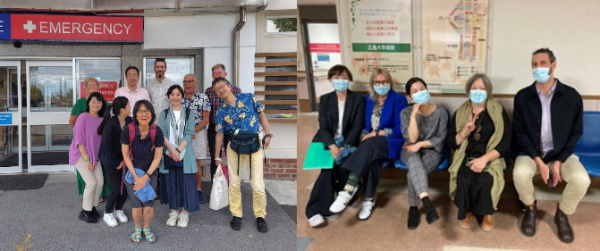
Research team members during reciprocal visits to partner hospitals in Hamilton (New Zealand) and Hiroshima (Japan), strengthening international collaboration and advancing shared clinical research efforts.
Mrs Leanne Ryan, Senior Lecturer in Nursing at the University of Waikato, is currently undertaking her PhD research on rural nurses’ experiences during Cyclone Gabrielle while also leading nursing education programmes at the university. Her frontline experiences during the cyclone have directly informed the integration of disaster health and climate change into health curricula across the University of Waikato, including within and beyond the Division of Health. Mrs Ryan and Professor 原田奈穂子 Nahoko Harada of 岡山大学 Okayama University are continuing to exchange ideas and collaborate, and Associate Professor 加古まゆみ Mayumi Kako of 広島大学 Hiroshima University is working with Mrs Ryan on the integration of online disaster health education into the Waikato health curriculum.
Mrs Ryan is developing plans for an interprofessional disaster response exercise, involving division of health students from a range of disciplines, other University departments and external agencies. This work is ongoing and was inspired and informed by the approaches of the DMAT (災害派遣医療チームDisaster Medical Assistance Team) system in Japan, and conversations with colleagues at the University of Hiroshima. This represents an exciting and valuable development that was not initially anticipated at the outset of the project.
Looking ahead, the partnership between the University of Waikato and 広島大学 Hiroshima University will continue to evolve through further research on disaster preparedness, healthcare systems, and the integration of Indigenous knowledge into resilience and recovery efforts. As a collaborative research group, we have already begun addressing the key objectives of the Catalyst Seeding funding. This includes developing research approaches to investigate equitable healthcare access, utilisation, and outcomes in rural communities in both New Zealand and Japan. Data analysis for this work commenced during the second year of the project. In parallel, the team has also begun analysing changes in health service accessibility following natural disasters in both countries, with the goal of informing more resilient and equitable healthcare planning in the future.
When everyone is looked after, we all thrive.
RESEARCHER
Professor Ross Lawrenson
ORGANISATION
University of Waikato
FUNDING SUPPORT
Catalyst: Seeding: New Zealand - Japan Joint Research Projects
CONTRACT OR PROJECT ID
JSP-UOW2301-JR: Developing equitable and resilient health systems that can respond to three key challenges: Growing demand for healthcare; climate change; and demographic change.