
Research
Published 17 December 2025Protecting and restoring freshwater biodiversity: A Trans-Tasman vision for fish passage and screening
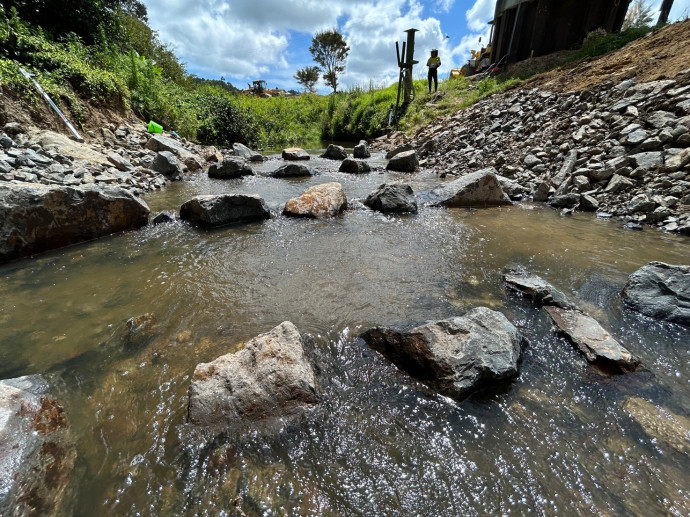
Protecting and restoring river connectivity in Aotearoa New Zealand is vital for the survival of many freshwater species including migratory fishes.
In Aotearoa, around three-quarters of our native freshwater fish are classified as at risk or threatened. Artificial instream structures such as culverts, weirs, dams, and flood pumps fragment rivers and impede or block access to critical habitats, reducing the number of fish able to survive and reproduce. For taonga species like tuna (eel), whitebait, and piharau or kanakana (lamprey), these barriers also erode cultural practices and mahinga kai traditions that have sustained Māori communities for generations. Restoring fish passage is not just an ecological imperative, it’s about safeguarding biodiversity, cultural heritage, the health of our rivers and enabling environmentally sustainable economic growth.
Across the Tasman Sea, Australian rivers are facing similar issues. Freshwater experts from New Zealand and Australia have launched a pioneering partnership under a Catalyst: Seeding funded programme. The collaboration brings together Earth Sciences New Zealand (ESNZ, formerly NIWA), Charles Sturt University (CSU), New South Wales Department of Primary Industries and Rural Development, and Australasian Fish Passage Services. Through sharing technological developments, expertise and resources, this international team is accelerating innovation in fish passage and screening technologies tailored to our unique Southern Hemisphere freshwater species. Many of these species migrate as tiny juveniles making them relatively poor swimmers compared to their Northern Hemisphere counterparts, leading to the failure of traditional fishways designs.
This collaboration has already led to the introduction of engineered lateral ridge rock ramp fishways to Aotearoa New Zealand. These innovative structures, built with natural materials, act like stairs for fish, with small steps and rest areas that allow small-bodied fish to easily move upstream. Demonstration sites in Northland, Hawke’s Bay, Taranaki, and the West Coast that were built using funding from the Ministry for the Environment are already proving their worth – successfully passing native species and withstanding floods that previously destroyed other designs. Their resilience and effectiveness have sparked interest from stakeholders including structure owners and local councils, paving the way for broader adoption across the motu.
The team is now developing a Trans-Tasman Fish Passage Strategy and Action Plan. At a recent joint Catalyst: Seeding funded workshop, team members worked with stakeholders to map out priority actions to accelerate progress and identify solutions to facilitate the restoration of river connectivity. This will help to improve ecological resilience, cultural wellbeing, and future-proof our waterways.
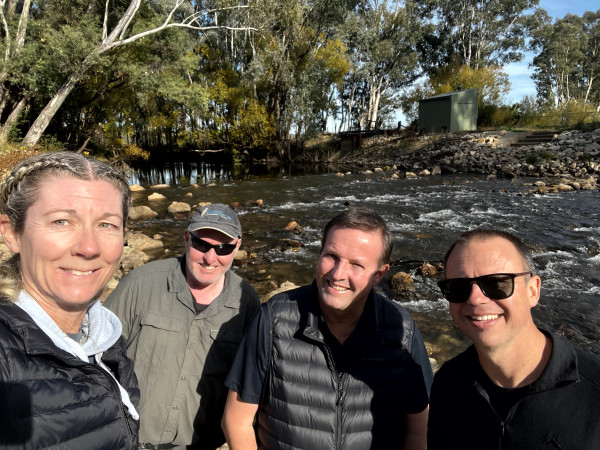
Some of the Catalyst: Seeding team members: from left to right Cindy Baker (ESNZ), Ivor Stuart (CSU), Mike Hickford (ESNZ) and Paul Franklin (ESNZ). (Supplied)
RESEARCHER
Dr Paul Franklin
ORGANISATION
Earth Sciences New Zealand (formerly NIWA)
FUNDING SUPPORT
Catalyst: Seeding General
CONTRACT OR PROJECT ID
CSG-NIW2403: Cross-Tasman excellence in fish passage and screening research and practice.