
Research
Published 10 March 2026Using greenhouse gas for good!
.jpeg)
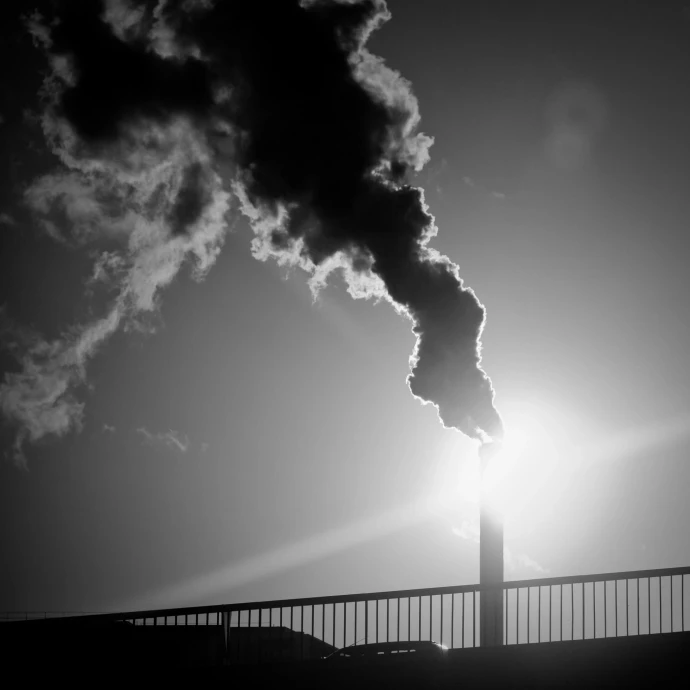
Carbon dioxide (CO₂) is widely seen as a waste burden and a major contributor to climate change. But what if CO₂ could be captured at its source and converted into economically valuable products such as methanol?
Methanol (CH3OH) and derivatives have numerous applications including in sustainable energy; environmental protection; and manufacturing various products including pharmaceuticals, construction materials, and textiles.
An Aotearoa New Zealand–China research partnership, facilitated by Catalyst: Seeding funding and the MacDiarmid Institute for Advanced Materials and Nanotechnology, is working to make this idea a reality. The international collaboration has brought together Dr Ben Yin and Professor Alex Yip from Te Whare Wānanga o Waitaha – the University of Canterbury — both experts in CO₂‑capture membrane technologies — with Professor Xinwen Guo 郭新闻 from Dalian University of Technology (DUT), a global leader in catalytic CO₂ conversion. Together they have a shared ambition to shift CO₂ from an environmental liability into an economic asset.
Catalytic membrane reactor: More than a simple stack
Traditionally, CO₂ capture and chemical conversion are treated as separate steps: CO₂ is first captured and purified, before being fed into a reactor which uses a catalyst to kickstart its conversion into more useful products. This team is developing a catalytic membrane reactor (CMR) that tightly combines both steps, increasing the cost-effectiveness of the process. The core component of this advanced technology is a catalytic membrane that captures and purifies CO₂ from emission sources while simultaneously converting it into useful chemicals. At the same time, the system can selectively remove the undesired byproduct, water, as it forms. This synergistic process boosts CO₂ conversion efficiency, increases product yields, and reduces deactivation of the catalyst over time – three major hurdles that currently limit CO₂ conversion technologies from widespread industrial uptake.
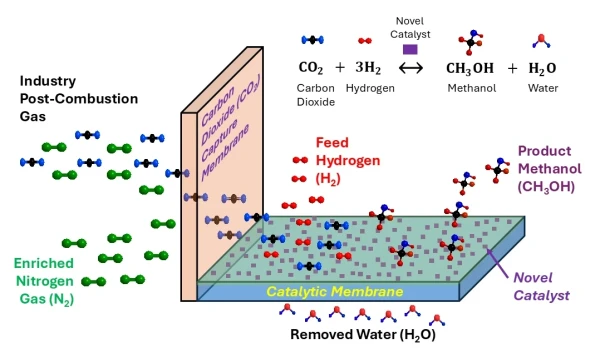
Schematic diagram of the Catalytic Membrane Reactor (CMR) process (Supplied).
A collaboration that goes beyond research outputs
Much like the CMR itself, the partnership between the New Zealand and China teams is more than a simple merging of expertise – it has become an integrated and enduring research partnership. The teams share research resources, facilities, and expertise through quarterly workshops, annual research visits, and student exchanges, allowing knowledge to flow freely between the two sides.
“I had the opportunity to deepen my work using advanced facilities not available in New Zealand, such as X‑ray absorption spectroscopy at the Shanghai Synchrotron Radiation Facility,” said Angie Fui Jie Tan, a University of Canterbury PhD candidate, who spent six months conducting research at DUT. “Beyond the lab research, I also learned about China’s needs and research strategy for decarbonisation – a different angle that enriched my understanding.”
The collaboration is already expanding. Joint research and PhD programmes in decarbonisation technologies between DUT, China and the University of Canterbury, the MacDiarmid Institute for Advanced Materials and Nanotechnology, and Te Herenga Waka — Victoria University of Wellington in New Zealand have now been established, ensuring enduring interaction between these organisations and joint training of the next generation of researchers in this advanced technology and its industrial applications. Additional experts in decarbonisation technologies, including Professor Shane Telfer (Te Kunenga ki Pūrehuroa Massey University; Principal Investigator at the MacDiarmid Institute) and Professor Yi Liu 刘毅 (DUT), have joined the growing research network.
From the lab to industry
The team keeps industry partners in mind as it translates research into real‑world impact. Through DUT’s connections, the researchers have begun early conversations with Aramco’s refinery operations in China, exploring real needs to reduce emissions from petroleum refining – a sector with significant decarbonisation challenges. “We want our research to make a difference outside the lab, by turning CO₂ into useful chemicals in a way that creates real value to both the environment and industry," Dr Yin said.
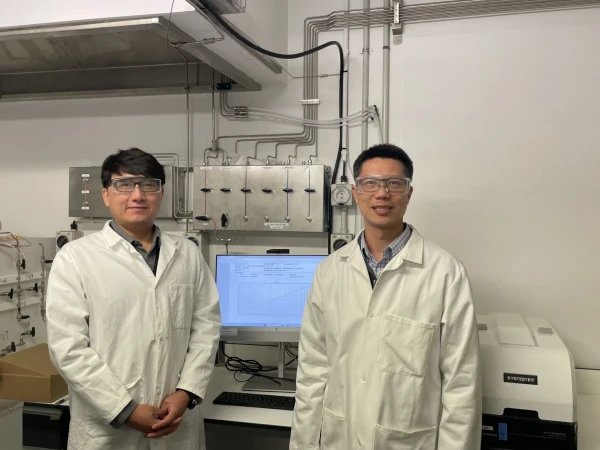
The team members based in Aotearoa New Zealand: Dr Ben Yin and Professor Alex Yip in the laboratory (Supplied).
RESEARCHER
Dr Ben Yin
ORGANISATION
University of Canterbury
FUNDING SUPPORT
Catalyst: Seeding General
CONTRACT OR PROJECT ID
CSG-UOC2203: Catalytic Membrane Reactor for CO₂ Hydrogenation to Methanol