
Graeme Stevens
(1932 – 2026)
QSO, MSc NZ, PhD Cantab, DSc Vict, FRSNZ
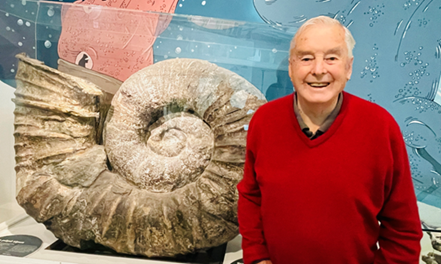
Graeme Stevens had a distinguished career as an internationally recognised palaeontologist, studying a wide range of fossils. Locally he is especially remembered for his work popularising science, both as a lecturer and author of numerous books on the distinctive landscapes and geology of New Zealand.
Stevens was born in the Avon maternity hospital in Lower Hutt. Apart from a few years spent studying at Cambridge University in the UK, he spent his whole life in the same area and was proud to be a son of the Hutt Valley. He was a foundation pupil at Waterloo School in 1938 and then moved on to Hutt Valley High School.
Scouting was an early interest. As soon as he turned twelve, he joined the First Waterloo scout troop and progressed up the ranks until he qualified as a King’s Scout. The international Bureau of Scouting proposed to hold a post-war peace jamboree in Paris, and Stevens was selected as part of the New Zealand delegation. But it was necessary to raise the cost of travel (350 pounds) which he achieved by working as a post office messenger and other odd jobs. The contingent left by sea in May 1947, returning in October. It was an incredible experience for a 14-year old, and undoubted whetted his appetite for travel in later years.
With a good academic record, University study beckoned, and he enrolled at Victoria University to study science. He couldn’t decide between zoology and geology, so did a double major, achieving a senior university scholarship which enabled him to continue with a masters degree. Throughout his university vacations he worked as a student assistant at the New Zealand Geological Survey, a branch of the Department of Scientific & Industrial Research (DSIR). This gave him valuable practical experience, and he came to know the staff including Charles Fleming who acted as his mentor. He opted to advance in geology, but his background in zoology was invaluable in his later career in paleontology.
An MSc degree in geology included a thesis that involved a detailed study of an area. Having no car, Stevens decided to work on his home region around the Hutt Valley. The resulting thesis included the first detailed mapping of a section of the Wellington Fault as well as an account of the groundwater aquifers beneath the Hutt valley, both topics providing the starting point for later work by others. He graduated with first class honours and was awarded a Shell Postgraduate scholarship that would allow him to study overseas for a PhD.
Charles Fleming proposed that he should go to Cambridge to study collections of New Zealand belemnites (the preserved remains of extinct squid-like creatures that were widespread globally from 65-200 million years ago), under the supervision of Dr Arkell who was an expert in this specialised field. Unfortunately, Dr Arkell died a few weeks after Stevens arrived in Cambridge, and the resulting thesis was a solo effort without an immediate supervisor, although he was able to consult other paleontologists elsewhere in the UK. The resulting monograph, later published as a Geological Survey Bulletin remains the definitive work on New Zealand’s belemnites.
Stevens was always a keen cross-country and middle-distance runner, initially joining the Scottish Harriers and the Hutt Athletic Club. He later joined the Victoria University Club, winning several championship races at the inter-university games, and being awarded a University of New Zealand Blue. He continued his running career at Cambridge and succeed again in winning a University Blue. In later years he commented on his surprise that the Cambridge blue gave him immediate status, including the possibility of joining some elitist gentleman’s clubs. Although he could see that this opened doors to possible career opportunities in the UK, he was keen to return to New Zealand and a job as a palaeontologist with the Geological Survey.
Over the succeeding years Stevens specialised in the fossil fauna of the Mesozoic era, especially belemnites and ammonites, but involving a variety of fossil identifications and geological mapping. He was very much a team player and took a major part in the completion and publication of the 2-volume “Geology of New Zealand” produced by the Geological Survey. He published many scientific papers and eventually succeeded Charles Fleming as Chief Palaeontologist. His work was recognised by Fellowship of the Royal Society of New Zealand in 1976 and the award of an honorary Doctor of Science degree by Victoria University.
Soon after his return to New Zealand, Graeme Stevens met Diane Ollivier at Scottish Country Dancing. They married in 1962, recently celebrating their diamond wedding anniversary with their three children, Peter, Robert and Trina.
In the 1960s Stevens was invited to take part in an adult education course on the geology of the Hutt Valley. He was a successful speaker and was soon in demand to give lectures by organisations such as WEA and university extension. These evolved into weekend courses with a field trip. He also took a leading role in running summer schools for up to 10 days where non-academic members of the public were introduced to the fundamentals of geology and geomorphology. One of the notable early participants was Joan Wiffen, later well known for her fossil reptile discoveries, who paid tribute to these experiences for raising her interest in geology and fossil collecting.
Stevens soon realised that there was a need for an illustrated book covering the topics he was lecturing on, leading to the preparation of “Rugged Landscape – the geology of central New Zealand”. There were almost no other books on New Zealand geology available at the time, and it was breaking new ground. As well as photographs, there were a large number of diagrams which were hand-drafted by Diane using ink pens and stick-on patterns before the arrival of computer technology. The book was published by AH & AW Reed, then the leading publisher of New Zealand books. It was accepted with the personal approval of the founder. AH Reed, who clearly had a nose for a good book. Published in 1975, it was reprinted several times and won the prestigious Wattie Book-of-the-Year award for non-fiction.
Pleased with the success of “Rugged landscape”, Reeds requested another book. The 1970s was the time when plate tectonics was becoming recognised as the explanation for diverse geological phenomena, but most literature was highly technical. The result was “New Zealand Adrift” published in 1980, and also winning the Book-of-the-year award. Several other books followed – one often found in tattered form at the bottom of a pack is “A tramper’s guide to the geology of the Tararuas”.
When giving a talk to the Wellington Rock and Mineral Club, Stevens exhibited a collection of fossil ammonites to illustrate the features of these unique fossils. A week later he was amazed to be contacted by Jean Gyles, who had been at his talk, reporting the discovery of a large ammonite in a road cutting near Kawhia. It was indeed a giant ammonite, over 1.5 meters wide and weighing over a tonne. Excavation took several weeks, aided by the local council, explosive experts from the NZ Army and a band of volunteers. The fossil, that Stevens described and named Lytoceras taharoaense, is now on display in Te Papa. It is the third-largest ammonite found anywhere in the world.
The change of DSIR to a series of Crown Research Institutes (including GNS Science) saw Stevens take early retirement in 1992, but he continued with scientific work as an unpaid Research Associate for the next 20 years. During this period, he completed and published two major monographs on New Zealand ammonite fossils as well as further research papers and a series of historical articles. In 1994 he was awarded a Queens Service Order (QSO) for his services to science, and was thrilled at the investiture ceremony when Dame Catherine Tizard said how much she had enjoyed reading “New Zealand Adrift”
Stevens continued to support colleagues around the world with peer reviews of their manuscripts until a few weeks before his death. It was a particular pleasure that French colleagues named a group of ammonites from the Himalayas after him: Stevensites
By Simon Nathan (with input from Hamish Cambell, Maggie Dyer and the Stevens family)