
Hirini Moko Mead
(1927–2026)
KNZM FRSNZ
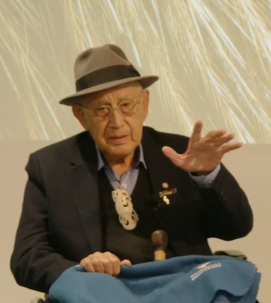
Tā Hirini Moko Mead KNZM FRSNZ (Ngāti Awa, Ngāti Tūwharetoa, Ngāi Tūhoe, Ngāti Manawa, Tūhourangi) was a foundational figure in Māori cultural scholarship and education. With his passing, we have lost one of our country’s great intellectual guardians.
His extensive and authoritative texts on tikanga and mātauranga Māori established the academic grounds from which Māori knowledge could be understood, taught, and expanded.
Initially an artist and teacher, Tā Hirini served as principal for many schools across the East Coast and Bay of Plenty. Lady June Te Rina Mead (Ngāti Porou), who taught alongside him from the earliest years of his career, shared his ambition to do more for these communities. After earning his PhD in the United States of America as a Carnegie Commonwealth Scholar in 1968, he taught anthropology in several Canadian universities. He returned to New Zealand in 1977 as the first Professor of Māori Studies at Victoria University of Wellington, and was largely responsible for the establishment of Te Herenga Waka Marae at the University. Tā Hirini and Lady June (who passed away in 2019) eventually led the people of Ngāti Awa to found Te Whare Wānanga o Awanuiārangi, as an institute for higher education and research:
In 1984, Tā Hirini co-curated Te Māori – a landmark exhibition at the Metropolitan Museum of Art in New York which presented Māori art to the world not as anthropological artefacts, but as a living culture. He lectured across the United States of America for several years as Te Māori toured, inspiring global appreciation of Indigenous art, and catalysing a cultural resurgence in Aotearoa.
Tā Hirini was elected as a Fellow of the Royal Society Te Apārangi in 1990. “I did feel very honoured to follow Peter Buck” he said in a recent interview, referring to the Society’s first Māori Fellow, Te Rangihīroa, Sir Peter Buck KCMG DSO FRSNZ. "He was one that I held as a model."
Tā Hirini led negotiations on behalf of Ngāti Awa in relation to the Crown’s obligations under Te Tiriti o Waitangi. After more than a decade, the iwi’s grievances were recognised in a 2005 settlement that included the return of Mataatua Wharenui – the carved meeting house that had been disassembled by the Government to be exhibited around Australia, and then at the Victoria & Albert Museum in Britain. It was finally restored to Ngāti Awa after 130 years – thanks largely to Tā Hirini’s determined advocacy.
Tā Hirini was a keynote speaker at last year’s Taikura Summit on Indigenous knowledge and research – a partnership between the Royal Society Te Apārangi, the Royal Society of Canada, and the Australian Academy of Science. He talked about traditional education in mātauranga Māori, the effects of colonisation, and the revitalisation and continuing evolution of the knowledge system – all themes of his 2025 publication, Mātauranga Māori.
“You’ve got this whole world of knowledge with heaps of specialisations within that knowledge system,” he told delegates. “It’s really an exciting world that opens up to you once you start looking at the whole system of knowledges.”
He closed his address with a wero (challenge) for the future: “We’ve freed ourselves really. I don’t think we’ll ever go back – to being subservient – to not being Māori any more. I think we’re on a trajectory. We’re going to keep going.”
The Royal Society Te Aparangi extends its deepest condolences to Tā Hirini's whānau and iwi, and to his many friends and collaborators. His three daughters – Distinguished Professor Linda Tuhiwai Smith CNZM FRSNZ, Dr Aroha Te Pareake Mead, and Hinauri Mead – continue to advance his legacy and set new trajectories.