
Tā te Tumuaki | Message from the Society’s President
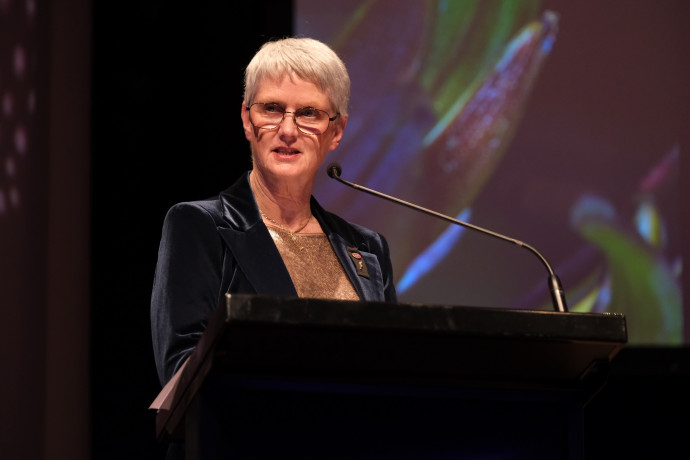
Distinguished Professor Dame Jane Harding DNZM FRSNZ FRACP
Tēnā koutou katoa,
Since I last wrote, Justine Daw has begun her role as Tumu Whakarae Chief Executive of the Society. Her initial focus has been on lifting the visibility of the Society in Wellington and ensuring that decision makers understand our perspectives. That is particularly important as we transition the Marsden Fund to the Ministry of Business, Innovation and Employment and Research Funding New Zealand over the next few months. In addition, Justine has begun to evolve the strategic direction for the organisation in line with our Growing Pathways of Knowledge strategy, and the Council and I welcome her positive leadership, energy, and networks.
The first meeting of Council was held on 11 February, followed by a planning day on 12 February. We were delighted to welcome Hadee Thompson-Morrison as our inaugural Early Career Researcher Observer on the Council. This new programme aims to ensure Council is taking the perspectives of early-career researchers in its deliberations, while also supporting one early-career researcher each year to develop their governance experience through ‘on the job’ learning around the Council table, plus an online learning programme.
View a summary of the topics of discussion at the Council meeting. The planning day was less formal, with Council and the Executive Leadership Team working together on a horizon-scanning exercise, and Council providing feedback on draft priorities for the Society’s international work programme, opportunities for revenue diversification, and an early vision for future development of the Society’s site in Thorndon.
You will be aware that the science and innovation system reforms continue to progress. In late 2025, the Government announced the inaugural Board of the New Zealand Institute of Advanced Technology. The Board includes Professor Cather Simpson FRSNZ, who sits on the Academy Executive Committee. A regular participant on a range of assessment panels for the Society’s Awards, Medals, and Fellowships, Professor Simpson has also served as a Panel Convenor for the Marsden Fund. In January, the Board of Research Funding New Zealand was announced. This includes one of our Fellows, Distinguished Professor Peter Hunter KNZM FRS FRSNZ. We congratulate these Fellows and wish them well in their important tasks.
Settings for transition of the Marsden Fund to MBIE (Research Funding New Zealand) are clarifying. A working group has been set up, and we have reached agreement that MBIE will advertise relevant Research Funding New Zealand roles to Society staff in the first instance, with a view to retaining specialist capabilities and ensuring a smooth transition of the Fund. While the Society will continue to administer all current contracts, and has begun the 2026 Marsden Fund round, Research Funding New Zealand will make all future funding decisions and administer associated contracts.
In parallel, we are working with MBIE to scope an independent evaluation of the Marsden Fund. This important task will articulate the benefits of undirected ‘basic’ research and support the case for ongoing Crown investment. The evaluation will complement work already under way to assess the current threats to science in New Zealand, some of which relate to reductions in Crown investment. Those of you who attended the Fellows Fora before each of the Research Honours events last year already will have contributed to this work, and we expect the first report from the working group in the near future.
Recently I was privileged to attend the inaugural Congress of the Pacific Academy of Sciences in Apia. The Congress explored the importance of Pacific researchers taking their place on the world stage and helping shape global agendas. We and the other Learned Academy representatives congratulated the Pacific Academy of Sciences on their election of 13 new fellows from nine different Pacific nations, including several currently or previously based in New Zealand. View a list of the new Fellows. Other key initiatives announced at this meeting included the launch of a new Pacific Research Hub to facilitate collaboration amongst Pacific researchers, launching a new Young Academy to support early-career researchers, and announcing the Tūpaia Grants to support Pacific early-career researchers. These grants are administered by our Society on behalf of the Ministry of Foreign Affairs and Trade.
We are presently seeking nominations for Companions of the Society – Ngā Takahoa a Te Apārangi. Please help us to identify individuals who have helped shape, support, and advance New Zealand’s research, science, and innovation systems. Companionship honours their contributions and invites them to join us to further our strategic objectives. View the criteria for Companionship, and we encourage nominations via email before Thursday, 30 April.
At the same time, the call for nominations for medals and awards for Research Honours Aotearoa 2026 is now open, with nominations closing on 31 March. This year, we are offering for the first time a Teaching Excellence Award for exemplary and innovative school science teaching. Please extend these invitations for nominations to your networks, and think about who you might shoulder-tap. We know that almost all of us are only Fellows because somebody shoulder-tapped us.
Wishing you well for the start of the year, and ongoing success in your efforts to work towards “An Aotearoa New Zealand guided and inspired by science and research.”
Ngā mihi nui,
Jane Harding
President, Royal Society Te Apārangi