
David Stuart (Stuart) Letham
(1926 ‒ 2025)
MSc NZ, PhD Birmingham (UK), FAA, FRSNZ (Hon)
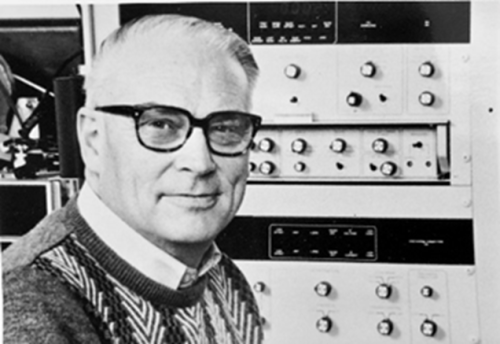
“Stuart’s work on zeatin was undoubtedly some of the very best and most influential plant research ever done in New Zealand.” - Ross Ferguson FRSNZ
“I am deeply saddened by the loss of the last great pioneer who established the foundation of cytokinin research.” – Hitoshi Sakakibara
Overview
Emeritus Professor David Stuart Letham - known universally as Stuart - was a chemist and biochemist whose pioneering work on plant cell division factors led to the identification of zeatin, the first naturally occurring cytokinin to be identified. His work, conducted first in New Zealand’s Department of Scientific and Industrial Research (DSIR) and later at the Australian National University (ANU), was foundational to our understanding of the critical role of the cytokinins in plant physiology and development. He was elected a Fellow of the Australian Academy of Science in 1983 and an Honorary Fellow of the Royal Society Te Apārangi in 1985. In 2001 he was awarded a Centenary Medal by the Commonwealth of Australia. Stuart died peacefully on 23rd November 2025 at the age of 99, mentally sharp and scientifically engaged until the end.
Early Life and Education
Life in mid-Canterbury
Stuart was born in Ashburton, mid-Canterbury on 8th September 1926. His parents (David Borland Letham and Jean Burnside) had emigrated separately from Scotland to New Zealand, and married in Christchurch in 1919, initially living in Levin, where Stuart’s older brother, John, was born in 1920, before returning south.
After promising to send me some details of his early life in Canterbury, Stuart (DSL) wrote to me (PEJ) on the 2nd December 2016:
“…my father’s uncle Andrew Letham arrived in mid-Canterbury from Scotland about 1870 and worked as a farm labourer but about 1900 purchased a large property (Sherwood) between Lauriston and Rakaia. This apparently influenced my father to go to work on farms around Ashburton when he arrived from Scotland in 1904. About 1925 he purchased a farm located on a road now called Back Track, at the corner of a side road Orr’s Rd. It was about 3-4 km from Barrhill. I was born in Ashburton (1926) and lived on the farm till 10½. I cycled 3 km (terrible road) to catch a school bus to Lyndhurst School.
“Because of heart trouble, my father sold the farm when I was 10½ and we went to live in CHCH [Christchurch] (a terrible place it seemed to be then). Just before that, my Mother left the Presbyterian Church (the church of her ancestors and all her relatives) and became an Adventist. I was sent to the Adventist School in Grants Rd and remained there till I matriculated and enrolled at CUC [Canterbury University College, the forerunner of the University of Canterbury] in 1944 having just turned 17. How lucky I was - just beside the Botanic Gardens!”
Stuart later wrote that the Botanic Gardens were his “favourite spot on the planet”.
Stuart’s brother, John, had left school young and worked on the family farm until the farm was sold, at which time (1937) he decided he wanted to become a doctor. To extend his education he intended to attend night school but was encouraged by the Seventh Day Adventist High School in Grants Road to attend as a mature student. This he did and matriculated in just two years. However, his application to attend Medical School in Otago was declined because he hadn’t studied Latin, but he was accepted in Sydney. He spent his career as a GP at the Sydney Adventist Hospital in Wahroonga, returning to New Zealand at the age of 61 to walk the Milford Track. He completed the Track and began on the Routeburn Track but suffered a heart attack and died soon after in hospital. John’s four children currently live in Australia.
Stuart continues:
“I now have no real connections to Mid-Canterbury. Andrew Letham had four sons and four daughters, so I have lots of distant relatives near Ashburton, and one first cousin in Methven (retired farmer) - Gavin Letham [since deceased].
If you are roving around Australia, you are welcome to call – we can discuss the early years of cytokinin in New Zealand.
p.s. If you have not visited Barrhill, you should – all CH.CH people need to. It will connect them to the start of agriculture in Mid Canterbury. It has a church, 1870, a village green, a village layout, but was never developed. The railway to Methven went via Lauriston.”
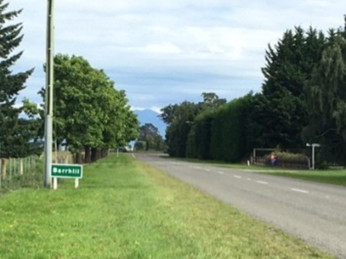
I visited Barrhill and sent Stuart some photos.
DSL to PEJ 17/3/2022:
“Thank you for the photos of Barrhill. The great macrocarpa hedge is still there along the road (pictured); must be well over 100 years old. It was huge in 1935. The farmers keep the roadsides very tidy now. In my day, the cocksfoot grew uncontrolled. All so beautifully flat and you can see Mount Hutt in the distance in one of your photos.”
Stuart continues 2/12/16:
“Unfortunately I never gained any real knowledge of the NZ flora. When living in ChCH, I might as well have been in Oxford, England! I never went tramping in the bush while at school or while at CUC. Work occupied all vacations. When aged 15 to 16 my friend and I made two excursions into the “wild” from ChCH on our bikes: one to Akaroa where N.B. I did see nikau palms, the other ended camping for five days on the banks of a flooded Waitaki river [An apparently thwarted trip to Dunedin owing to a howling nor’wester]. Cycled through the night to get back to CHCH, returning almost in the one day – aided by nor’west wind.”
Canterbury University College and early career positions
In commenting on his undergraduate experience:
“Undergrad in Chemistry – one paper in Botany. And then finishing botany at stage 1 did not help my phytology.” [Botany stage 1 with Mr. Foweraker].
DSL to PEJ 4/11/2015:
“…Writing this makes me think of the time (1945) when I did Botany 1 at CUC. It was run by a Mr Fauraker (?spelling). He was not inspirational but very sympathetic to poor chemistry students, the beginning of a life long pleasant association with NZ and Australian botanists!
Stuart completed his BSc in1946 and an MSc in Chemistry 1948 at Canterbury University College.
He worked initially as an analytical chemist and then biochemist with the New Zealand Department of Agriculture at the Ruakura Animal Research Station (1949–52). Realising a deeper scientific ambition, he went on to complete a PhD in Organic Chemistry at the University of Birmingham, UK (1955). Publications from his PhD [1-6] were on the topical subject of sequencing DNA and chemical properties of purines and pyrimidines – experience that may have paid off in a different context ten years later.
Stuart had met his future wife, Iris Nixon (1922-2010) at the Hamilton Seventh Day Adventist Church (SDA) in 1951. In August 1952, he left for Birmingham. He and Iris became engaged in October 1952, and his niece, Carlene, writes that Stuart sent for Iris after he had found suitable lodgings. They were married on 12th February 1953 at Handsworth SDA Church in Birmingham. However, according to Ray Bailey, a kiwi PhD student at Birmingham at the same time, Stuart’s fellow PhD students never knew that Stuart was married - he was worried that he might lose his funding!
Scientific Achievements
Early years in the Fruit Research Division of DSIR
Although a chemist, but keen to return to New Zealand, Stuart joined the Fruit Research Division (FRD) of DSIR at Mt Albert, Auckland in 1956.
DSL to PEJ 25/9/2015:
“When I returned to NZ in 1955, after studying chemistry in England, I accepted a position to study apple fruit physiology in relation to fertiliser treatments. It was the only position I could find in NZ. It seemed a dead end. However, after 5 years, we had justification to try to purify natural stimulants of cell division which was a life changing experience.”
This work led to the identification of zeatin (Z), the first of a group of naturally occurring cell division-inducing factors, now referred to as cytokinins.
Ross Ferguson (FRSNZ) described Stuart’s work on zeatin as undoubtedly some of the very best and most influential plant research ever done in New Zealand.
Stuart became associated with cell division research in a very indirect way, arriving in the lab to work on fruit from a long-term fertiliser trial (the Appleby Fertiliser Experiment). Initially Stuart was involved in investigating cold storage disorders of apple as stored fruit from the different fertiliser treatments had shown consistent differences in internal breakdown. The work was conducted in what was known as the ‘Barn’ - a temporary laboratory built over the top of a storage shed for farm machinery (as described in Ferguson & Bellamy, 2011).
The incidence of internal breakdown during cold storage was shown to be related to cell size and P content: smaller cell size and elevated P content was correlated with better storage [12]. To measure cell volume Stuart devised a method of macerating cells without changing their volume [8,10]. This technique was the forerunner of work by others on protoplasts. As it was clear that the promotion of cell division was desirable, Stuart investigated this in in vitro culture and was the first to publish successful in vitro cultivation of six pome-fruit tissues [9, 11]. Three of these papers [8,9,11] were published in Nature, highlighting the significant early breakthroughs made by Stuart.
Critically, in order to cultivate the fruit tissues, in addition to auxin (a plant hormone that promoted cell expansion in vitro) and other nutrients, a cell division promoting compound was needed. Stuart used coconut milk (as had others), kinetin (a cell division-inducing factor identified in 1955 derived from autoclaved herring sperm DNA, but not naturally occurring) and, notably, extracts from immature sweet corn (Zea mays) seeds. Stuart was interested in identifying the cell division factor which was clearly present in a number of plant species, including fruit, seeds and coconut milk as detected by biological assays [17]. He had shown that these extracts were more effective than kinetin. This interest was in spite of comments such as “If eight major overseas laboratories are purifying this unknown hormone, why waste time trying to do it in New Zealand with very limited facilities?”
However, Letham was encouraged by Ted Bollard (his boss at DSIR; see obituary by Ferguson & Bellamy, 2011) but told, initially, that he couldn’t work on coconut milk as that was F.C. Steward’s area [F.C.S. was a world leading plant physiologist, although not universally liked], as well as others including Van Overbeek in California. Apples were also out, as in Canberra CSIRO were working with those. So, plums were chosen [15].
Stuart realised that to purify this cell division factor he needed to follow the activity through the purification process. To do this, he developed a bioassay using explants from the secondary phloem of carrot roots [17]. His work then, and subsequently, represented a unique integration of plant physiology, biochemistry, natural product chemistry and synthetic organic chemistry.
By late 1962, Stuart had crystals of a picrate derivative of the cell division factor from both plums and sweet corn (Fig. 1). Stuart wrote that the “key to the purification and identification of zeatin lay in the crystallisation step to form the picrate of zeatin.”
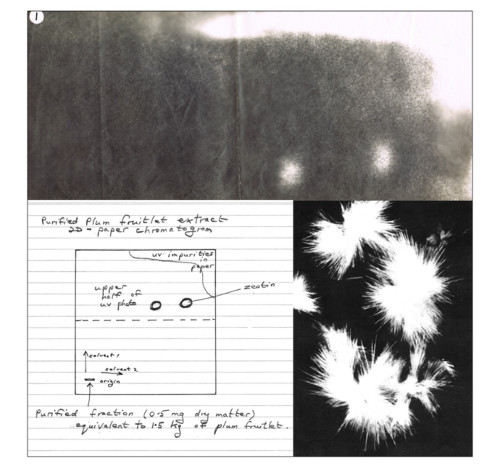
Figure 1. UV-absorbing compounds in purified plum extract and crystals of zeatin picrate.
Top: The upper half of the original exposed photographic paper. Lower left: Hand-drawn image of the filter paper by Stuart. Lower right: Photomicrograph of the crystals of the picrate of zeatin from Zea mays. This composite figure is published in Jameson (2023).
In his 1963 paper [16] Stuart named the factor ‘zeatin’ – the ‘zea’ was from Zea mays not New Zealand! In the same paper he coined the term ‘cytokinin’ to describe this new class of plant hormone, ‘kinin’ already being in use in animal physiology.
Letham relates how he was offered funding to attend the International Conference on Plant Growth Substances in France in July 1963 [the GIF meeting]. Fruit Research Division was visited by J.P. Nitsch, CNRS plant chief, late in 1962 after he had attended the opening of the phytotron in Canberra along with other “prominents” (e.g., Thimann). DSL to PEJ 20/7/2018:
“Nitsch thought my work was promising and gave me invitation and air ticket to the 1963 conf.”
At the conference Stuart met Carlos Miller who was also working with Zea mays.
DSL to PEJ 5/3/2022:
“Miller gave paper and summarised all his data re maize factor – nothing new. Miller’s factor, my plum factor & my maize factor all had very similar UV spectra [18], were very probably N6-substituted adenines and closely related (or? identical). However, N6-substituents could differ in structure.
I suggested to Miller that we collaborate on elucidation of structure, but he declined and wished to move onto other things, e.g., mechanism of kinetin action. When Z structure determined and chemically synthesized (first by Shaw in England and soon after in Auckland), he said he was indebted to me for disposing of his ‘problem’. He got a generous supply of synthetic Z and so did Skoog and others.”
On return to New Zealand, Stuart extracted 60 to 70 kg of sweet corn kernels, using a sweet corn stripping machine borrowed from a local cannery. Ross Ferguson recalls:
“I remember him starting with the vast amount of sweetcorn – thinking that it was bucket chemistry that most real chemists would disdain”.
Every step of the purification process was tracked by his carrot bioassay and, eventually, Stuart obtained 4.2 mg of crystalline product - sufficient for the identification of zeatin [19].
A full account of the identification of zeatin is given in “Zeatin: the 60th Anniversary of its Identification (Jameson, 2023). This account was written with significant input from Stuart [he titled our emails ‘HZ’ referring to the History of Zeatin], but he wanted not to be a co-author. Neither did he want it to be biographical. He also said “this material is difficult to write. It’s the history of Z, we must not over emphasise the work of DSL!” What Stuart did want to highlight was how one person with little support and limited facilities opened an impasse for exploitation by the instrument-based brilliance of others. Here he is referring to Shannon (MS) and McDonald (PMR). Stuart never claimed to be the sole actor in the identification of zeatin – it was teamwork [19, 27]. Shannon visited New Zealand in 1965, and Stuart recalled that
“…he was impressed by my facilities for tissue culture and how we tolerated tractors in the floor below.”
If DSIR was to make use of zeatin and try to develop apples with more small cells they needed gram quantities of zeatin. For over nine years Stuart had had the assistance of only one technician but, fortuitously, a Dr Tony Cebalo, a recently completed PhD student from the University of Auckland was spending some months at FRD before moving overseas. Within six weeks, gram amounts of zeatin were prepared [29; another Nature paper] and applied to apple fruitlets. The resulting apples had reduced cell volume, increased tissue density and altered shape [34].
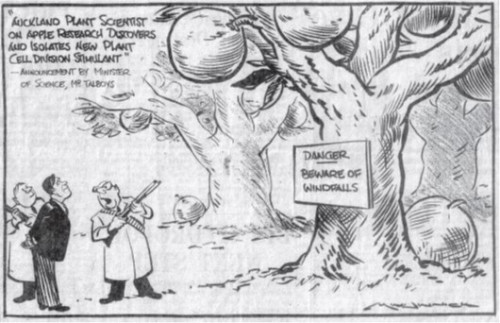
“….but we haven’t quite solved the ensuing new codlin stimulant problem”
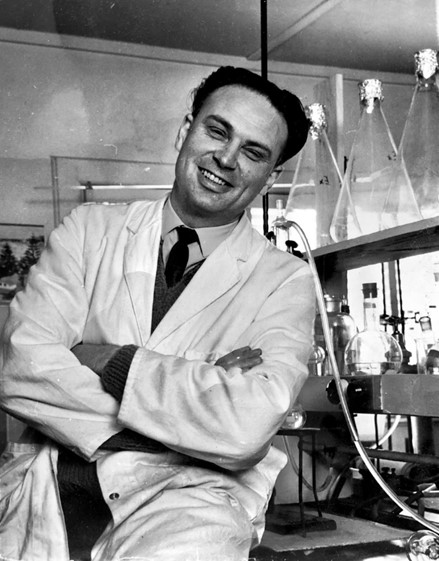
DSL to PEJ 13/8/2022:
“My pleasant expression was not caused by the crystals of zeatin, but by the reporter from the NZ Herald who took the picture. He had brought a cartoon to show me before it appeared in the paper. This was drawn by the cartoonist for the paper and showed an apple tree with giant fruit (sprayed with zeatin) from which giant codlin moths were emerging. Standing next to the tree, armed with a shotgun, was the director of FRD (the likeness is striking) shooting down giant moths. The caption read: the fruit is great but we have yet to solve the insect problem (or something like that). The photo shows how well we dressed on a daily basis at that time in the lab; and I worked from 8 am to 6pm with 10 min for lunch. How times have changed! The official DSIR start time was 8 am sharp”.
Figure 3. A cartoon published in an Auckland paper in 1964, and Stuart 1964.
In the ‘Barn’ at Mt Albert, DSIR
Stuart’s DSIR colleagues remember him as rather quiet but having a rather cheeky sense of humour which came as a surprise as normally he looked most solemn. They remember him nearly poisoning himself by drinking too much carrot juice. This was apparently not from juicing left-over carrots from his bioassays but, according to Ross Ferguson, because Stuart was on a health kick and drinking too much carrot juice from a commercial preparation. This was picked up by jaundice of the eyeballs. They also remember him damaging his eyesight by not using UV protection when looking for spots of UV irradiated zeatin on paper chromatograms, and that he was a prison visitor and suggest that this was likely to have been a challenge for him and the prisoners as he was not an easy conversationalist!
Ross Ferguson suggests that Stuart always felt a bit diffident by being surrounded by biologists – or non-chemists. Harry Young told Ross that when he [Harry] started working with Stuart, he was specifically warned about biologists.
After reading HZ, Robert Redgwell provided the following insights into Stuart’s working habits in the lab:
“It [HZ] certainly took me back to those days when the lab was full of bench workers.
When I started work as a technician for Rod Bieleski in February 1964, Stuart's work on the isolation of zeatin from maize must have either been done, or near completion, as the cartoon from the Herald was already on the wall of the corridor leading into the main Lab of the Barn. The lab was obviously very proud of Stuart's achievements.
It was full of energetic, young scientists (relatively speaking - Ted Bollard was the oldest and he was only 44) and PhD students. It was a daunting prospect for a nervous young man of 17, not sure that he was going to be able to cope. My first job eased my worries as I was asked to unpack several large boxes containing Winchesters of glacial acetic acid. There was at least 40 of them and when I asked what they were for, I was told that most were for Stuart Letham, a chemist in the lab.
My clearest memory of Stuart is him walking across the lab to the distilled water container, a beaker in his hand. We had 2 stills. One over the sink, was
for general purpose use and for rinsing the glassware after it had been washed by the cleaning lady. The second was a glass still, designed so that no metal parts could contaminate the water. Of course, Stuart always used the water from this still. His actions were always the same. He took the beaker and rinsed it out, not once, not twice but 3 times with our precious glass distilled water and only then did he take what he wanted.
This action encapsulated the scientist that Stuart was. A perfectionist. A man with a stringent focus who could succeed in the challenge that isolating zeatin offered.
Noel Turner told me that he often worked into the night and his wife would arrive with some dinner for him. Reminds me of a few lines I read once.
The heights by great men reached and kept
were not attained by sudden flight
but they, while their companions slept
were toiling upwards in the night.
[From: The ladder of St Augustine. Longfellow].
Stuart was the quiet man among the noisy egos that filled the barn at that time but he always appeared to me a very pleasant personality. He was of course from Christchurch and he often chided me on a rugby result where his home team had triumphed over Auckland. Before he left for Australia he offered me a job as his technician. I must say I was very flattered but I was also very happy with my job in the Barn.”
For the next decades, Stuart continued to wash his glassware multiple times as I witnessed in 1983 when I spent several months in his lab. His postdoctoral fellow Dr Jane Badenoch-Jones, on learning of Stuart’s death, wrote:
“He did incredibly well to live as long as he did for a chemist - a testament to his meticulous laboratory technique.”
For a short spell of time Jessica Beever did some technical work for Stuart. She wrote:
“At the end of 1968 I had completed an MSc at Mt Albert DSIR, where Stuart was working in The Barn, though such a quiet, shadowy figure I cannot recall even being aware of him. I had become engaged to Ross Beever and was looking at the possibility of doing a PhD somewhere in the north of England, Ross having already been accepted at the Genetics Department, University of Leeds. We would leave for England in August 1969. Seemingly out of the blue, I was told there was funding for me to work with Stuart Letham for the intervening months, looking at the effect of cytokinins on radish cotyledons. I had no intellectual input to the project, but was evidently a good technical pair of hands, as he wrote a glowing reference for my application for a place in the Botany Department at the University of Leeds, where there was some peripheral interest in cytokinins, and awareness of D.S. Letham’s ground-breaking research in the field. My name was then put forward for a substantial scholarship at Leeds, and no doubt on the strength of a reference from a prestigious world leader, I was successful. We were financially secure.
I got the impression Stuart was very much an independent worker. Ted Bollard later told us he was very pleased he had to sign off Stuart’s equipment requests, so that he could glean some knowledge of his plans. This independence of spirit encouraged me, when I expressed concern at the lack of substantial papers coming from the lab I was planning to join, he said, with his gentle smile, “Don’t worry, it’s you that will be doing the PhD”.
Stuart and his wife gave us a beautiful wooden bowl and salad servers as a wedding present. They declined the invitation to attend, but by then we well understood his social mores, and were not in the least offended.
Some years later I received a reprint, with me as 3rd author on a paper entitled “Regulators of cell division in plant tissues XXIV. The effect of cytokinins on ribosome yield from radish cotyledons” [66]. This was well before the days when technicians’ names began to be included on research publications. So typical of this generous man.”
The Australian National University and later career
In November 1969, Stuart moved to the Australian National University, where he remained for the rest of his career. Initially appointed as a Senior Research Fellow, he was one of the earliest appointees when the Research School of Biological Sciences at ANU was established in 1968, becoming a Professorial Fellow (1986-91) and Head of Plant Cell Biology (1988-91) providing, according to Emeritus Professor Brian Gunning, scrupulously fair and clear minded service. When Stuart retired in 1992, he was appointed Visiting Fellow at the Cooperative Research Centre for Plant Science (1992-98) and Emeritus Professor in 1999. Following his retirement, Stuart continued his research career for more than another two decades, collaborating with former students and colleagues, including several current members of RSBS.
Students, postdoctoral fellows, collaborators and visitors
As an academic Stuart supervised nine postgraduate students - Bill Parker, Margaret Gordon, Charles Hocart, Zhang Ren, Shyamal Nandi, Santokh Singh, Wang Jian, Zhang Xuedong, and Jean Yong; and post-doctoral fellows including Barry Entsch, Lok Palni, Martin Palmer, Geert-Jan de Klerk, Jane Badenoch-Jones and Ma Qinghu.
Stuart collaborated with colleagues at ANU (notably Roger Summons and John Macleod), and hosted several visitors to his lab including Tao Guoqing, Larry Nooden, Prudy Hall, Stan Knypl, and myself. Stuart was generous with first authorships for his visitors [e.g., 105, 113, 118, 128,132]. Stan Knypl was visiting from Poland and got delayed in Australia after the military coup in Poland. Stuart very kindly found money for living expenses and set him up in the lab.
One name associated with multiple publications is that of Charles William (Bill) Parker. He was Stuart’s first and only MSc student who then continued as a technician, contributing substantially over two decades. Other technical staff whose names appear on publications include Bettina Gollnow, David Willcocks, Christine Bates, Sue McKinney, and Liz Tavenner.
For the first decade after moving to ANU, Stuart’s lab made a systematic study of the metabolic fate of cytokinins in plant tissues. Methods were developed for the synthesis of radio-isotopically-labelled zeatin [43], and the metabolites formed from this labelled cytokinin were investigated in organs of several plant species, leading to multiple publications. Nineteen metabolites were identified from lupin leaves alone including glycoside metabolites of unusual structure. Fifteen new metabolites were structurally elucidated and matched against unambiguously synthesised standards.
The metabolic studies provided a fundamental body of chemical knowledge on which subsequent studies of cytokinin metabolism and translocation were based. These are covered in detail in HZ.
New methods, including TLC, HPLC, GC-MS and immunoassays, were developed in the pursuit to understand the actions of cytokinins in planta. Deuterated derivatives of every major cytokinin were synthesised by colleagues in the Research School of Chemistry [72] and used as internal standards for GC-MS quantification.
The synthetic routes of the deuterated derivatives were published [82, 90] and this substantial contribution by Stuart’s lab was taken up commercially by Apex Organics, England who were bought out by Olchemin Ltd (Olomouc, Czech Republic). These are the standards used internationally today for quantification of cytokinins.
A novel compound synthesised by Stuart about 1982 as an inhibitor of cytokinin glucosylation [119] is being developed as a cancer inhibiting drug [169]. Stuart’s story of this compound, known now as roscovitine, is provided in Supplementary File 4 to HZ.
While Stuart and his colleagues ultimately isolated and chemically characterised the majority of the cytokinins known from higher plants, their research also included the first unequivocal identification of cyclic AMP in higher plants. 2H- and 15N-labelled cAMP was synthesised and used as a carrier and internal standard during purification and MS quantification [92-93]. Cyclic AMP was well known as a ‘second messenger’ and a crucial component of regulatory systems in animal cells and tissues, but its presence in plants had been highly controversial. The MS procedures used by Stuart to identify cAMP in plants were subsequently adopted for animal tissues.
Following Stuart’s early work on nucleic acids, he continued researching and writing on ribonucleic acids, co-editing a book on The Ribonucleic Acids [195,196] and contributing a number of chapters [49, 50, 69,70]. Earlier, Stuart had shown that hydrolysates of soluble RNA from plants contained a zeatin-like compound [30]. This was subsequently identified as the cis- isomer of zeatin which was attached to transfer RNA molecules. There was controversy over whether cis-zeatin was an artifact of extraction, but cis-zeatin was subsequently shown to be naturally occurring and translocated within the plant [137]. As Stuart wrote, this opened a whole new chapter of cytokinin biology as referenced in HZ, as the biological relevance of the cis- derivatives continues to be debated.
A collaboration with the Farquhar lab at RSBS led to the first examination of the effects of elevated [CO2] and nitrogen nutrition on plant growth [183]. As then PhD student Jean Yong related, Stuart was always keen on the root-to-shoot cytokinin story:
“We (with Stuart – he was supporting strongly!, Charles Hocart, Graham Farquhar and Chin Wong) were the first one to show that the better/larger growth in elevated [CO2] (with sufficient nutrients) was due to higher fluxes of cytokinins – acting on the meristems. High [CO2] drives growth via cytokinins. This positive response was investigated further by Hitoshi Sakakibara’s lab.”
Jean Yong wrote that Stuart encouraged him to continue on with some cytokinin research and with Stuart’s support Jean’s team began looking into the relationship between phytohormones (or biostimulants) and biofertilizers (including earthworms’ vermicompost) [191], highlighting that:
“These ‘soil health, and natural soil fertility’ research projects involving organic amendments (‘biostimulants’) are now part of the European Union focus on sustainable food production through Circular Nutrients”.
From the mid-1990’s (i.e., post-retirement), Stuart engaged in a number of applied problems in collaboration with Calgene Pacific (now Florigene) [e.g., 180, 184]. Stuart had also added the techniques of genetic engineering to his repertoire [e.g.,170, 173] and his post-doctoral fellow Ma Qinghu showed that seed-specific expression of the IPT gene, that leads to elevated cytokinin, increased the protein content of tobacco seeds [178].
The combined effect of elevated [CO2] and increased cytokinin via IPT expression in potato led to some results of interest to Florigene [188]. Charles Hocart related the following account to me:
“Members of the lab (whose names will not be revealed) drove down to Melbourne with bags of transgenic potatoes. There was an accident, the car rolled and potatoes were spread all over the Hume Highway. Fortunately, nobody was injured! When they heard the news, colleagues raced up the highway to try to gather up all the transgenic potatoes as there was some question as to whether or not this method of transportation was strictly legal!! However, sufficient potatoes had been grown to do a field trial but unfortunately the crop was a failure as the excess cytokinin in addition to inhibiting root growth, a known effect of cytokinins, also had the effect of jamming the stomata open so the poor plants struggled with taking up and retaining enough water – something that was not a problem when grown in the lab.”
These potato plants were a great example of the multiple effects of cytokinin on growth, development and physiology!
Stuart’s final first author publication was at age of 93 in 2019 [194], although he admitted to me that the actual lab work was done many years earlier. Stuart published 194 research papers and reviews, predominantly on the cytokinins. He is also co-editor of the widely acclaimed two-volume treatise on Phytohormones [197,198].
Recognition and Fellowships
The quality and significance of Stuart’s work on the identification of zeatin was recognised immediately in New Zealand with the award of the Research Medal from the New Zealand Association of Scientists in 1964. The significance of this and his ongoing work were subsequently recognised with his elevation to Fellow of the Australian Academy of Science (FAA) in 1983, and Honorary Fellow, Royal Society Te Apārangi, 1985. In 1991, almost three decades after he attended his first IPGSA meeting in France, Stuart was awarded the Medal for Excellence in Research by the International Plant Growth Substances Association.
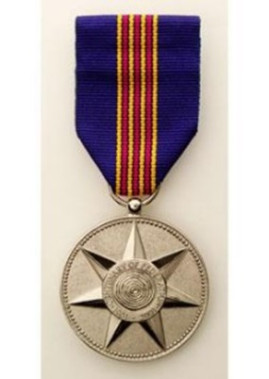 This century, he was awarded a Centenary Medal (2001) (pictured) by the Commonwealth of Australia for service to Australian society and science in biochemistry of plant hormones. Stuart served on the Australian Academy of Sciences Sectional Committee for Plant Sciences from 1988 to 1992.
Emeritus Professor Brian Gunning provided the following story relating to Stuart’s election to Fellow of the Australian Academy of Science:
“In early 1983 I had not long succeeded Denis Carr as Head of the Department of Developmental Biology in RSBS. Denis, as Foundation Professor, had appointed Stuart to his Senior Fellowship post some ten years earlier. Often the Headship was an uncomfortable job but on one particular morning that year it was pure pleasure. I called an impromptu Departmental meeting of all academic and technical staff and students. Everyone crowded into one of the laboratories, wondering what it could be about, even more puzzled when drink (non-alcoholic!) was served. When all was ready I explained that "from time to time people may go and other people may come, but Stuart Letham has been the Backbone of our Department, constant and staunch, for an entire decade: I have the honour to tell you that this morning Dr Stuart Letham was elected as a Fellow of The Australian Academy of Science". Everyone applauded, raising their glasses to Stuart in congratulation. It was a memorable moment. I suspect that Stuart, being Stuart, went back to his lab and in his unassuming way quietly got on with whatever experiment he was working on that day.”
Charles Hocart confirmed that they all did return to the lab. However, the lab group did succeed in prising Stuart away from the bench for a celebratory lunch in the Fellows’ Garden at University House within the next few days.
Santokh Singh related that Stuart’s attention could be diverted from cytokinins:
“Everyone knew about Stuart’s passion for cytokinin research, but far fewer knew about his keen interest in cricket and his unwavering support for the New Zealand cricket team. I remember how cheerful he would be whenever New Zealand defeated Australia. As a cricket player myself, I often found myself discussing cricket with Stuart - even during our lab meetings! Our shared enthusiasm for the game continued long after I left Australia.”
Integrity and Scientific Vindication
For decades Stuart’s identification of zeatin was over-shadowed – wrongly – by claims that he had “stolen Miller’s data”.
I was introduced to Folke Skoog at a conference in 1988 with the added comment that I was from New Zealand. Skoog’s response was “more’s the pity”. Surprised I asked why. His response: “Well, Letham was from New Zealand and he stole Miller’s data”. Taken aback, I said “but you’d have to agree that he has made valuable contributions to the study of cytokinins”, to which Skoog agreed. [I had completed my PhD on cytokinins in developing wheat grains at the University of Canterbury and was well aware of the substantive body of research published by Stuart.]
These comments made both verbally, to myself and others, and later in writing, where Skoog stated that Miller should be given precedence for the discovery and identification of zeatin (Skoog, 1994), hurt Stuart deeply. Yet Stuart remained dignified and principled. After visiting Stuart in Canberra in 2001 and telling him of Skoog’s comments, Stuart provided me with annotated papers, which seeded the idea of writing something to put Stuart’s side of the story. Many years later, when I visited Stuart in his retirement village in 2018, he again provided me with annotated papers, as well as the original exposed photographic paper showing two UV-absorbing compounds from purified plum extract and a photo of the crystals of zeatin picrate (Fig. 1). Finally, after my retirement, I had the time to write what Stuart called HZ – the History of Zeatin. This historical reconstruction, written with Stuart’s careful and substantive input was published in 2023 (Jameson, 2023). Along with much historical and detailed chemical input Stuart wrote:
“A suggestion - Miller’s GIF 1963 paper was omitted from the published volume by error. It was later published as an appendum but few ever saw it. It was his final statement regarding the structure of the corn CK. Could we present it as an appendix to HZ and my contribution at GIF could be added. That would answer some of Skoog’s criticisms.”
A clean and a version annotated by Stuart are included in HZ Supplementary Files S1A and S1B.
It seems that over time Skoog invented the controversy. During a phone chat, Stuart mentioned to me how elated Folke Skoog was when he [Stuart] announced at the IPGSA conference in Ottawa in 1967 that he had identified zeatin riboside from coconut milk [32] which F.C. Steward had failed to do, identifying a contaminant instead [see HZ for detail]. Skoog told Stuart that his lecture was 'terrific'. Skoog couldn't wait to tell FCS [Steward] that it was solved! There was no love lost between Skoog and Steward. Stuart met Skoog several times over the years and he always seemed very friendly. In the Supplementary File 3 in HZ there is a timeline showing that Skoog changed his opinion of Stuart. In chatting with Rick Amasino (PhD student of Miller's), Skoog was clearly upsetting a lot of people. Stuart’s final comment being “you will see how irrational Skoog became”. I should note here that Carlos Miller did not agree with Skoog’s statements, and Rick Amasino said that Carlos always spoke very highly of Stuart. Indeed, Stuart and Carlos Miller co-authored a paper, with Stuart identifying Miller’s factor as zeatin [20].
HZ finally corrected the record, a vindication acknowledged warmly by colleagues around the world.
This from Rick Amasino, University of Wisconsin, US:
“Until I read your article, I did not know that Skoog had made that comment in print (Skoog, 1994). It is unconscionable that the editors of that book would have let that comment remain in Skoog's contribution without consulting Carlos Miller. And I know what Carlos’ response would have been because when Skoog made the comment to me, I talked to Carlos about it. It is a pity that this could not have been dealt with when Carlos was alive and able to provide his own statement…. Your article is an important historical contribution that celebrates the many and important contributions of Stuart Letham and also celebrates him as the kind of person we hope all scientists would be.”
This from Thomas Schmülling, Freie Universität Berlin:
“…I did not know, for example, how many groups were actively searching at that time the plants own cytokinin and its structure. This article is a very valuable source for the community, for Letham certainly a kind of redemption. To have been accused of stealing the results was a strong reproach of Skoog but the answer has got a prominent (visible) place. Good that you met Letham in time, so you could realize this story. Thank you for this effort!”
This from Aaron Rashotte, Auburn University, US:
“I just read your new paper on Zeatin – 60th anniversary of its identification – and wanted to share that I really enjoyed it. I find it very interesting to hear the stories about scientific discoveries, and I am glad to see what appears to be setting some of the record straight.
My lab has really gone down the N-conjugate CK form rabbit hole in the last few years, and the Letham and other's works are things that we look back on regularly as the foundational works. We should have some interesting findings related to all the base and N7, N9 conjugate forms in senescence (re-parallel omics) that, maybe add some new knowledge to field.
Again, thanks and I will be passing this on to my lab to read and be part of their understanding of the cytokinin history.”
Margaret Gordon, a New Zealander and Stuart’s first PhD student noted:
“It is great that you have done such a comprehensive paper on Stuart Letham’s work and that he is still alive to see it, to assist with checking its contents, and to receive due credit for his work that was diminished by Skoog. I did not realise how much so it is great that you have set the record straight.”
Charles Hocart, Stuart’s second PhD student wrote:
“...I have heard bits and pieces of the early history from Stuart so it is nice to see it all laid out. Most particularly, because Skoog put the slur against Stuart into words in the chapter he wrote for Mok’s book (Skoog, 1994). I remember him being very hurt and indignant about that. I was also pleased to see you included the stories about FC Stewart taping private conversations and being caught out by phenyl urea contamination of his coconut milk extracts. Two years ago I was chasing up some of the conference papers for Stuart and we chewed those stories over. He told me he had sent you copies of old correspondence etc and was really very happy to have you writing it all up into a coherent story. I think he will be 96 this year!”
The later retirement years
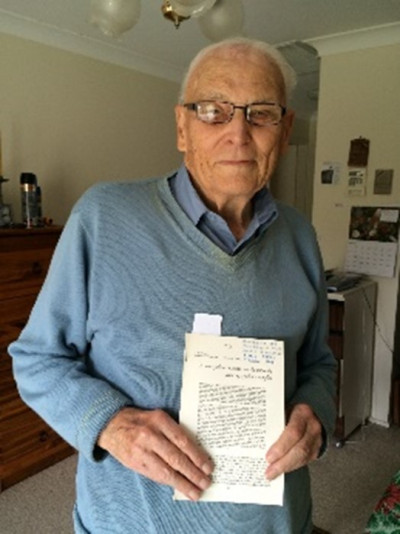 Stuart spent his final years in Cooranbong, NSW, in an Adventist retirement village close to his community of faith.
This photo of Stuart was taken in his retirement village in April 2015 by Jean Yong. Stuart is holding the paper that included the identification of zeatin riboside in coconut milk [32].
Stuart was predeceased by his beloved wife Iris neé Nixon (1922-2010) having shared 57 years of married life together. Stuart and Iris had no children of their own and Stuart is survived by his late brother’s four children who remained closely connected with him throughout his long life.
Not only was Stuart scientifically engaged during these later retirement years, he also maintained an interest in international and local affairs writing in 17/3/2022:
“I also find this Russian-Ukrainian war disturbing. It reminds me of Sept 2 or 3 1939 when I was 12 and Germany invaded Poland. NZ PM Michael Joseph Savage gave his speech: where Britain goes, we go. And all NZers agreed.”
And of more recent happenings:
“Best regards for 2022 and low Covid case numbers. In NSW, we often get 20,000 new cases in 24 h.”
Living independently at Alton Villas was not without challenges.
In an email DSL to PEJ 2022, Stuart was referring to 2021.
“It was not an ideal year for me. At the end of January, I had a fall and broke my hip joint …I had a complete hip replacement which went very well …I still drive short distances, but have decided to make this my last year for driving. As next September I will be 96.”
Matters were taken out of Stuart’s hands as he wrote on the 17/3/22:
“I have had a minor disturbance recently. On Sunday morning very early (? 2 am), my car was stolen out of my garage. 18 years old, value only $1,600, so no great loss. I had decided to stop driving in Sept, too old!”
On 6/1/2024 he wrote:
“I spent my 97th birthday Sept 8 (2023) in hospital with broken elbow (fall). It has healed well.”
And again on 22/10/24:
“Thank you for your email and references etc re CK and cell division. Hope to get onto that again shortly.
I think you visited me on March 13 when I was not so well. I had two broken bones in my lower back, and two days later I was carted off by ambulance to hospital for 4 weeks.
Have kept reasonably well since then. But am now 98 which does not help!”
Even though Stuart had broken bones in his back and was clearly in severe pain, his hospitality during our visit ran to providing afternoon tea and he was clearly still scientifically engaged requesting copies of papers that showed high levels of zeatin at the time of cell division during early seed development.
Despite the falls and broken bones, an earlier prostate cancer diagnosis and treatment, and a cataract operation in 2015, Stuart still remained living independently at Alton Villas, supported by close neighbours, and celebrating his 99th birthday in September 2025 with family and friends. Unfortunately, a fall led to his hospitalisation in Gosford Hospital on 19th November 2025. He came through surgery for a broken hip but passed peacefully on Sunday 23rd November 2025 with his niece Floris by his side.
Memories and Tributes
From Charles Hocart:
“I came to Stuart under rather tragic circumstances. I had originally started, in 1980, a PhD at Wollongong looking at the metabolic profile of acidotic neonates using GC/MS but my studies were cut short by the sad demise of my supervisor, Prof Bert Halpern. Roger Summons, a graduate of Wollongong, was at the funeral and one thing led to another and he offered to introduce me to Stuart. A few weeks later I drove to Canberra and had a long chat with Stuart which I illustrated on the whiteboard in Stuart's office. The whiteboard was rarely cleaned and some of my drawing's, in red, survived until Stuart's retirement.
Stuart was a Seventh Day Adventist and so of course didn't drink. However, there was one occasion when alcohol did touch his lips. It was the day of my thesis viva (RSBS was one of the last schools at ANU to drop this requirement). Stuart ushered me into the examination room and said to TJV Higgins and Barry Milborrow, that they shouldn't take too long as he had the restaurant booked for midday. Ren had brought a bottle of champagne. And afterwards I think Stuart was so glad to see the back of his second PhD student, that I think he had just the merest sip.
When my father died, I became severely depressed although it wasn't something I recognised at the time. I was seriously contemplating giving up but Stuart with a few kind words set me on the path to completion. Later he helped me return to Australia with the award of a National Research Fellowship.
Stuart also had a prodigious memory. There were a number of occasions where he embarrassed me, remembering better than myself (checked against my lab book) what I had done and the outcome!! A great help in the days before computer searches for references.
A gentleman and a scholar of great integrity who rose above the internecine school squabbles.”
From Santokh Singh, The University of British Columbia, Canada:
“The first time I met Stuart was in 1983, when I arrived at RSBS, ANU to begin my PhD under his supervision. Having just travelled from India, I was experiencing a fair bit of culture shock when I landed in Canberra. I still remember how impressed I was by Stuart’s kindness and generosity at our very first meeting. He made sure I received my scholarship funds quickly so I could manage my initial expenses. Despite being an internationally acclaimed phytohormone scientist, Stuart always remained humble, gracious, and unfailingly supportive of his colleagues and students. I remain deeply grateful for his patience in teaching me the intricacies and complexities of cytokinin biochemistry - knowledge that led to numerous publications from my PhD work.
I consider it a great privilege to have explored the field of cytokinin biochemistry under Stuart’s expert guidance and generous mentorship.”
Hitoshi Sakakibara (Nagoya University, Japan), on learning of Stuart’s passing, wrote:
“I am deeply saddened by the loss of the last great pioneer who established the foundation of cytokinin research. … Knowing that I live in the same time as such a legend in the field of cytokinin research filled me with a profound sense of admiration and inspiration.
I have been engaged in cytokinin research for the past twenty-five years, but the field still remains full of unanswered questions. I am determined to continue pursuing the functions of this vital signaling molecule with the deepest respect for his pioneering contributions.”
[Hitoshi was a co-author of the paper announcing the identification of the IPT genes in plants. These genes code for the rate limiting enzyme in cytokinin biosynthesis. This critical and long-awaited step did not occur until 2001 – 37 years after Stuart identified zeatin. This is the gene which Stuart’s lab subsequently used in the potato experiments mentioned earlier].
Thomas Schmülling, Freie Universität Berlin:
“This is sad news, but he reached the amazing age of 99. It is unbelievable that the man who, for the first time, isolated cytokinin more than half a century ago was still with us until recently. It was really very good that you wrote the review about his discovery and the circumstances before he passed away. He must have been very glad to read that.”
Carlene Bagnell, Stuart’s niece, wrote:
“Stuart was an unassuming man, a devoted son, a loyal husband, a beloved uncle, a faithful Christian, and a man in possession of a fine mind… He remained strong in his Christian faith throughout his life and applied his mind to reconciling his Adventist and scientific beliefs.”
Stuart was clearly engaged in the debate within his church surrounding Young Earth and Old Earth Creationism. That Stuart believed in the ancientness of earth is clear in his scientific writings and his excitement when Z was identified in cyanobacteria and in human pathogens [194]. In HZ, Stuart wanted the following inserted:
“Zeatin is an ancient molecule present at the dawn of aerobic life on Earth. Zeatin is synthesized in cyanobacteria, the organisms that oxygenated the atmosphere of Earth in the Great Oxidation Event that initiated some 2.4 billion years ago.”
And in his email titled ‘HZ-the end’ 28/2/2023 he wrote:
“Of course, the story covers nearly 80 years from the time of van Overbeek and Caplin and Steward who drew attention to the unknown compounds in coconut milk. However, you elegantly guided the reader through it all and then turned the clock back 3 billion years to the real beginning!!”
The tribute written by Graeme Stacey and read at Stuart’s funeral stated that:
“Stuart was an outstanding and productive scientist, a loyal colleague, a caring friend, a hospitable carer and helper, and a kindly prompter (irritant) to his church family on matters of science and faith.”
Graeme Stacey had sought comments from many friends and colleagues of Stuart’s. In summarising these comments, he found that:
“Stuart demonstrated a true humility. So many examples were given by family and friends. Some labelled it self-effacing humility. Others recalled Stuart as one who remained in the background - a mentor providing support and priority to colleagues. A quiet, thoughtful gentleman. (I mention this finding because, in the lofty heights of academia, humility is not always a common commodity. But it was true for Stuart).”
Modesty is another frequently used word to describe Stuart. Added here is a quote from one of his PhD students (Zhang Ren) who arrived at ANU late 1982:
“I recall Stuart saying the nasty behaviour of FC Steward. Also my former supervisor for MSc in China Prof Cheng Tsui spoke of Stuart highly for his character, especially modesty, recommending he would be a best supervisor for my PhD when I was considering where to go - U Wisconsin (I got a Gov Scholarship – Skoog’s lab) or ANU. Tsui did postdoc work with Skoog but didn't like him, I can tell. Your review put the details to clarify Stuart's honesty as a respected scientist. I am always proud of being his student and very grateful to his offer to take me on board as well as the long time support during my study and career.”
Charles Hocart wrote:
“Stuart was not only a first rate scientist but somebody who was very generous in his interactions with those around him. He was a very proud New Zealander but always very modest about his own accomplishments.”
And regarding modesty and HZ, Stuart wrote in various emails:
“I do not think I should be an author, but will do my best to help you”; “it’s too much about the chemistry in Letham lab”; “This material is difficult to write. It’s the history of Z, we must not over emphasise the work of DSL!”
Graeme Stacey’s tribute continues:
“Along with the humility, Stuart is remembered for his generosity. Generous with his time, gifts, support, help and advice. Examples provided were wide-ranging. Help with editing academic papers, help with transporting friends and others to church, supporting a man who had been financially scammed. David [his nephew] remembers - he was generous with his signature vegetable soup.”
Warm and hospitable, Iris and Stuart delighted in welcoming visitors and feeding people. Stuart shared in the preparation and cooking at home and continued mid-Canterbury hospitality after Iris’ passing.
A neighbour, Leon Miller, wrote:
“I first met Stuart when we became a neighbours five years before his death. During that time his scientific achievements only slowly became evident through contact with his friends and some former colleagues. While he contributed very significantly to science, his care and generosity towards others were equally significant.”
Graeme Stacey also highlighted kindness stating that:
“This defining quality came in many many forms. Most importantly, he was devoted to Iris. He is reported to have said “caring for her was the greatest work he had ever done.” Family remember that was not always an easy task, particularly in the latter years. Kindness paired with grace in the face of reasonable or unreasonable demands is not an accidental attribute. It is a reasoned moral choice grounded in kindness and love.”
After Iris’ death, Stuart chose to honour his brother, John, by establishing a postgraduate scholarship for nurses at the Sydney Adventist Hospital in Wahroonga. The scholarship was named for Dr John Letham as a tribute to John’s long and faithful service at the hospital. Stuart’s final act of generosity was willing his estate to further support the scholarship.
Valedictory
The thread of research that led Stuart from storage disorders of apples through to his identification of zeatin to his exploitation of the most sophisticated applications of mass spectrometry, is a truly remarkable example of penetrating scientific endeavour. Stuart’s characterisation of the naturally occurring cytokinins engendered a whole field of study for plant biochemists and physiologists. He created a legacy that reshaped plant biology and influenced generations of researchers worldwide.
Stuart was quiet and unassuming but very determined. He was successful in competing with international groups, which were better funded and had better facilities. He successfully demonstrated the contributions that good chemists can make to solving biological problems. His work was very innovative and at the same time quite exceptionally rigorous.
Stuart Letham will be remembered not only for the identification of zeatin but for how he exemplified the ideal of the careful, principled scientist. Colleagues remembered his cheeky sense of humour, his modesty, his willingness to support students, and others, through personal hardship, and his capacity for kindness.
“Stuart Letham was a wonderful colleague, an unassuming, devout man of great wisdom who stood above the occasionally turbulent affairs of the School, focussing on his science with profound ability, integrity and dignity. He was respected by all and will be remembered as a truly great scientist and gentleman.” [Brian Gunning]
Note: I had started drafting HZ with some biographical comments drawn from letters and conversations, but Stuart wrote 31/1/2022 “Instead of writing a biography, I have suggested you write a historical account of the discovery of zeatin”, “…please don’t write a biography”. However, this obituary has given me the opportunity to do just that, drawing also on input from many others.
Acknowledgements
I acknowledge the funeral tributes by Carlene Bagnall (Stuart’s niece) and Graeme Stacey, and information and comment provided by family, friends, colleagues, former inhabitants of the ‘Barn’, and former students and postdocs of Stuart’s. Some details were obtained from the
Encyclopaedia of Australian Science and Innovation Letham, David Stuart (Stuart)
References mentioned in the text
Ferguson AR & Bellamy AR (2011). Edward George Bollard. Obituary, RSNZ Te Apārangi. http://www.royalsociety.org.nz/organisation/academy/fellowship/obituaries/edward-bollard/
Jameson PE (2023). Zeatin: The 60th anniversary of its identification. Plant Physiology 192: 34-55. doi: 10.1093/plphys/kiad094.
Skoog (1994). A personal history of cytokinin and plant hormone research. In: Cytokinins: Chemistry, Activity and Function. Eds: Mok DWS & Mok MC pp1-14.
Paula Jameson ONZM, FNZIAHS
Publications
Stuart Letham’s publications as laid out by him in a typed and, from 1997, handwritten list.
1954
1. Jones AS, Letham, DS. A submicro method for the estimation of sulphur. Chem Ind. (London). 1954: 662–663.
2. Jones AS, Letham, DS. Studies in the determination of nucleotide sequence in deoxypentose nucleic acids. Biochim Biophys Acta. 1954: 14:438–440.
1956
3. Jones AS, Letham DS. A spectrophotometric method for the determination of sub-micro quantities of sulphur with 4‑amino-4′-chlorodiphenyl. Analyst (London) 1956: 81:15–18.
4. Jones AS, Letham DS. The nucleotide sequence in deoxypentose nucleic acids. Part I. The action of mercaptoacetic acid on calf-thymus deoxyribonucleic acid. J Chem Soc. 1956: 2573-2578.
5. Jones AS, Letham DS, Stacey M. The nucleotide sequence in deoxypentose nucleic acids. Part II. The alkaline degradation of calf-thymus aldehyde-apurinic acid di(carboxymethyl) dithioacetal. J Chem Soc. 1956: 2570–2583.
6. Jones AS, Letham DS, Stacey M. The nucleotide sequence in deoxypentose nucleic acids. Part III. The nature of the end groups produced by the alkaline hydrolysis of calf-thymus aldehyde-apurinic acid di(carboxymethyl) dithioacetal. J Chem Soc. 1956: 2584–2586.
1957
7. Letham DS, Perrin DD. A simple continuous solid-liquid extractor. NZ J Sci Tech. B. 1957: 38:695–696.
1958
8. Letham DS. Maceration of plant tissues with ethylenediamine-tetraacetic acid. Nature. 1958: 181(4602):135–136.
9. Letham DS. Cultivation of apple fruit tissue in vitro. Nature. 1958: 182(4633):473–474.
1960
10. Letham DS. The separation of plant cells with ethylenediamine-tetraacetic acid. Expl Cell Res. 1960: 21(2):353–360.
11. Letham DS. Growth requirements of pome fruit tissues. Nature. 1960: 188(4748):425–426.
1961
12. Letham DS. Influence of fertiliser treatment on apple fruit composition and physiology. I. Influence on cell size and cell number. Aust J Agric Res. 1961: 12:600–611.
13. Letham DS, Bollard EG. Stimulants of cell division in developing fruits. Nature. 1961: 191(4793):1119–1120.
1962
14. Letham DS. Separation of plant cells with hexametaphosphate and the nature of intercellular bonding. 1962: Expl Cell Res. 27:352–355.
1963
15. Letham DS. Purification of factors inducing cell division extracted from plum fruitlets. Life Sci. 1963: 3:152–157.
16. Letham DS. Zeatin, a factor inducing cell division isolated from Zea mays. Life Sci. 1963: 8:569–573.
17. Letham DS. Regulators of cell division in plant tissues. I. Inhibitors and stimulants of cell division in developing fruits: their properties and activity in relation to the cell division period. NZ J Bot. 1963: 1:336–350.
1964
18. Letham DS. Isolation of a kinin from plum fruitlets and other tissues. In: Nitsch JP, editor, Régulateurs de la Croissance Vegétalé, Coll. Int. Centre Nat. Recherche Sci. France: Gif-sur-Yvette; 1963. [The Proceedings of the 5th International Conference on Plant Growth Substances at Gif, France in July 1963.] Recherche Sci. 1964: 123:109–117.
19. Letham DS, Shannon JS, McDonald IR. The structure of zeatin, a factor inducing cell division. Proc Chem Soc (London). 1964: 230–231.
1965
20. Letham DS, Miller CO. Identity of kinetin-like factors from Zea mays. Plant Cell Physiol. 1965: 6(2):355–359.
21. Letham DS. Methods for detecting and distinguish between purines and pyrimidines on paper chromatograms. J Chromatography A. 1965: 20:184–186.
1966
22. Letham DS. Naturally-occurring stimulants of plant growth. [Paper read at the 11th New Zealand Science Congress, Auckland, 1965.] Chem Ind NZ. 1966: 2:173–176.
23. Letham DS. Regulators of cell division in plant tissues. II. A cytokinin in plant extracts: isolation and interaction with other growth regulators. Phytochem. 1966: 5(3):269–286.
24. Shannon JS, Letham DS. Regulators of cell division in plant tissues. IV. The mass spectra of cytokinins and other 6-aminopurines. NZ J Sci. 1966: 9:833–842.
25. Letham DS. Purification and probable identity of a new cytokinin in sweet corn extracts. Life Sci. 1966: 5(6):551–554.
26. Letham DS. Isolation and probable identity of a third cytokinin in sweet corn extracts. Life Sci. 1966: 5(21):1999–2004.
1967
27. Letham DS, Shannon JS, McDonald IRC. Regulators of cell division in plant tissues. III. The identity of zeatin. Tetrahedron. 1967: 23(1):479–486.
28. Letham DS. Regulators of cell division in plant tissues. V. A comparison of the activities of zeatin and other cytokinins in five bioassays. Planta. 1967: 74(3):228–242.
29. Cebalo T, Letham DS. Synthesis of zeatin, a factor inducing cell division. Nature. 1967: 213:86.
30. Letham DS, Ralph RK. A cytokinin in soluble RNA from a higher plant. Life Sci. 1967: 15(4):387–394.
31. Letham DS. Chemistry and physiology of kinetin-like compounds. Annu Rev Plant Physiol. 1967: 18:349–364.
1968
32. Letham DS. A new cytokinin bioassay and the naturally occurring cytokinin complex. In: Wightman F, Setterfield G, editors. Biochemistry and physiology of plant growth substances. Ottawa: Runge Press; 1968. pp. 19–31. [Paper presented at the 6th International Conference on Plant Growth Substances, Ottawa, 1967.]
1969
33. Letham DS. Cytokinins and their relation to other phytohormones. BioScience. 1969: 19(4):309–316.
34. Letham DS. Regulators of cell division in plant tissues. VI. The effects of zeatin and other stimulants of cell division on apple fruit development. NZ J Agric Res. 1969: 12(1):1–20.
35. Letham D, Mitchell RE, Cebalo T, Stanton DW. Regulators of cell division in plant tissues. VII. The synthesis of zeatin and related 6-substituted purines. Aust J Chem. 1969: 22: 205–219.
36. Letham DS, Williams MW. Regulators of cell division in plant tissues VIII. The cytokinins of the apple fruit. Physiol Plant. 1969: 22:925–936.
37. Young H, Letham DS. Regulators of cell division in plant tissues. IX. 6-(substituted amino)purines: synthesis by a new method and cytokinin activity. Phytochem. 1969: 8:1199–1203.
38. Letham DS. The influence of fertilizer treatment on apple fruit composition and physiology. II. Influence on respiration rate and contents of nitrogen, phosphorus, and titratable acidity. Aust J Agric Res. 1969: 20:1073–1085.
39. Letham DS, McGrath HJW. Influence of fertiliser treatment on apple fruit composition and physiology: III. Influence on contents of phosphorus, magnesium, calcium, and potassium. NZ J Agric Res. 1969: 12:642–649.
40. Williams MW, Letham DS. Effect of gibberellin and cytokinins on development of parthenocarpic apple fruits. Hort Sci. 1969: 4:215–216.
1970
41. Berridge MV, Ralph RK, Letham DS. The binding of kinetin to plant ribosomes. Biochem J. 1970: 119: 75–84.
1971
42. Letham DS, Young H. Regulators of cell division in plant tissues. X. The synthesis and cytokinin activities of N-(purin-6-yl)amino acids. Phytochem. 1971: 10:23–28.
43. Letham DS, Young H. Regulators of cell division in plant tissues. XI. The synthesis of radioisotopically labelled zeatin. Phytochem. 1971: 10(9):2077–2081.
44. Letham DS. Regulators of cell division in plant tissues. XII. A cytokinin bioassay using excised radish cotyledons. Physiol Plant. 1971: 25:391–396.
1972
45. Parker CW, Letham DS, Cowley DE, MacLeod JK. Raphanatin, an unusual purine derivative and a metabolite of zeatin. Biochem Biophys Res Commun. 1972: 49(2):460–466.
46. Letham DS. Regulators of cell division in plant tissues. XIII. Cytokinin activities of compounds related to zeatin. Phytochem. 1972: 11(3):1023–1025.
47. Berridge MV, Ralph RK, Letham DS. On the significance of the binding of cytokinins to plant ribosomes. In: Carr DJ, editor. Plant Growth Substances 1970. Springer-Verlag; 1972. pp. 248–255.
48. Letham DS, Parker CW, Gordon ME. Regulators of cell division in plant tissues. XIV. The cytokinin activities and metabolism of 6-acylaminopurines. Physiol Plant. 1972: 27:285-290.
1973
49. Letham DS, Stewart PR, Clark-Walker GD. RNA in retrospect. In: Stewart PR, Letham DS, editors. The Ribonucleic Acids, Springer-Verlag; 1973. pp. 1–6.
50. Letham DS. Transfer RNA and cytokinins. In: Stewart PR, Letham DS, editors. The Ribonucleic Acids. Springer-Verlag; 1973. pp. 81–106.
51. Parker CW, Wilson MM, Letham DS, Cowley DE, MacLeod JK. The glucosylation of cytokinins. Biochem Biophys Res Commun. 1973: 55(4):1370–1376.
52. Letham DS. Cytokinins from Zea mays. Phytochem. 1973: 12(10):2445–2455.
53. Parker CW, Letham DS. Regulators of cell division in plant tissues. XVI. Metabolism of zeatin by radish cotyledons and hypocotyls. Planta. 1973: 114(3):199–218.
1974
54. Gordon ME, Letham DS, Parker CW. Regulators of cell division in plant tissues. XVII. The metabolism and translocation of zeatin in intact radish seedlings. Ann Bot. 1974: 38(4):809–825.
55. Parker CW, Letham DS. Regulators of cell division in plant tissues. XVIII. Metabolism of zeatin in Zea mays seedlings. Planta. 1974: 115(4):337–44.
56. Wilson MM, Gordon ME, Letham DS, Parker CW. Regulators of cell division in plant tissues. XIX. The metabolism of 6-benzylaminopurine in radish cotyledons and seedlings. J Exp Bot. 1974: 25(4):725–732.
57. Letham DS. Regulators of cell division in plant tissues. XX. The cytokinins of coconut milk. Physiol Plant. 1974: 32(1):66–70.
58. Letham DS. Regulators of cell division in plant tissues. XXI. Distribution coefficients for cytokinins. Planta. 1974: 118(4):361–364.
59. Gordon ME, Wilson MM, Parker CW, Letham DS. The metabolism of cytokinins by radish seedlings. In: Bieleski RL, Ferguson AR, Cresswell MM, editors. Bulletin 12: Mechanisms of Regulation of Plant Growth. Wellington: Royal Society NZ of New Zealand; 1974. pp. 773–780.
1975
60. MacLeod JK, Summons RE, Parker CW, Letham DS. Lupinic acid, a purinyl amino acid and a novel metabolite of zeatin. J Chem Soc Chem Comms. 1975: 19:809–810.
61. Parker CW, Letham DS, Wilson MM, Jenkins ID, MacLeod JK, Summons RE. The identity of two new cytokinin metabolites. Ann Bot. 1975: 39:375–376.
62. Duke CC, Liepa AJ, MacLeod JK, Letham DS, Parker CW. Synthesis of raphanatin and its 6-benzylaminopurine analogue. J Chem Soc Chem Comms. 1975: 24:964–965.
63. Cowley DE, Jenkins ID, MacLeod JK, Summons RE, Letham DS, Wilson MM, Parker CW. Structure and synthesis of unusual cytokinin metabolites. Tetrahedron Lett. 1975: 16(12):1015–1018.
64. Gordon ME, Letham DS. Regulators of cell division in plant tissues. XXII. Physiological aspects of cytokinin-induced radish cotyledon growth. Funct Plant Biol. 1975: 2(2):129–154.
65. Letham DS, Wilson MM, Parker CW, Jenkins ID, MacLeod JK, Summons RE. Regulators of cell division in plant tissues. XXIII. The identity of an unusual metabolite of 6-benzylaminopurine. Biochim Biophys Acta. 1975: 399(1):61–70.
66. Gordon ME, Letham DS, Beever JE. Regulators of cell division in plant tissues. XXIV. Effect of cytokinins on ribosome yield from radish cotyledons. Physiol Plant. 1975: 35(1):27–33.
1976
67. MacLeod JK, Summons RE, Letham DS. Mass spectrometry of cytokinin metabolites. Per(trimethylsilyl) and permethyl derivatives of glucosides of zeatin and 6-benzylaminopurine. J Org Chem. 1976: 41:3959–3967.
1977
68. Letham DS, Parker CW, Duke CC, Summons RE, Macleod JK. O-glucosyl zeatin and related compounds - a new group of cytokinin metabolites. Ann Bot. 1977: 41:261–263.
89. Letham DS, Wettenhall REH. Transfer RNA and cytokinins. In: Stewart PR, Letham DS, editors. The Ribonucleic Acids, 2nd Edition. New York: Springer-Verlag; 1977. pp. 129–193.
70. Letham DS, Stewart PR. RNA in retrospect. In: Stewart PR, Letham DS, editors. The Ribonucleic Acids, 2nd Edition. New York: Springer-Verlag; 1977. pp. 1–8.
71. Murakoshi I, Ikegami F, Ookawa N, Haginiwa J, Letham DS. Enzymatic synthesis of lupinic acid, a novel metabolite of zeatin in higher plants. Chem Pharm Bull. 1977: 25(3):520–522.
72. Summons RE, Macleod JK, Parker CW, Letham DS. The occurrence of raphanatin as an endogenous cytokinin in radish seed: identification and quantitation by gas chromatographic—mass spectrometric analysis using deuterium‐labelled standards. FEBS Lett. 1977: 82:211–214.
1978
73. Letham DS, Higgins TJV, Goodwin PB, Jacobsen JV. Phytohormones in retrospect. In: Letham DS, Goodwin PB, Higgins TJV, editors. Phytohormones and Related Compounds – A Comprehensive Treatise, Volume 1. Amsterdam: Elsevier/North Holland; 1978. pp. 1–27.
74. Letham DS. Cytokinins. In: Letham DS, Goodwin PB, Higgins TJV, editors. Phytohormones and Related Compounds – A Comprehensive Treatise, Volume 1. Amsterdam: Elsevier/North Holland; 1978. pp. 205–263.
75. Letham DS. Naturally-occurring plant growth regulators other than the principal hormones of higher plants. In: Letham DS, Goodwin PB, Higgins TJV, editors. Phytohormones and Related Compounds – A Comprehensive Treatise, Volume 1. Amsterdam: Elsevier/North Holland; 1978. pp. 349–417.
76. Goodwin PB, Gollnow BI, Letham DS. Phytohormones and growth correlations. In: Letham DS, Goodwin PB, Higgins TJV, editors. Phytohormones and Related Compounds – A Comprehensive Treatise, Volume 1. Amsterdam: Elsevier/North Holland; 1978. pp. 215–249.
77. Parker CW, Letham DS, Gollnow BI, Summons RE, Duke CC, MacLeod JK. Regulators of cell division in plant tissues. XXV. Metabolism of zeatin by lupin seedlings. Planta. 1978: 142(3):239–251.
78. Letham DS, Summons RE, Entsch B, Gollnow BI, Parker CW, MacLeod JK. Glucosylation of cytokinin analogues. Phytochem. 1978: 17:2053–2057.
79. Cowley DE, Duke CC, Liepa AJ, MacLeod JK, Letham DS. The structure and synthesis of cytokinin metabolites. 1. The 7-and 9-β-D-glucofuranosides and pyranosides of zeatin and 6-benzylaminopurine. Aust J Chem. 1978: 31(5):1095–1111.
80. Duke C, Macleod J, Summons R, Letham D, Parker CW. The structure and synthesis of cytokinin metabolites. II. Lupinic acid and O-β-D-glucopyranosylzeatin from Lupinus angustifolius. Aust J Chem. 1978: 31:1291–1301.
1979
81. Entsch B, Letham DS. Enzymic glucosylation of the cytokinin, 6-benzylaminopurine. Plant Sci Lett. 1979: 14(2):205–212.
82. Summons RE, Duke CC, Eichholzer JV, Entsch B, Letham DS, MacLeod JK, Parker CW. Mass spectrometric analysis of cytokinins in plant tissues. II. Quantitation of cytokinins in Zea mays kernels using deuterium labelled standards. Biomed Mass Spectrom. 1979: 6(9):407–413.
83. Summons RE, Entsch B, Parker CW, Letham DS. Mass spectrometric analysis of cytokinins in plant tissues. III. Quantitation of the cytokinin glycoside complex of lupin pods by stable isotope dilution. FEBS Lett. 1979: 107(1):21–25.
84. Letham DS, Gollnow BI, Parker CW. The reported occurrence of 7-glucofuranoside metabolites of cytokinins. Plant Sci Lett. 1979: 15(3):217–23.
85. Duke CC, Letham DS, Parker CW, MacLeod JK, Summons RE. The structure and synthesis of cytokinin metabolites. IV. The complex of O-glucosylzeatin derivatives formed in Populus species. Phytochem. 1979: 18(5):819–824.
86. Entsch B, Parker CW, Letham DS, Summons RE. Preparation and characterization, using high-performance liquid chromatography, of an enzyme forming glucosides of cytokinins. Biochim Biophys Acta Enzymology 1979: 570(1):124–139.
87. Letham DS, Summons RE, Parker CW, MacLeod JK. Regulators of cell division in plant tissues. XXVII. Identification of an amino-acid conjugate of 6-benzylaminopurine formed in Phaseolus vulgaris seedlings. Planta. 1979: 146(1):71–74.
1980
88. Summons RE, Entsch B, Letham DS, Gollnow BI, MacLeod JK. Regulators of cell division in plant tissues. XXVIII. Metabolites of zeatin in sweet corn kernels: purifications and identifications using high performance liquid chromatography and chemical-ionization mass spectrometry. Planta. 1980: 147(5):422–434.
89. Duke CC, Entsch B, Letham DS, MacLeod JK, Parker CW, Summons RE. Mass spectrometric and GC-MS studies of cytokinin metabolism. In: Frigerio A, McCamish M. editors. Recent Developments in Mass Spectrometry in Biochemistry and Medicine. 6th International Symposium of Mass Spectrometry in Biochemistry. Amsterdam: Elsevier; 1980. pp. 7–19.
90. Entsch B, Letham DS, Parker CW, Summons RE, Gollnow BI. Metabolites of cytokinins. In: Skoog F, editor. Plant Growth Substances 1979. Proceedings of the 10th International Conference on Plant Growth Substances. Berlin: Springer-Verlag; 1980. pp.109–118.
91. Letham DS. This week’s citation classic. In: Current Contents Oct 6, 1980. Ann Rev Plant Physiol.1967: 18: 349–364.
1981
92. Johnson LP, MacLeod JK, Parker CW, Letham DS. The quantitation of adenosine 3′: 5′-cyclic monophosphate in cultured tobacco tissue by mass spectrometry. FEBS Lett. 1981: 124:119–121.
93. Johnson LP, MacLeod JK, Parker CW, Letham DS, Hunt NH. Identification and quantitation of adenosine-3′: 5′-cyclic monophosphate in plants using gas chromatography-mass spectrometry and high-performance liquid chromatography. Planta. 1981: 152:195–201.
94. Summons RE, Letham DS, Gollnow BI, Parker CW, Entsch B, Johnson LP, MacLeod JK, Rolfe BG. Cytokinin translocation and metabolism in species of the Leguminosae: studies in relation to shoot and nodule development. In: Guern J, Peaud-Lenoel C, editors. The Metabolism and Molecular Activities of Cytokinins. CNRS Coll. Int. Berlin: Springer-Verlag; 1980. pp. 69–79.
1982
95. Letham DS. A 6-oxypurine with growth promoting activity. Plant Sci Lett. 1982: 26:241–249.
96. Badenoch-Jones J, Summons RE, Djordjevic MA, Shine J, Letham DS, Rolfe BG. Phytohormones, Rhizobium mutants and nodulation in legumes. I. Mass spectrometric quantification of indole-3-acetic acid in Rhizobium culture supernatants: relation to root hair curling and nodule initiation. Appl Environ Micro. 1982: 44(2):275–280.
97. Badenoch‐Jones J, Summons RE, Entsch B, Rolfe BG, Parker CW, Letham DS. Phytohormones, Rhizobium mutants and nodulation in legumes. II. Mass spectrometric identification of indole compounds produced by Rhizobium strains. Biomed Mass Spectrom. 1982: 9(10):429-437.
98. Letham DS, Tao GQ, Parker CW. An overview of cytokinin metabolism. In: Wareing PF, editor. Plant Growth Substances 1982. New York: Academic Press; 1982. pp. 143–153.
1983
99. Entsch B, Parker CW, Letham DS. An enzyme from lupin seeds forming alanine derivatives of cytokinins. Phytochem. 1983: 22:375–381.
100. Summons RE, Palni LM, Letham DS. Determination of intact zeatin nucleotide by direct chemical ionisation mass spectrometry. FEBS Lett. 1983: 151:122–126.
101. Letham DS, Palni LMS. The biosynthesis and metabolism of cytokinins. Annu Rev Plant Physiol. 1983: 34:163–197.
102. Palni LM, Summons RE, Letham DS. Mass spectrometric analysis of cytokinins in plant tissues. V. Identification of the cytokinin complex of Datura innoxia crown gall tissue. Plant Physiol. 1983: 72:858– 863.
103. Badenoch-Jones J, Rolfe BG, Letham DS. Phytohormones, Rhizobium mutants, and nodulation in legumes. III. Auxin metabolism in effective and ineffective pea root nodules. Plant Physiol. 1983: 73:347–352.
104. Letham DS, Palni LMS, Tao G-Q, Gollnow BI, Bates CM. Regulators of cell division in plant tissues. XXIX. The activities of cytokinin glucosides and alanine conjugates in cytokinin bioassays. J Plant Growth Regul. 1983: 2:103–115.
105. Tao GQ, Letham DS, Palni LMS, Summons RE. Cytokinin biochemistry in relation to leaf senescence. I. The metabolism of 6-benzylaminopurine and zeatin in oat leaf segments. J Plant Growth Regul. 1983: 2:89–102.
106. Tsui C, Shao LM, Wang CM, Tao GQ, Letham DS, Parker CW, Summons RE, Hocart CH. Identification of a cytokinin in water chestnuts (corms of Eleocharis tuberosa). Plant Sci Lett. 1983: 32:225–231.
107. Badenoch‐Jones J, Summons RE, Letham DS. Synthesis of (2H5) indole‐3‐pyruvic acid. J Labelled Comp Radiopharma. 1983: 20:1325–1330.
1984
108. Badenoch-Jones J, Summons RE, Rolfe BG, Letham DS. Phytohormones, Rhizobium mutants, and nodulation in legumes. IV. Auxin metabolites in pea root nodules. J Plant Growth Regul. 1984: 3:23–39.
109. Badenoch-Jones J, Rolfe BG, Letham DS. Phytohormones, Rhizobium mutants, and nodulation in legumes. V. Cytokinin metabolism in effective and ineffective pea root nodules. Plant Physiol. 1984: 74:239–246.
110. Palni LM, Palmer MV, Letham DS. The stability and biological activity of cytokinin metabolites in soybean callus tissue. Planta. 1984: 160:242–249.
111. Palmer MV, Letham DS, Gunning BE. Cytokinin metabolism in nondividing and auxin-induced dividing explants of Helianthus tuberosus L. tuber tissue. J Plant Growth Regul. 1984: 2:289–298.
112. Badenoch-Jones J, Rolfe BG, Letham DS. Phytohormones, Rhizobium mutants, and nodulation in legumes. VI. Metabolism of zeatin riboside applied via the tips of nodulated pea roots. J Plant Growth Regul. 1984: 3:41–49.
113. Noodén LD, Letham DS. Translocation of zeatin riboside and zeatin in soybean explants. J Plant Growth Regul. 1984: 2:265–279.
114. Badenoch-Jones J, Letham DS, Parker CW, Rolfe BG. Quantitation of cytokinins in biological samples using antibodies against zeatin riboside. Plant Physiol. 1984: 75:1117–1125.
1985
115. Palni LMS, Tay SAB, Nandi SK, Pianca DJ, de Klerk GJM, Wong OC, Letham DS, MacLeod JK. Cytokinin biosynthesis in plant tumour tissues. International Symposium on Plant Growth Regulators, Czech Academy of Sciences. Biol Plant. 1985: 27:195–203.
116. Letham DS, Gollnow BI. Regulators of cell division in plants. XXX. Cytokinin metabolism in relation to radish cotyledon expansion and senescence. J Plant Growth Regul. 1985: 4:129–145.
117. Tay SAB, MacLeod JK, Palni LMS, Letham DS. Detection of cytokinins in a seaweed extract. Phytochem. 1985: 24:2611–2614.
118. Knypl JS, Letham DS, Palni LM. Cytokinins in maturing and germinating Lupinus luteus L. seeds. International Symposium on Plant Growth Regulators, Czech Academy of Sciences. Biol Plant. 1985: 27:188–194.
1986
119. Parker CW, Entsch B, Letham DS. Inhibitors of cytokinin metabolism. I. Inhibitors of two enzymes which metabolize cytokinins. Phytochem. 1986: 25:303–310.
120. Hocart CH, Wong OC, Letham DS, Tay SAB, MacLeod JK. Mass spectrometry and chromatography of t-butyldimethylsilyl derivatives of cytokinin bases. Analyt Biochem. 1986: 153:85–96.
121. Noodén LD, Letham DS. Cytokinin control of monocarpic senescence in soybean. In: Bopp M, editor. Plant Growth Substances 1985. Proceedings of the 12th International Conference on Plant Growth Substances, Heidelberg,1985. Berlin: Springer-Verlag; 1986. pp. 324–332.
1987
122. Zhang R, Letham DS, Wong OC, Noodén LD, Parker CW. Cytokinin biochemistry in relation to leaf senescence. II. The metabolism of 6-benzylaminopurine in soybean leaves and the inhibition of its conjugation. Plant Physiol. 1987: 83:334–340.
123. Badenoch-Jones J, Parker CW, Letham DS. Phytohormones, Rhizobium mutants, and nodulation in legumes. VII. Identification and quantitation of cytokinins in effective and ineffective pea root nodules using radioimmunoassay. J Plant Growth Regul. 1987: 6:97–111.
124. MacLeod JK, Tay, SAB, Letham DS, Palni LMS. Mass spectrometric studies of cytokinin metabolism. Adv Mass Spec. 1987: 10B:1289–1290.
125. Wong OC, Hocart CH, Letham DS. Mass spectrometry of t-butyldimethylsilyl derivatives of cytokinins. In: McEwen CN, editor. Proceedings of the 34th Annual Conference on Mass spectrometry and Allied Topics. Cincinnati, OH: American Society of Mass Spectrometry; 1987. pp. 337–338.
126. Wong OC, Zhang, R, Letham, DS. Mass spectrometric studies of cytokinin metabolites in relation to the retardation of leaf senescence. In: McEwen CN, editor. Proceedings of the 34th Annual Conference on Mass spectrometry and Allied Topics. Cincinnati, OH: American Society of Mass Spectrometry; 1987. pp. 339–340.
127. Zhang R, Letham DS, Parker CW, Schroeder H, Higgins TJV. Retardation of soybean leaf senescence and associated effects on seed composition. J Plant Growth Regul. 1987: 6:15–21.
128. Hall PJ, Letham DS, Barlow BA. The influence of hormones on development of Amyema seedlings cultured in vitro. In: Weber HC, Forstreuter W, editors. Parasitic Flowering Plants. Marburg, FRG: Philipps University Publication; 1987. pp. 285–291.
129. Hall PJ, Badenoch-Jones J, Parker CW, Letham DS, Barlow BA. Identification and quantification of cytokinins in the xylem sap of mistletoes and their hosts in relation to leaf mimicry. Aust J Plant Physiol. 1987: 14:429–438.
130. Badenoch-Jones J, Parker CW, Letham DS. Use of isopentenyladenosine and dihydrozeatin riboside antibodies for the quantification of cytokinins. J Plant Growth Regul. 1987: 6(3):159–82.
131. Zhang R, Letham DS, Noodén LD. Cytokinin conjugation in relation to soybean leaf senescence. In: Schreiber K, Schotte HR, Sembner G, editors. Conjugated Plant Hormones - Structure, Metabolism and Function, Academy of Sciences of the GDR; 1987. pp. 128–137.
132. Jameson PE, Letham DS, Zhang R, Parker CW, Badenoch-Jones J. Cytokinin translocation and metabolism in lupin species. I. Zeatin riboside introduced into the xylem at the base of Lupinus angustifolius stems. Aust J Plant Physiol. 1987: 14:695–718.
1988
133. Hocart CH, Badenoch-Jones J, Parker CW, Letham DS, Summons RE. Cytokinins of dry Zea mays seed: quantification by radioimmunoassay and gas chromatography-mass spectrometry. J Plant Growth Regul. 1988: 7:179–196.
134. Singh S, Letham DS, Jameson PE, Zhang R, Parker CW, Bandenoch-Jones J, Noodén LD. Cytokinin biochemistry in relation to leaf senescence. IV. Cytokinin metabolism in soybean explants. Plant Physiol. 1988: 88:788–794.
135. Nandi SK, Palni LM, Letham DS, Knypl JS. The biosynthesis of cytokinins in germinating lupin seeds. J Exp Bot. 1988: 39:1649–1665.
1989
136. Letham DS, Singh S. Quantification of cytokinin O-glucosides by negative ion mass spectrometry. Plant Physiol. 1989: 89:74–77.
137. Parker CW, Badenoch-Jones J, Letham DS. Radioimmunoassay for quantifying the cytokinins cis-zeatin and cis-zeatin riboside and its application to xylem sap samples. J Plant Growth Regul. 1989: 8:93–105.
138. Mineyuki Y, Letham DS, Hocart CH. New 3-substituted xanthines: potent inhibitors of cell plate formation. Cell Biology Internat Rep. 1989: 13:129–136.
139. Zhang R, Letham DS. Cytokinin biochemistry in relation to leaf senescence. III. The senescence-retarding activity and metabolism of 9-substituted 6-benzylaminopurines in soybean leaves. J Plant Growth Regul. 1989: 8:181–197.
140. Nandi SK, Letham DS, Palni LM, Wong OC, Summons RE. 6-Benzylaminopurine and its glycosides as naturally occurring cytokinins. Plant Sci. 1989: 61:189–196.
141. Nandi SK, Palni LM, Letham DS. Axial control of cotyledon expansion and chlorophyll formation in germinating lupin seeds. Plant Sci. 1989: 60:181–188.
142. Nandi SK, Palni LM, Letham DS, Wong OC. Identification of cytokinins in primary crown gall tumours of tomato. Plant Cell Environ. 1989: 12:273–283.
143. Letham DS, Zhang R. Cytokinin translocation and metabolism in lupin species. II. New nucleotide metabolites of cytokinins. Plant Sci. 1989: 64:161–165.
144. Zhang R, Hocart CH, Letham DS. Inhibitors of cytokinin metabolism. II. Inhibition of cytokinin-alanine conjugation in soybean leaves and associated effects on senescence. J Plant Growth Regul. 1989: 8:327–330.
1990
145. Noodén LD, Guiamet JJ, Singh S, Letham DS, Tsuji J, Schneider MJ. Hormonal control of senescence. In: Pharis RP, Rood SB, editors. Plant Growth Substances 1988. New York: Springer-Verlag; 1990. pp. 537–546.
146. Palni LM, Nandi SK, Singh S, Letham DS. An overview of cytokinin biosynthesis. In: Pharis RP, Rood SB, editors. Plant Growth Substances 1988. New York: Springer-Verlag; 1990. pp. 258–266. Springer-Verlag, New York.
147. Letham DS, Parker CW, Zhang R, Singh S, Upadhyaya MN, Dart PJ, Palni LM. Xylem-translocated cytokinin: metabolism and function. In: Pharis RP, Rood SB, editors. Plant Growth Substances 1988. New York: Springer-Verlag; 1990. pp. 275–281.
148. Young H, Letham DS, Hocart CH, Eichholzer JV. Synthesis of radioactive zeatin riboside and related compounds by alkylation of purine moieties. Phytochem. 1990: 29:385–386.
149. Hocart CH, Letham DS. Biosynthesis of cytokinin in germinating seeds of Zea mays. J Exp Bot. 1990: 41:1525–1528.
150. Hocart CH, Letham DS, Parker CW. Metabolism and translocation of exogenous zeatin riboside in germinating seeds and seedlings of Zea mays. J Exp Bot. 1990: 41:1517–1524.
151. Zhang R, Letham DS. Cytokinin translocation and metabolism in lupin species. III. Translocation of xylem cytokinin into the seeds of lateral shoots of Lupinus angustifolius. Plant Sci. 1990: 70:65–71.
152. Noodén LD, Singh S, Letham DS. Correlation of xylem sap cytokinin levels with monocarpic senescence in soybean. Plant Physiol. 1990: 93:33–39.
1991
153. Tao GQ, Letham DS, Hocart CH, Summons RE. Inhibitors of cytokinin metabolism. III. The inhibition of cytokinin N-glucosylation in radish cotyledons. J Plant Growth Regul. 1991: 10:179–185.
154. Letham DS, Singh S, Wong OC. Mass spectrometric analysis of cytokinins in plant tissue VII. Quantification of cytokinin bases by negative ion mass spectrometry. J Plant Growth Regul. 1991: 10:107–113.
155. Hocart CH, Letham DS, Parker CW. Inhibitors of cytokinin metabolism. IV. Substituted xanthines and cytokinin analogues as inhibitors of cytokinin N-glucosylation. Phytochem. 1991: 30:2477–2486.
156. Upadhyaya NM, Kumar Rao JVD, Dart PJ, Letham DS. Leaf curl syndrome of pigeonpea (Cajanus cajan Millsp.) is a systemic response to effective nodulation by the Rhizobium strain IC3342. Physiol Mol Plant Path. 1991: 38:357–373.
157. Upadhyaya NM, Letham DS, Parker CW, Scott KF, Dart PJ. Evidence for cytokinin involvement in Rhizobium (IC3342)-induced leaf curl syndrome of pigeonpea (Cajanus cajan Millsp.). Plant Physiol. 1991: 95:1019–1025.
158. Upadhyaya NM, Letham DS, Parker CW, Hocart CH, Dart PJ. Do Rhizobia produce cytokinins? Biochem Int. 1991: 24(1):123–130.
1992
159. Singh S, Palni LM, Letham DS. Cytokinin biochemistry in relation to leaf senescence. V. Endogenous cytokinin levels and metabolism of zeatin riboside in leaf discs from green and senescent tobacco (Nicotiana rustica) leaves. J Plant Physiol. 1992: 139:279–83.
160. Singh S, Letham DS, Zhang XD, Palni LM. Cytokinin biochemistry in relation to leaf senescence. VI. Effect of nitrogenous nutrients on cytokinin levels and senescence of tobacco leaves. Physiol Plant. 1992: 84:262–268.
161. Singh S, Letham DS, Palni LMS. Cytokinin biochemistry in relation to leaf senescence. VII. Endogenous cytokinin levels and exogenous applications of cytokinins in relation to sequential leaf senescence of tobacco. Physiol Plant. 1992: 86:388–397.
162. Singh S, Letham DS, Palni LMS. Cytokinin biochemistry in relation to leaf senescence. VIII. Translocation, metabolism and biosynthesis of cytokinins in relation to sequential leaf senescence of tobacco. Physiol Plant. 1992: 86(3):398–406.
163. Hocart CH, Letham DS, Wang J, Cornish E, Parker CW. Control of cytokinin levels by inhibitors of metabolism, symbiosis and genetic manipulation. In: Karssen CM, Van Loon LC, Vreugdenhil D, editors. Progress in Plant Growth Regulation: Proceedings of the 14th International Conference on Plant Growth Substances, Amsterdam, 1991. Dordrecht: Springer Netherlands; 1992. pp. 607–616.
164. Singh S, Letham DS, Palni LM. Effect of growth substances and mineral nutrients on cytokinin levels and senescence of tobacco (Nicotiana rustica) leaves. In: Karssen CM, Van Loon LC, Vreugdenhil D, editors. Progress in Plant Growth Regulation: Proceedings of the 14th International Conference on Plant Growth Substances, Amsterdam, 1991. Dordrecht: Springer Netherlands; 1992. pp. 628–634.
165. Letham DS, Singh S, Willcocks DA. Reversed phase thin layer chromatographic methods for separation of cytokinins. Phytochem Anal. 1992: 3:218–222.
1993
166. Noodén LD, Letham DS. Cytokinin metabolism and signalling in the soybean plant. Funct Plant Biol. 1993: 20:639–653.
[Contribution to the Robertson Symposium, Chemical Signalling in Plants, edited by BD Glenn, to mark the retirement of DS Letham. Organised by ANU and CSIRO and published in the Australian Journal of Plant Physiology.]
167. Chaudhury AM, Letham S, Craig S, Dennis ES. amp1‐ a mutant with high cytokinin levels and altered embryonic pattern, faster vegetative growth, constitutive photomorphogenesis and precocious flowering. Plant J. 1993: 4:907–916.
1994
168. Letham DS. Cytokinins as pytohormones – sites of biosynthesis, translocation and function. In: Mok DWS, Mok MC, editors. Cytokinins: Chemistry, Activity and Function. Boca Raton, USA: CRC Press; 1994. pp 57–80.
169. Veselý J, Havliček L, Strnad M, Blow JJ, Donella‐Deana A, Pinna L, Letham DS, Kato JY, Detivaud L, Leclerc S, Meijer L. Inhibition of cyclin‐dependent kinases by purine analogues. Eur J Biochem. 1994: 224:771–786.
1995
170. Zhang R, Zhang XD, Wang J, Letham DS, McKinney SA, Higgins TJ. The effect of auxin on cytokinin levels and metabolism in transgenic tobacco tissue expressing an ipt gene. Planta. 1995: 96:84–94.
171. Wang J, Letham DS, Taverner E, Badenoch‐Jones J, Hocart CH. A procedure for quantification of cytokinins as free bases involving scintillation proximity immunoassay. Physiol Plant. 1995: 95:91–98.
172. Wang J, Letham DS. Cytokinin oxidase - purification by affinity chromatography and activation by caffeic acid. Plant Sci. 1995: 112:161–166.
1996
173. Zhang XD, Letham DS, Zhang R, Higgins TJ. Expression of the isopentenyl transferase gene is regulated by auxin in transgenic tobacco tissues. Transgenic Res. 1996: 5:57–65.
174. Badenoch‐Jones J, Parker CW, Letham DS, Singh S. Effect of cytokinins supplied via the xylem at multiples of endogenous concentrations on transpiration and senescence in derooted seedlings of oat and wheat. Plant Cell Envir. 1996: 19:504–516.
175. Zhang K, Letham DS, John PC. Cytokinin controls the cell cycle at mitosis by stimulating the tyrosine dephosphorylation and activation of p34cdc2-like H1 histone kinase. Planta. 1996: 200:2–12.
1997
176. Wang J, Letham DS, Cornish E, Stevenson KR. Studies of cytokinin action and metabolism using tobacco plants expressing either the ipt or the GUS gene controlled by a chalcone synthase promoter. I. Developmental features of the transgenic plants. Aust J Plant Physiol. 1997: 24:661–672.
177. Wang J, Letham DS, Cornish E, Wei K, Hocart CH, Michael M, Stevenson KR. Studies of cytokinin action and metabolism using tobacco plants expressing either the ipt or the GUS gene controlled by a chalcone synthase promoter. II. ipt and GUS gene expression, cytokinin levels and metabolism. Aust J Plant Physiol. 1997: 24:673–683.
1998
178. Ma QH, Zhang R, Hocart CH, Letham DS, Higgins TJ. Seed-specific expression of the isopentenyl transferase gene (ipt) in transgenic tobacco. Aust J Plant Physiol. 1998: 25:53–59.
179. Hocart CH, Wang J, Letham DS. Derivatives of cytokinins for negative ion mass spectrometry. J Chromat A. 1998: 811:246–249.
1999
180. Taverner E, Letham DS, Wang J, Cornish E, Willcocks DA. Influence of ethylene on cytokinin metabolism in relation to Petunia corolla senescence. Phytochem. 1999: 51:341–347.
181. Letham DS. Cytokinins and plant growth. In: Hogan D, Williamson B, editors. Chemical Milestones in New Zealand History. Christchurch: Clerestory Press (Christchurch) and New Zealand Institute of Chemistry; 1999. pp. 161–167.
2000
182. Nogué N, Hocart H, Letham DS, Dennis ES, Chaudhury AM. Cytokinin synthesis is higher in the Arabidopsis amp1 mutant. Plant Growth Regul. 2000: 32:267–273.
183. Yong JW, Wong SC, Letham DS, Hocart CH, Farquhar GD. Effects of elevated [CO2] and nitrogen nutrition on cytokinins in the xylem sap and leaves of cotton. Plant Physiol. 2000: 124:767–780.
184. Taverner EA, Letham DS, Wang J, Cornish E. Inhibition of carnation petal inrolling by growth retardants and cytokinins. Aust J Plant Physiol. 2000: 27:357–362.
2001
185. Tantikanjana T, Yong JW, Letham DS, Griffith M, Hussain M, Ljung K, Sandberg G, Sundaresan. V. Control of axillary bud initiation and shoot architecture in Arabidopsis through the SUPERSHOOT gene. Genes & Develop. 2001: 15:1577–1588.
2002
186. Zhang R, Letham DS, Willcocks DA. Movement to bark and metabolism of xylem cytokinins in stems of Lupinus angustifolius. Phytochem. 2002: 60:483–488.
2003
187. Letham DS, Smith NG, Willcocks DA. Cytokinin metabolism in Narcissus bulbs: chilling promotes acetylation of zeatin riboside. Func Plant Biol. 2003: 30:525–532.
2010
188. Tao G-Q, Letham DS, Yong JWH, Zhang K, John PCL, Schwartz O, Wong SC, Farquhar GD. Promotion of shoot development and tuberisation in potato by expression of a chimaeric cytokinin synthesis gene at normal and elevated CO₂ levels. Funct Plant Biol. 2010: 37:43–54.
189. Yong JWH, Letham DS, Wong SC, Farquhar GD. Effects of root restriction on growth and associated cytokinin levels in cotton (Gossypium hirsutum). Func Plant Biol. 2010: 37:974–984.
2014
190. Yong JWH, Letham DS, Wong SC, Farquhar GD. Rhizobium-induced elevation in xylem cytokinin delivery in pigeonpea induces changes in shoot development and leaf physiology. Funct Plant Biol. 2014: 41:1323–1335.
2016
191. Yong JWH, Tan SN, Wong WS, Ge L, Chen Z, Letham DS. The importance of phytohormones and microbes in biostimulants: mass spectrometric evidence and their positive effects on plant growth. Internat. World Congress on the Use of Biostimulants in Agriculture 2015. Acta Hort. 2016: 49–60.
192. Wang Y, Letham DS, John PC, Zhang R. Synthesis of a cytokinin linked by a spacer to dexamethasone and biotin: conjugates to detect cytokinin-binding proteins. Molecules. 2016: 21:576.
2018
193. Wang Y, Letham DS, John PC, Zhang R. Using yeast hybrid system to identify proteins binding to small molecules. In: Two-Hybrid Systems: Methods and Protocols. New York: Springer; 2018. pp. 225–234.
2019
194. Letham DS, Zhang XD, Hocart CH. The synthesis of 3H-labelled 8-azido-N6-benzyladenine and related compounds for photoaffinity labelling of cytokinin-binding proteins. Molecules. 2019: 24:349.
Books edited
1973
195. Stewart PR, Letham DS (Editors). The Ribonucleic Acids. New York: Springer-Verlag; 1973. 268 pp.
1977
196. Stewart PR, Letham DS (Editors). The Ribonucleic Acids. 2nd Edition. New York: Springer-Verlag; 1977. 374 pp.
1978
197. Letham DS, Goodwin PB, Higgins TJ (Editors). Phytohormones and related Compounds – A comprehensive Treatise. Volume I. Amsterdam: Elsevier-North Holland; 1976. 641 pp.
198. Letham DS, Goodwin PB, Higgins TJ (Editors). Phytohormones and related Compounds – A comprehensive Treatise. Volume II. Amsterdam: Elsevier-North Holland; 1976. 648 pp.)