
Gene technology for farming and pest control
The first Parliamentary Science Forum of 2026 was held on Rātu Tuesday 17 Hui-tanguru February. Professor Peter Dearden spoke about using gene drives to combat invasive wasps and Dr John Caradus FRSNZ talked about coexistence of genetically modified and organic crops.
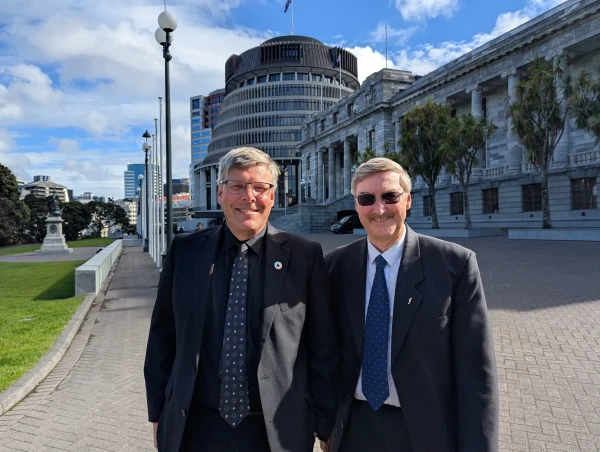
Prof Peter Dearden and Dr John Caradus at Parliament
Genetic engineering, primary production, and pest control
Distinguished Professor Peter Dearden, University of Otago
"My research lab works to develop genetic controls for invasive pests that are harmful to Aotearoa New Zealand's environment and industries.
Invasive social wasps are a problem for New Zealand. Social wasps are the ones that live in hives or nests and come out angrily when you mow the lawn over their nest. Invasive social wasps cost the country upwards of $133 million per year, damage our tourism and beekeeping industries, and reduce the pollination of clover by bees, by eating bees. In some forests, they strip away all the native insects, leaving little for our birds to eat.
Living socially gives these wasps a huge advantage over other insects, allowing them, if nothing eats or kills them, to build up to huge numbers. Due to a lack of natural competition here, New Zealand now has the densest wasp population in the world. Some places have up to 50 nests (with up to 1000 wasps in each nest) per hectare. If you have been to our West Coast Beech forests in Summer, you will know what that means – there are more wasps in those forests than anything else.
So, what can we do about it? This is a hard problem – we have tried lots of things, but the huge populations and the wasps' ability to spread easily make it hard for anything to work.
My research team is developing genetic biocontrol for wasps (in EPA-approved containment). This work is funded by the Ministry of Business, Innovation and Employment. We want to produce a genetic system called a gene drive. Gene drives control pest populations through the use of a clever genetic trick to push a mutation in the genome of the pest, which causes something that is damaging to the pest, like infertility, through the wasp population. If it works, this technology is self-sustaining and should suppress the pest’s populations. So far so good, but to do this we have to make a transgenic wasp (a wasp carrying a piece of DNA from another species). This technology only works this way.
Gene drives have been developed in fruit flies, in malaria-carrying mosquitos, and in mice, and are very effective. Releases of gene drives targeting malaria are slated to occur overseas relatively soon. The problem is mosquitos and fruit flies are about 350 million years distant from wasps (the same evolutionary distance between humans and amphibians). This makes it really hard to develop gene drives for wasps, as we have never investigated the basic biology of these species in this way.
Our project is making progress, however, and as we proceed, we are generating the knowledge needed for this technology to work.
Other arms of our research programme are investigating the social and cultural aspects of gene drive technologies targeting wasps, especially determining if these technologies—if we prove them biologically possible in wasps— are culturally and socially acceptable in Aotearoa New Zealand.
We work on wasps, but these are far from the only insect problem we have here. Aotearoa New Zealand has been invaded by over 2000 species of insects, more than the count for all of Europe. These insects are being joined year on year by other pests, such as varroa mites, sawflies, aphids, and, most recently, hornets. Gene drives are a technology we need to investigate to see if they are safe, effective and fit-for-purpose. We need to know if they are a key tool in our future control on invasive species, or, if they are not biologically, culturally or socially acceptable, to be discarded as an option while we race to head off the insect invasion of our country."
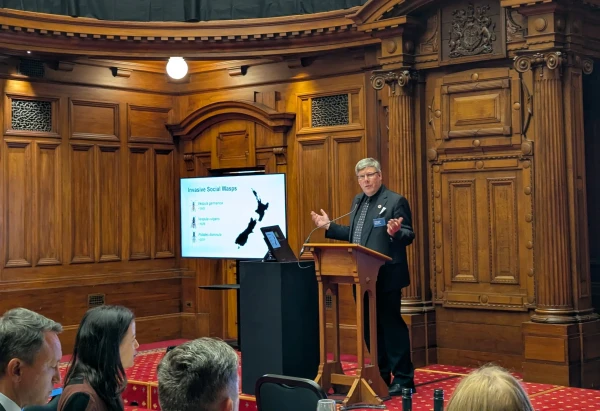
Prof Dearden presents to MPs.
GM and non-GM co-existence in the New Zealand context
Dr John Caradus FRSNZ, Grasslanz Technology Ltd
"There are many challenges impacting managed agricultural systems, be they economic, environmental, and societal issues. Plant breeding is one option to solve some of these challenges, and is considered to have begun over 10,000 years ago through the gradual domestication of wild plant species. Over time the ability of humankind to manipulate plant characteristics has become more targeted and precise. Plant mutations — whether spontaneous or engineered — are at the heart of food security and agricultural innovation. The important question is not how a mutation arises but whether it makes food safer, more nutritious, or more resilient to climate stress. If yes, the mechanism by which it arose may be less important than the benefits it provides. Over 3000 plant varieties had been generated since 1950 using unregulated chemical or ionising radiation.
New Zealand’s Organic Standards Regulations are possibly the strictest for organic farming worldwide. Zero tolerance of contamination by plants generated using unregulated ionising radiation or any regulated gene altering agents is a challenge. Unintentional genetically modified (GM) presence in seed lots is often referred to as adventitious presence. In Australia, South Africa, Brazil, and China 1% unintentional GM seed is permitted in non-GM seed lots, while it is 5% in US, Canada, and Japan, and 0.9% in European Union. The regulated 0% tolerance is undoubtedly a barrier to adoption of GM technologies in New Zealand.
Co-existence ensures that different primary production systems can exist concurrently or in the vicinity of each other and can be managed in such a way that they affect each other as little as possible. Some principles for a co-existence framework include: the ability to detect the transgene or its products in food or feed commodities, understanding the mechanism and extent of pollen (gene) flow and seed dispersal, management interventions that can effectively 'separate' GM and non-GM crops and prevent gene flow between them, the extent of agronomic or nutritional equivalence of the GM-derived trait compared with non-GM crops, and the segregation of products upon entering the manufacturing, marketing and supply chain.
Market Choice is an industry-led programme in Australia that enables GM and non-GM crops to co-exist. It involves regulatory approvals as appropriate, a knowledge of market risk assessment and approvals, and unintended presence contingency plan. It is managed by the industry. Most EU member states have adopted internal co-existence rules. However, Spain (which does grow GM maize) has no co-existence policy and manages co-existence at the farm level by following the good agricultural practices defined by the National Association of Seed Breeders. Note that many countries who use GMOs (e.g., Australia, USA, Spain, Canada) have industry managed co-existence, while countries who do not use GMOs (e.g., rest of Europe) have government regulation. Co-existence of GM technology is possibly best managed by industry.
Co-existence has been achieved through using some or all of the following: appropriate planting times, crop placement, maintaining separation distances to limit pollen dispersal and seed movement, physical containment, proper post-harvest handling, including cleaning equipment and storage facilities, and most importantly good communication, use of scientific approaches and practical quality management measures. GM technologies like many non-GM technologies can bring risks, but these are monitored and quantified, allowing decisions to be made about commercial, societal and environmental benefits versus real risks.
What is needed? An open evidence-based debate involving society, plus industry and political leaders about benefits and risks of GM technologies."
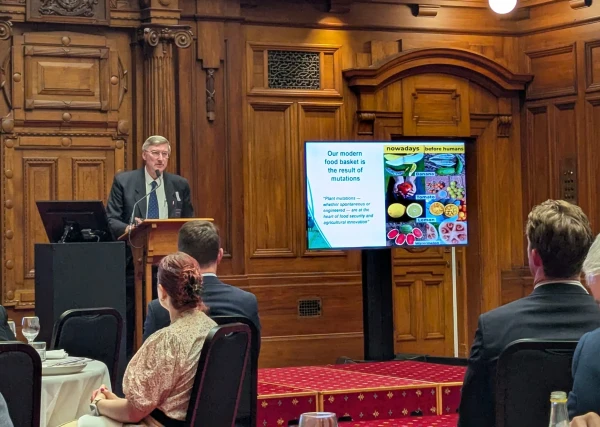
Dr Caradus presenting to MPs.