
Renewable energy: the storage challenge
At the Parliamentary Science Forum held in April, Professor Aaron Marshall talked about the science behind liquid electricity, a new approach to clean energy storage and security, and Dr Peter Rendel spoke about the potential of geological energy storage beneath Taranaki.
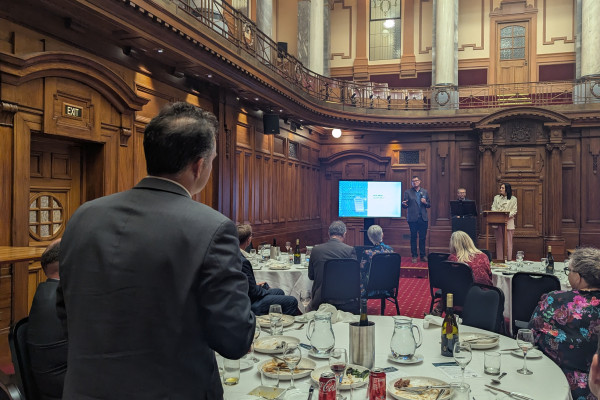
Prof Marshall and Dr Rendel answering questions from Members of Parliament, with Dr Parmjeet Parmar MP
'Liquid electricity': The science behind a new approach to clean energy storage and security
Professor Aaron Marshall, Te Whare Wānanga o Waitaha – the University of Canterbury and Ternary Kinetics Ltd
"The problem
New Zealand consistently generates over 85% of its electricity from renewables. But electricity is only part of the picture with around 60% of the country’s total energy still coming from fossil fuels. The problem is not generating clean energy – it's storing it and moving it to the industries and vehicles that need it.
Why current options fall short
All energy storage loses energy in the round trip – this is thermodynamics, not an engineering problem waiting to be solved. Batteries achieve ~90% round-trip efficiency but have roughly one-twentieth the energy density of petrol, limited cycle life, difficult recycling, and depend on critical minerals concentrated in a small number of countries. Hydrogen is energy-dense by weight but expensive to produce and extremely hard to store and transport. A full hydrogen round trip (electrolysis, compression, fuel cell) sits around 40% efficiency. After two decades of development, these fundamentals have not changed.
A third approach: liquid electricity
Ternary Energy, a NZ-based company, has developed the world’s first system for storing renewable electricity in a safe, pumpable liquid with ten times the energy density of batteries. Two proprietary devices make this work. An on-vehicle electrochemical cell convertor that changes the liquid from one form to another and releases electricity to drive the electric motors. The discharged liquid is returned to another electrochemical system (stationary, at a renewable energy source) where it is recharged back to the original liquid using only electricity and water. The liquids cycle in a closed loop – nothing is consumed except renewable electricity.
Why it matters for New Zealand
The liquid carrier can be stored in conventional tanks, moved by existing tanker trucks, and dispensed at existing fuel depots – no new grid, no cryogenics, no high-pressure pipelines. Storage can be distributed around the country next to demand rather than centralised in a single location. Storing the equivalent of the Lake Onslow project (5,000 GWh) could be achieved by distributing this energy-carrying liquid across existing fuel terminals, at a fraction of the cost. The same infrastructure could also power transport, maritime industries, and agriculture at a cost modelled to be half that of diesel – offering New Zealand a path to energy security without new dependencies on imported fuels or critical minerals.
Key message
Electrification is inevitable – the challenge is moving the electricity to where it is needed. Liquid electricity, developed in New Zealand, is a potential solution to both storage and distribution."
RELATED CONTENT
Prof Marshall was awarded the 2025 Pickering Medal by the Society for reimagining materials and energy for sustainability.
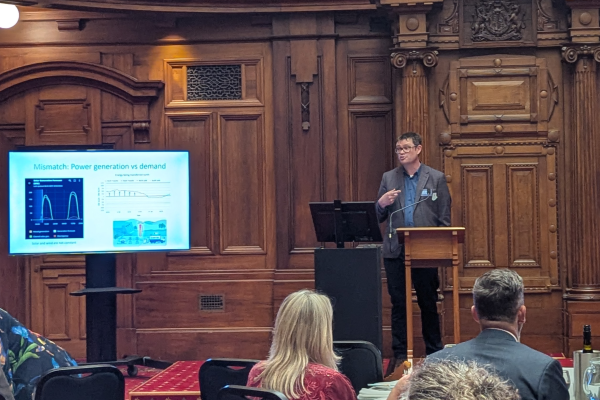
Prof Marshall presents to MPs.
New Zealand’s missing middle – the potential energy storage hidden deep in the reservoirs of Taranaki
Dr Peter Rendel, Earth Sciences New Zealand
"New Zealand can transform Taranaki’s depleted oil and gas reservoirs into much-needed grid storage and help the sector transition at the same time."
Dr Rendel opened his talk by reframing New Zealand’s energy storage challenge, saying that the problem isn’t the technology available, but a blind spot in the middle of our thinking.
He began by setting the context, explaining how New Zealand’s storage conversation has become polarised between short‑duration batteries and long‑term pumped hydro. Both are important, but Dr Rendel showed how this thinking could leave a growing vulnerability as wind and solar increase, particularly during multi‑day low‑generation periods. This, he argued, is the 'missing middle' in the energy system.
From there, he transitioned to the core proposition that could help bridge the gap: geological energy storage. Dr Rendel described how depleted reservoirs are already proven storage assets, capable of safely holding large amounts of gas and oil underground. Simply, they can be reused by reinjecting compressed air or gas that then can be used to power turbines when the grid needs it. He explained that formations are technically well-understood and uniquely suited to repurposing, stressing that "this is about reusing infrastructure, industry, and knowledge we already have".
He said New Zealand could see that "our depleted oil and gas assets are not legacy liabilities, but rather an essential future sector".
The talk then moved into scale and system value. Dr Rendel quantified the opportunity: Taranaki’s onshore depleted reservoirs could store up to 70 GWh of energy. This is enough to power every home in New Zealand for around two days. He emphasised that this storage would sit close to demand sources in the North Island and existing transmission, making it especially valuable for energy security and resilience.
He also explained why we haven’t heard about this before. Simply, the technology was tested at pilot scale in the US for decades and it showed clear technical feasibility, but the economics of using gas was cheaper. Now it’s clear the economics and needs for energy sovereignty are changing across the world. Germany, Netherlands, Norway, and the UK are already assessing their reservoir storage potential. Australia is making progress with evaluating a commercial proposal. He said that with all of the world sitting on the starting line "New Zealand has the rare opportunity to become a leader in energy storage technology" with Taranaki’s potential.
Dr Rendel concluded by zooming back out to the strategic level, outlining what would be needed to turn the concept into reality. New Zealand needs coordinated planning, policy support, and early action.
His closing message was clear: "the solution to New Zealand’s storage gap may already be beneath our feet, and the real risk is not technical feasibility, but hesitation".
He concluded with a call to action, "this is not 20 years away, we could start tomorrow".
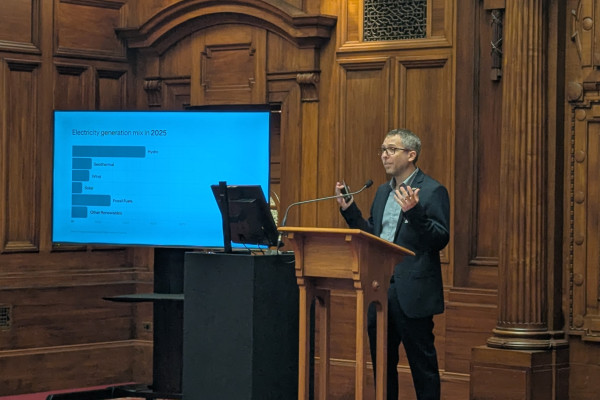
Dr Rendel presents to MPs.