
Supporting our ageing population
How to best support our ageing population was the topic of the March Parliamentary Science Forum. Professor Ngaire Kerse shared an overview of research into elder support in Aotearoa, highlighting challenges and opportunities, and Dr Joanna Hikaka talked about health equity for older Māori.
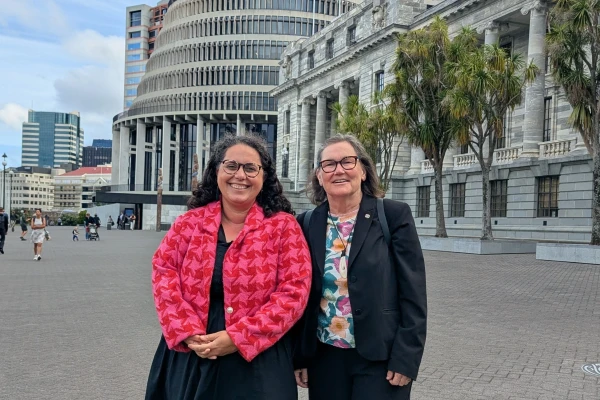
Dr Joanna Hikaka and Professor Ngaire Kerse in front of the Beehive
Ageing in Aotearoa: What is actually happening?
Professor Ngaire Kerse, Centre for Co-Created Ageing Research, Waipapa Taumata Rau – the University of Auckland
The proportion of older people in Aotearoa New Zealand is increasing. The Office for Seniors predicts that in 2034 we will have nearly 600,000 people in the 65-74 age bracket, 430,000 aged 75-84, and 178,000 aged 85 and over. To best support our oldest citizens and society as a whole, we need to understand their wants and needs.
Professor Ngaire Kerse is the principal investigator of the Te Puāwaitanga O Ngā Tapuwae Kia Ora Tonu | Life and Living in Advanced Age, a Cohort Study in New Zealand. The research followed 500 Pākehā aged 85 and 400 Māori aged 80–90 in 2010 for 10 years to learn about what life looks like for the oldest New Zealanders.
Prof Kerse busted some persistent myths about older people with facts including:
- most of the cohort lived independently
- participants make valuable contributions to their communities, including providing whanau support and caregiving (about a third of participants), volunteering and working (20%)
- it is not a given that people in this age group experience declines in their health and functionality. More than half stay the same or improve over a year
- Māori are half as likely as Pākehā to use residential care in old age. Māori report feeling culturally unsafe in such settings.
Data from the study show that about 40% received government-funded community support, with non-Māori women more able to access this than other groups, and this access remained relatively stable as people aged. All demographic groups experienced more informal support from whānau over time. Men and Māori women were more likely to receive informal support than other groups.
Whānau and families make a large contribution to society by providing care at home. Prof Kerse estimates that the value of informal care for the 220,000 citizens aged 80+ years in 2025 was $3.6 billion. Those living at home with whānau had high levels of disability and were more likely to report that they thought they could have received more practical and emotional support than they received, indicting that more carer support is needed.
Frailty in old age is preventable. Easy interventions can prevent falls, loss of mobility, and cognitive decline. Prof Kerse shared positive results from the SAYGO and Senior Chef classes[1] which are locally designed and delivered, to reduce the progression of frailty and improve function for older people living in the community in New Zealand.
"Older people are here to stay," Prof Kerse emphasised. There are currently 20 New Zealands aged 100+ who are still driving! They make significant contributions to society, community, family and whānau, even in advanced age. Opportunities for prevention at all stages of ageing will improve independence and intersectoral support is needed for older people to flourish.
Prof Kerse welcomes correspondence.
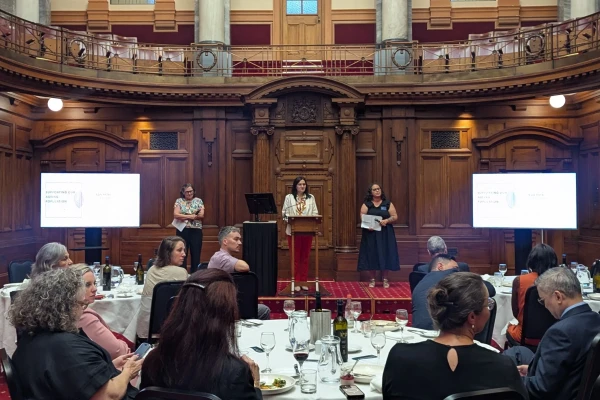
Professor Kerse and Dr Hikaka answering questions from Members of Parliament, with Dr Parmjeet Parmar MP
Planning for Māori futures: ageing with mana
Dr Joanna Hikaka (Ngāruahine), Centre for Co-Created Ageing Research, Waipapa Taumata Rau – the University of Auckland
"The number of older people in New Zealand is increasing rapidly and the number of older Māori is increasing at twice the rate of Pākehā. This demographic shift makes it even more vital that older Māori can access culturally appropriate, affordable, and effective health and aged care services.
Instead, older Māori continue to experience persistent inequities in health, access to services, and overall wellbeing. These inequities are cumulative, shaped across the life course and become more visible in older age. Māori experience fewer years in good health, develop frailty earlier, and face barriers to accessing healthcare, including medicines and new treatments. Economic disadvantage further compounds these issues. On average, Māori receive significantly fewer years of superannuation, and many enter older age with fewer financial resources, lower home ownership, and ongoing work obligations. These factors may limit choice and independence in later life. These are not isolated issues but reflect long-standing structural inequities that shape how Māori experience ageing.
Māori flourishing in later life – a decade of research
Decades of research provides us with evidence of what supports flourishing in older life.
First, holistic models of care are essential. Wellbeing includes physical, mental, spiritual, cultural, and social dimensions.
Second, older Māori make substantial contributions to society, including caregiving, volunteering, and maintaining cultural knowledge. These roles strengthen communities and provide significant social and economic value and need to be encourage and supported in older life.
Third, whānau play a critical role in supporting older people and this role and resource needs to be recognised.
Finally, care that reflects Māori values leads to better outcomes. The evidence consistently shows that culturally anchored, relationship-based care strengthens wellbeing and supports sustainable health and social systems.
Pathways to ageing with mana
Mana, often described as power, prestige, and authority, is a collective and relational concept upheld through whakapapa, relationships, and community. There are many Māori-led models that demonstrate what 'ageing with mana' can look like. Initiatives such as Rauawaawa Kaumātua Charitable Trust provide holistic, community-based services and housing designed by and for kaumātua, supporting independence and connection. Taurite Tū, a Māori-led strength and balance initiative grounded in Māori practices, has shown measurable improvements in physical health and reductions in falls, alongside social and cultural benefits, delivering positive outcomes for individuals and whānau.
Emerging work in Wairoa, following Cyclone Gabrielle, illustrates how community-led, evidence-informed responses can address urgent needs while building long-term solutions. Across these examples, common elements include kaumātua leadership, co-design, cross-sector collaboration, and measurable health, social, and economic benefits.
Moving forward: system change to support 'ageing with mana'
While evidence for effective models exist, current system settings do not adequately support equitable ageing for all New Zealanders. Funding remains fragmented, investment in kaupapa Māori providers is limited, and a coordinated, cross-sector response is needed.
Achieving ageing with mana requires aligning policy, health, housing, and social systems to support holistic, culturally grounded care. Supporting older Māori to age with mana means enabling autonomy, strengthening whānau, and ensuring care systems reflect Māori values. The pathway forward is clear: co-design with kaumātua, invest in holistic and culturally grounded approaches, engage and resource whānau, and take coordinated action. In doing so, Aotearoa can create an aged care system that improves outcomes for Māori and benefits the entire country."