
News
Published 9 December 2025Breaking the limit: How Dr Nate Davis is changing the solar game
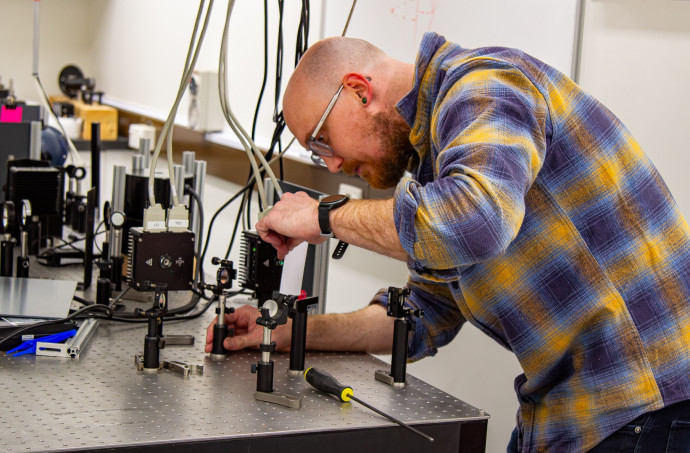
Determination and pivoting to new approaches have allowed Dr Nathaniel Davis' fundamental research on solar energy, supported by a Marsden Fund grant and a Rutherford Discovery Fellowship, to now be close to commercialisation. His new solar cells can break the known limits of electricity generation from sunlight and look set to revolutionise the solar power industry.
After exploring many potential solutions for more efficient solar energy, Dr Nate Davis is now developing a new type of solar cell using perovskites, a class of crystalline materials which he believes have the potential to break the Detailed‑Balance Limit – a limit researchers have been trying to find an effective way to break for over 50 years.
The Detailed-Balance Limit defines the maximum amount of electricity that can be generated from a unit of sunlight.
Over the last six years, Nate has tried all sorts of ways to get past this pesky limit. With his latest approach, he’s now steps away from being able to commercialise a solar panel that has the potential to cut costs and revolutionise the $350 billion solar industry.
His research has been supported with a Science for Technological Innovation National Science Challenge grant, a Marsden Fund Fast-Start grant, and an MBIE Smart Idea grant, followed by a Rutherford Discovery Fellowship.
He shares some key steps in his research journey:
In 2019, Nate began exploring the development of luminescent solar concentrators [LSCs] to allow for more efficient solar energy collection with the support of a National Science Challenge grant.
LSCs are like the 'sheepdogs of the solar world'; they make sure as much of the light as possible is usable, herding it into a pen, being the solar cell. But a rapid decrease in costs of solar cell technology meant that LSCs were no longer commercially viable.
The next solution that Nate explored was hybrid nano-materials, a combination of a nanoparticle and a dye. This system is like a hybrid car –both parts, the nanoparticle (quantum dot) and dye, together make a more efficient solar panel.
“Quantum dots are special types of nanoparticles made of semiconductor materials that won the Nobel Prize for chemistry in 2023," Nate explains.
"They are super useful because of a lot of their properties, like colour and energy levels, for example, are easily controlled by changing their size and shape. This makes them useful in things like TVs and solar cells, to medical imaging agents and catalysts."
In principle, the hybrid system works, but there’s a catch — hybrid materials, like their hybrid car counterparts, are more complicated to make. The complex fabrication and quality control processes required for hybrid nanomaterials meant that Nate had look somewhere else, again.
Next up, he looked to a quirk of the quantum world — multiple exciton generation process like singlet fission. Excitons and charges are the building blocks of electricity in a solar cell, like petrol is a building block of power in a car.
Excitons and charges are formed from light; they then move through the solar cell material and pass on their energy to electrical contacts in a solar cell. Normally, one piece of light equals one electron; in singlet fission, you get two excitons for one piece of light, and so more electricity for less.
The trick with singlet fission is high-energy light is needed to get it working. Nate explored singlet fission in a promising material, crystalline perovskites. Through careful optimisation, Nate showed that singlet fission can be used to generate more than one electron from each piece of light, which could lead to a massive boost in the efficiency of the solar cell, past the pesky Detailed‑Balance Limit.
With lab testing, he and his team have finally found a solution with the potential to double energy capture in solar panels.
“We’ve made a system which can break this fundamental Detailed-Balance limit. Everyone’s been trying to do that for 50 years,” Nate says.
He’s now months away from filing international patents. Nate has plans to take his highly efficient solar panel to the market soon, but needs investors to make it a reality and scale up his solar panel from its current thumbnail size.
This next stage is still quite a challenge with our current commercialisation systems and settings – as money is needed for both polishing the science and developing the industry, including fabrication.
Despite these challenges, Nate remains optimistic about the technology and its seemingly bright future.