
News
Published 5 February 2026Waitangi Day Q&A: 50 Years of The Waitangi Tribunal – Whakamana i Te Tiriti
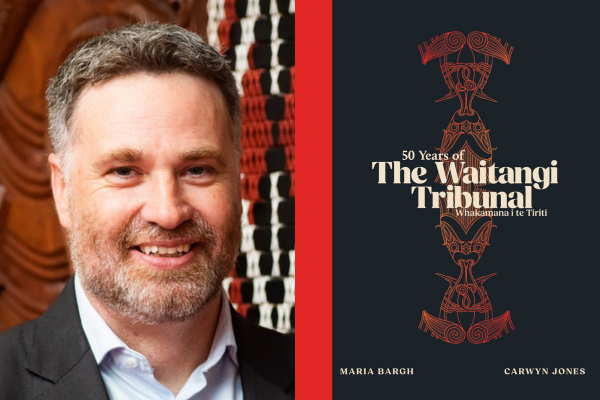
In recognition of Waitangi Day this year, we spoke with Dr Carwyn Jones FRSNZ (Ngāti Kahungunu, Te Aitanga-a-Māhaki) about the recently released book he co-edited with Professor Maria Bargh (Te Arawa, Ngāti Awa).
The book 50 Years of The Waitangi Tribunal – Whakamana i Te Tiriti has recently been announced as having made it onto the Ockham New Zealand Book Awards longlist.
Why is it important that we understand the Waitangi Tribunal?
The Waitangi Tribunal plays a really important role in Aotearoa. It plays a key role in keeping the Crown accountable to the promises made in te Tiriti. Its bicultural process and membership has been truly groundbreaking for a body such as this. It is particularly important that we understand the Tribunal at this moment in time, when Māori rights under te Tiriti are being challenged and the Tribunal itself is under review. If we don’t understand the purpose of the Tribunal, its relevance to current law and policy, or the value of having expert Tribunal members of high standing in the community, whose independence is protected, then we risk undermining, not only the Tribunal’s effectiveness, but the legitimacy of our foundational constitutional document.
What inspired you and Maria Bargh to compile 50 Years of The Waitangi Tribunal – Whakamana i Te Tiriti?
50 years is obviously an important milestone, and it seemed like an appropriate point to take stock of the Tribunal’s work. We wanted to give people a sense of the findings and recommendations that the Tribunal has already made as an important foundation for how we address current and future policy challenges. As editors, we were so pleased to be able to bring together an amazing group of Māori contributors to share their expertise in this collection.
What's one important thing everyone should know about the Waitangi Tribunal?
The Waitangi Tribunal is not just about historical land claims. When it was first set up in 1975, it couldn’t inquire into Crown actions that took place before 1975. That is, its purpose was to focus on contemporary policy and practice. In addition to its historical inquiries, the Tribunal has produced significant reports on everything from Te Reo Māori to the policy underpinning the Foreshore and Seabed Act to health services and outcomes.
Did you discover anything unexpected in the process of compiling this book?
This is perhaps not so much unexpected, but something that was really brought home to me when I was working on the book was just what an immense impact the Waitangi Tribunal has had on our understanding of our history, our society, and especially of te Tiriti and the relationship that it created. From today’s perspective, is hard to comprehend just how invisible te Tiriti and Māori rights were. While there is still a lot of work to do, the public education provided by 50 years of carefully researched and reasoned Tribunal reports has enabled us to have discussions and make progress in many areas of public life that would have been unthinkable 50 years ago.
Do you have anything else to add?
The effectiveness of the Waitangi Tribunal is a tribute to those politicians who had the courage to set it up, the Tribunal members who had the vision to ensure it continued to evolve to meet the need of the country, and, most of all, the claimants with their determination for justice and their commitment to engage in good faith to give effect to the relationship in te Tiriti.