
News
Published 3 December 2025Two students will represent Aotearoa New Zealand at the International Science and Engineering Fair
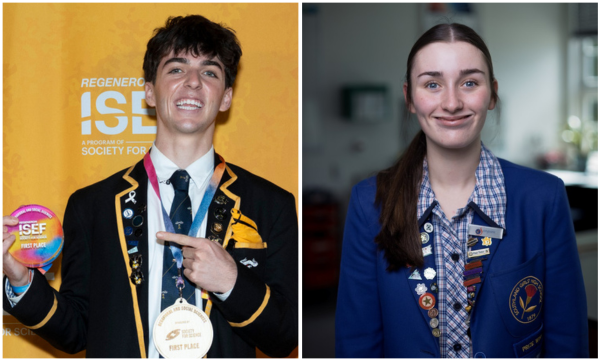
Two students have demonstrated their curiosity, creativity, dedication, and investigative skills in outstanding science projects that have been judged as the best in Aotearoa New Zealand this year.
Jesse Rumball-Smith and Sophie Ineson have been selected as our representatives for the International Science and Engineering Fair in the United States of America in May 2026.
The Royal Society Te Apārangi assembled a team of judges with expertise in science teaching, ethics, and research, and gave them the difficult task of deciding which students should travel to the international competition. Seven science projects, by students in Years 11, 12, and 13, were put forward by regional science fairs around Aotearoa New Zealand. The judges interviewed a shortlist and chose two outstanding students as the best candidates to compete in the international competition.
Jesse Rumball-Smith, a year 13 student at Wellington College, explored an innovative idea to develop New Zealand wool into a textile that can passively capture carbon dioxide. Jesse’s project, Wool that Breathes, involved growing porous crystalline microstructures on the wool to capture the CO2, with the goal of demonstrating a clear pathway and proof of concept for passive carbon-capturing textiles. The potential of this technology would be to not only reduce emissions, but also lift the value of New Zealand wool.
Sophie Ineson, a year 12 student at Southland Girls’ High School, investigated the hidden biochemical effects of microplastics on the digestive health of Antarctica’s iconic seabirds. Sophie’s project, Disrupted Digestion, compared the effects of different microplastics on digestive enzymes, such as the enzymes that break down starch and fats. She tested this by simulating the conditions in the small intestines of king penguins.
The judges also awarded a Special Prize (3rd place), for innovation, technical skill, and potential for impact, to Ishaan Badiyani and Siddhesh Kalyanasundaram. Their project Wave Safe investigated whether an AI-powered drone system could rapidly detect and save people at risk of drowning using autonomously deployed flotation aids.
The judges awarded another Special Prize (4th place), for in-depth understanding and demonstration of mathematics and algorithms, to Jenny Petegem-Thach, whose project Sliding Puzzles and Heuristics compared the performance of different algorithms and heuristics for navigating search-trees, with the aim of optimising decisionmaking by artificial intelligence.
The judges also commended:
- Jeremy Billing for Fight of the kiwi – a video game designed to advance the goal of Predator Free 2050 (Special Prize for for innovation and excellence in software engineering).
- Thomas Bannister for Epipen Locator – a tool to help people locate treatments for severe allergic reactions (Special Prize for outstanding demonstration of science education addressing important issues).
- Luka Manley for Wind Tunnel – a model that can be used to explore the principles of fluid dynamics and physics (Special Prize for showing curiosity in science and seeking innovative solutions in science education).
The students who made it to this shortlist had competed in the Aurora Energy Otago Science & Technology Fair, the NIWA Wellington Regional Science and Technology Fair, the South and East Auckland Science and Technology Fair, the Southland Science & Technology Fair, and Te Tūkohu Ngāwhā Mātauranga Māori Science and Design Fair.
President of the Royal Society Te Apārangi, Distinguished Professor Dame Jane Harding DNZM FRSNZ FRACP says that science fairs challenge and inspire students to excellence, and that the Society is very pleased to be able to help students to represent Aotearoa New Zealand internationally.
“Science and technology fairs offer students valuable opportunities to apply scientific investigation to real-world problems, while strengthening their critical thinking, creativity, and communication skills. Fairs provide a wonderful opportunity for our future scientists, technologists, and engineers to develop their skills and become inspired.”
“Congratulations to the winning students, and a huge thanks to the expert members of our new Scientific Review Committee, to all the judges, teachers, sponsors, and other people involved in supporting science fairs and competitors around the country.”
The members of the Society’s Scientific Review Committee were:
- Amanda Hood (Chair), Teacher at St Patrick's College, Wellington, and Co-Organiser of the NIWA Wellington Regional Science and Technology Fair
- Stacey Parbhu, Team Manager, Animal Welfare Systems, Ministry for Primary Industries, Board Member for the Australian & New Zealand Council for the Care of Animals in Research and Teaching
- Jordon Lima, PhD Candidate, Centre for Translational Cancer Research, University of Otago – Ōtākou Whakaihu Waka
- Dr Vithya Yogarajan, Research Fellow, Division of Health, University of Waikato – Te Whare Wananga o Waikato
Both the winning students have had other successes. This is Jesse’s second time attending the Regeneron International Science and Engineering Fair. Last year, his project Building a Better Backseat Driver, a road-safety app, placed 1st in the Behavioral and Social Sciences category, winning US$6,000 and US$1,000 for his school and his regional science fair. Sophie was recently awarded the Prime Minister’s Space Prize for Student Endeavour for her project Hydro Heal, in which she designed new hydrogel wound-dressings for astronauts to promote healing and prevent infection. She received NZ$50,000 towards her tertiary studies.
Members of the Society’s Scientific Review Committee will mentor Sophie and Jesse to get their projects ready for the international fair, and Amanda Hood will travel with them to Phoenix, Arizona, to support them during the competition.