
News
Published 6 March 2026International Women's Day 2026
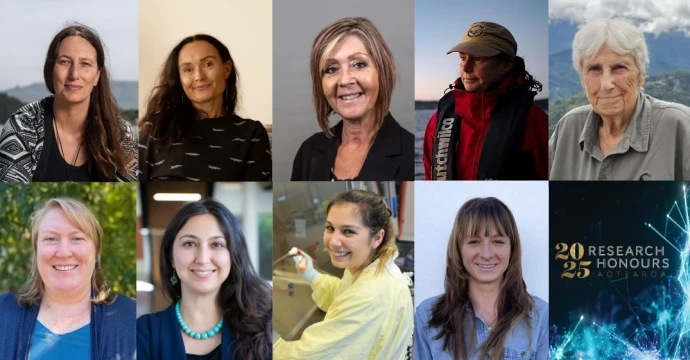
For International Women's Day, we are featuring amazing wāhine who won medals and awards from the Society last year. Who will you nominate for Research Honours Aotearoa this year?!
International Women's Day (IWD), on Sunday, 8 March 2026, is an important opportunity to focus on women's advancement. IWD2026 will feature events, awards, rallies, and performances around the world.
Last year, at our Research Honours Aotearoa, the Society presented medals and awards to some inspirational wāhine. Read on to learn more about the outstanding contributions of these women...
Professor Tahu Kukutai FRSNZ (Ngāti Tīpā, Ngāti Mahanga, Ngāti Kinohaku, Ngāti Ngawaero, Te Aupōuri), of Te Whare Wānanga o Waikato – the University of Waikato, won the 2025 Te Rangi Hiroa Medal for world-leading contributions to Indigenous data sovereignty and Indigenous demography. Notably, it is 100 years since Te Rangi Hiroa, Sir Peter Buck KCMG DSO FRSNZ, became the Society’s first Māori Fellow.
Watch a video of Tahu talking about demography and data sovereignty:
The groundbreaking ideas of Distinguished Professor Jacinta Ruru MNZM FRSNZ (Raukawa, Ngāti Ranginui), of Ōtākou Whakaihu Waka – the University of Otago, are shaping legal interpretations of the rights and responsibilities of Indigenous people around the world, particularly in land and water rights. Her internationally acclaimed research is recognised by the 2025 Humanities Aronui Medal.
Associate Professor Sonja Macfarlane FRSNZ and the team at Te Kāhui-a-Te-Rū-Rangahau, of the School of Teacher Education at Te Whare Wānanga o Waitaha – the University of Canterbury, won the 2025 Te Rangaunua Hiranga Māori Medal for their work to enable culturally responsive teaching in Aotearoa New Zealand.
A marine ecologist and conservation biologist, Professor Rochelle Constantine ONZM, of Waipapa Taumata Rau – the University of Auckland, has led multidisciplinary teams studying endangered marine species – whales and dolphins in particular. On receiving the 2025 Fleming Medal, she said: “Our ocean space is 14 times larger than our landmass, but we don’t value it like we should. Whales are great messengers to get the public’s attention to talk about important ocean issues.”
Emeritus Professor Carolyn (Kim) King FRSNZ, of Te Whare Wānanga o Waikato – the University of Waikato, was awarded the 2025 Thomson Medal for her five decades as a researcher, author, editor, historian, and lecturer in zoology and ecology. Kim is a world authority on small mammals – especially stoats and weasels – both as invasive pests and as valued natives.
The Callaghan Medal is awarded annually for an outstanding contribution to science communication and raising public awareness of the value of science. The 2025 Callaghan Medal was won by Professor Margaret Stanley, of Waipapa Taumata Rau – the University of Auckland. Margaret is an accomplished ecologist focused on trying to understand and stop some of the key threats to biodiversity – particularly invasive species and urban development.
Watch a video of Kim and Margaret talking about their research and communication on conserving biodiversity:
Winning the 2025 Early Career Research Excellence Award for Social Sciences for her research, Dr Ayca Arkilic, of Te Herenga Waka – Victoria University of Wellington, investigated how and why women have converted to Islam, and with what consequences for their citizenships, identities, and everyday challenges.
To aid development of personalised medicines for Māori women, Helena Abolins-Thompson (Ngāti Toarangatira, Ngāi Tahu), of Ōtākou Whakaihu Waka – the University of Otago (Wellington), has been redefining translational research with and for Indigenous communities. She won the 2025 Te Kōpūnui Māori Research Award for her research. Her most recent study focused on cancer and cardiovascular diseases in Māori women.
Sofia Rauzi, from Te Whare Wānanga o Waikato – the University of Waikato, won the 2025 Hatherton Award for her paper that helps to answer a long-standing question about historic climate change through lithium isotopes in sedimentary rocks. Sofia’s research focused on the puzzle of why, after massive volcanic eruptions in the Permian period caused catastrophic climate change, the high temperatures persisted for 5 million years longer than would be expected.
#InternationalWomensDay, #IWD2026 Everyone, everywhere, can play a part!
Nominations are open for Research Honours Aotearoa 2026 until 31 March 2026. Who will you nominate?!