News
Published 11 March 2026NZJCHS Call for Papers: Special issue on Embryo, Stone, and Fruit Development in Crops: Integrating Breeding, Genetics, and Multi-Omics
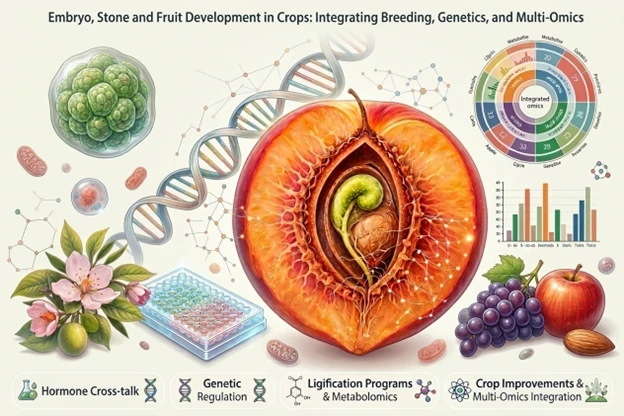
The New Zealand Journal of Crop and Horticultural Science invites submissions for a forthcoming Special Issue titled Embryo, Stone, and Fruit Development in Crops: Integrating Breeding, Genetics, and Multi-Omics.
Fleshy fruits are often discussed as though they share a common developmental logic, yet their architectures, and therefore their biological constraints, are fundamentally different. In drupes, embryo and seed development are tightly coordinated with endocarp differentiation, where the inner pericarp undergoes cell specification, lignification, and programmed cell death to form the stone. In berries, pomes, and other fleshy fruits, embryo-maternal-fruit interactions follow altered differentiation trajectories that determine varied fruit set, size, composition, ripening, and stress resilience.
This Special Issue of the New Zealand Journal of Crop and Horticultural Science focuses on embryo-maternal-fruit communication as a unifying framework across crops, with a dedicated spotlight on the drupe “pit-to-pulp” axis. Across these diverse fruit systems, a common biological principle emerges: developing seeds act as central hubs for signaling and resource allocation, while maternal tissues interpret these cues to determine fruit growth, reproductive success, and resilience.
We invite mechanistic and translational studies linking genetic variation to regulatory networks, including hormone crosstalk (auxin-GA-ABA-ethylene), transcriptional and epigenetic control, cell-wall and lignification programs, and metabolite transport, integrated with environmental drivers (temperature, water, nutrition). We especially encourage multi-omics and quantitative approaches (genomics, transcriptomics, metabolomics, proteomics, spatial, and integrative modeling) along with functional evidence that enable causal insight, trait prediction, and breeding for improved yield, quality, processing traits, and resilience.
Topics of Interest
Submissions may include, but are not limited to, the following themes:
Developmental Biology
- Embryo–seed–fruit developmental coordination
- Maternal–embryo communication pathways
- Endocarp differentiation and stone formation
- Fruit tissue specification and developmental patterning
Molecular and Genetic Regulation
- Hormonal cross-talk (auxin, gibberellin, ABA, ethylene, cytokinin)
- Transcriptional and epigenetic regulation of fruit development
- Gene regulatory networks controlling seed and fruit traits
Structural and Metabolic Processes
- Cell wall biosynthesis and lignification pathways
- Metabolite transport and nutrient allocation during seed development
- Regulation of fruit composition and ripening
Omics and Systems Biology
- Genomics and quantitative genetics of fruit traits
- Transcriptomics and spatial transcriptomics
- Proteomics and metabolomics
- Multi-omics integration and predictive modelling
Submission information
Please send a preliminary title, indicative author list, affiliations and a short descriptive paragraph outlining the scope of your proposed manuscript as soon as convenient to the Lead Guest Editor Dr Bilal Ahmad, at bilalahmad@caas.cn by 30 April 2026.
Authors will be notified of the result and formally invited for full submission by 31 May 2026. The anticipated manuscript submission deadline is 31 January 2027.
See Instructions for Authors on the journal homepage before making a formal submission to the New Zealand Journal of Crop and Horticultural Science through the journal’s online submission system if your Expression of Interest (EOI) is selected. During submission, authors should select the option indicating that their manuscript is intended for the Special Issue on Embryo, Stone, and Fruit Development in Crops.
Note that an invitation to submit does not guarantee acceptance for publication, which will depend on the outcome of the normal peer review process and authors meeting critical time schedules. Accepted papers will be published online individually with final citation details ahead of their inclusion in the Special Issue collection.
If the corresponding author is affiliated with a growing range of global institutions covered by a transformative agreement with Wiley, they may be eligible to publish their articles Open Access at no cost. Otherwise, publishing under the traditional subscription model is completely free.
Guest Editors
Dr Bilal Ahmad
Xinjiang Institute of Ecology and Geography, Chinese Academy of Sciences, China
bilalahmad@caas.cn
Dr Noor-ul Ain
Agricultural Genomics Institute at Shenzhen (AGIS), Chinese Academy of Agricultural Sciences, China
noorulainali001@gmail.com
Dr Vivek Yadav
Institute of Fruits and Vegetables, Xinjiang Academy of Agricultural Sciences, China
vivekyadav@nwafu.edu.cn