
AI: infrastructure and education
AI infrastructure and education was the topic of the Parliamentary Science Forum held in July. Nick Jones shared insights on the scientific pipeline, and the ongoing shift from AI as a tool to AI as the foundational infrastructure we operate within. Dr Mahsa McCauley (Mohaghegh) discussed AI in education as a capability challenge rather than a technology issue, outlining the skills, policy gaps, and literacy frameworks needed to empower teachers and students.
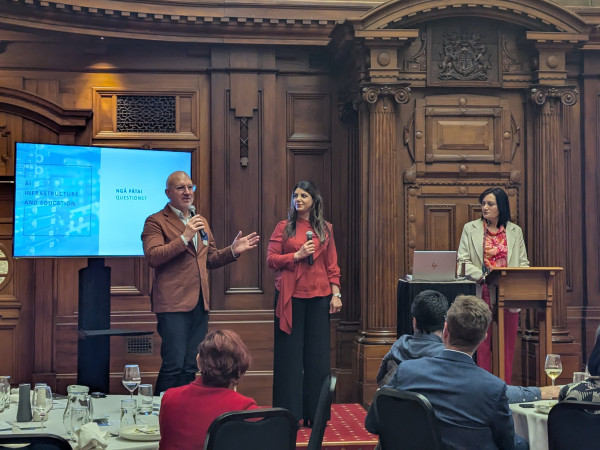
Mr Jones and Dr McCauley answering questions from MPs.
From tool to utility: AI as infrastructure for science
Nick Jones, Waipapa Taumata Rau | University of Auckland
"AI capabilities are now surpassing a human baseline of performance, with a widening gap between what AI can do and how prepared we are to manage it.” This was Nick Jones' opening message to MPs. Nick Jones argued that AI in science has moved decisively out of its experimental phase, and that the question facing New Zealand is no longer whether to adopt AI, but whether we build the sovereign capability and infrastructure to use it on our own terms. Nick spent fifteen years as founding Director of NeSI, so he came at this from the infrastructure side.
Nick's central point was simple: AI in science is no longer just something we experiment with, but is becoming something we depend on – AI as infrastructure, not just a tool. The 2024 Nobel Prizes marked the point of formal recognition. Geoffrey Hinton and John Hopfield shared the Physics prize for foundations laid in the 1980s that underpin modern neural networks. David Baker, Demis Hassabis and John Jumper shared the Chemistry prize for protein design and for AlphaFold, which broke a fifty-year challenge in predicting protein structures and was released free and open source. It is now used universally to accelerate drug development. Nick underlined that these prizes recognise four decades of groundwork completed before generative AI arrived in 2022.
The pace has compounded since. He described early 2025 as an inflection point, when models gained the ability to reason, use tools and run deep research, with a marked improvement in reliability. Research groups overseas are now moving from predictive models like AlphaFold to autonomous agents running research campaigns, and to self-driving laboratories that generate hypotheses and write their own code. Demis Hassabis recently described this as a pivotal moment in human history, comparable to the discovery of electricity or fire, at ten times the magnitude of the Industrial Revolution and at ten times the speed.
All of it rests on computing. AI hardware costs have risen 30 to 50% in 6 months, while agentic AI consumes far more infrastructure than the chatbot era did. Other countries are reorienting their investments. Monash University has invested A$60M in AI computing for its pharmaceutical pipeline and Australia has approved A$82M for AI supercomputing and data. The recently announced US$6B Genesis Mission in the United States will build four AI supercomputers, one of them a 100,000 GPU machine at Argonne National Laboratory, and connect labs and instruments into a single common AI platform across the nation. The rationale is that scientific output per unit of investment has been declining over the long term, and the goal is to double research productivity within ten years. "Progress is about taking a 10-year horizon and shortening it to 5 years or less," Nick said.
He was equally direct about the risks. "As AI subsumes more of our work, we are more and more dependent on it. I believe it is rapidly becoming critical infrastructure, with concerns around capability, autonomy, and sovereignty." The gap between commercial and open models is closing, raising new cybersecurity and biosecurity concerns.
His closing message was that the experimental phase is over. "We are now operating beyond a human baseline of performance that is set to change the very nature of research. New Zealand will not host the world's largest AI supercomputers and does not need to, but reaching the frontier through partnership requires sovereign capability at home: enough infrastructure to grow our expertise, people who can evaluate and implement AI across the sciences, and support for scientists adopting it." Done well, he argued, this is an opportunity to break through a productivity plateau in science and other industries, and to ensure our researchers can lead in the fields that matter to New Zealand.
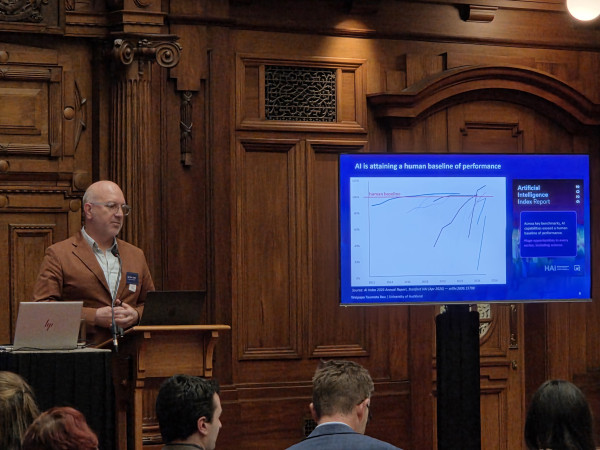
Mr Jones presenting to MPs.
AI and the Future of Education: Evidence, Ethics and the Art of Learning
Dr Mahsa McCauley (Mohaghegh), Te Wānanga Aronui o Tāmaki Makau Rau – Auckland University of Technology
"AI in education is neither saviour nor threat. It is both, and pretending otherwise is a mistake. Used well, AI personalises learning and gives teachers their time back. Used badly, it widens the gaps we already carry. The future of education turns on the choices we make now, not on the technology.
The tools are already in their hands
Students did not wait for policy. Around 86% of students worldwide now use AI in their studies, and the Stanford Human-Centred AI Index for 2026 puts university use at four in five. Roughly two-thirds of students say AI is essential to their academic success. The question in front of us is no longer whether to move quickly or slowly. It is whether this transformation is guided or left to govern itself.
Why this is not simply the next internet
It is tempting to treat AI as the internet arriving a second time, and to assume our institutions will absorb it as they did before. That underestimates it. The internet connected information; AI acts on it. Where the internet asked a person to search, decide and implement, AI can perceive, reason and execute. The difference is agency, not merely speed.
What government should do
Equity is the sharpest risk regarding AI’s use in education. The likeliest risk is a widening AI access gap: well-resourced schools acquire tools, training and safeguards, while under-resourced schools take whatever is free and unsupervised. Equity – through access to reliable, safe resources – has to be built in from the start and made an explicit funding rule, with money following need rather than whoever applies first.
The proper role for government is national direction with local flexibility. Set guidelines schools can rely on, fund training and infrastructure ahead of tools, and protect children's data with rules that mean something. Education should lead but cannot carry responsibility alone; data belongs with the privacy regulators, infrastructure with connectivity, procurement with its own standards. When no one owns the whole picture, it falls between the cracks. The instinct to ban AI until the rules exist is understandable but misguided, because a ban only drives use underground and out of sight. A better approach is interim guidance now, firm policy soon, and guardrails aimed at harms rather than at innovation.
Children's data is among the sharpest issues of all. Children cannot meaningfully consent, and a great many tools are built offshore under other countries' rules. We need clear standards on what is collected, where it is held, how long it is kept, and a firm limit on using children's data to train commercial models. Data sovereignty deserves a settled answer rather than a case-by-case guess, and Māori data governance cannot be an afterthought.
On assessment, detection tools are unreliable and we should not lean on them. The better answer is to design assessment so that the process, and not only the output, is what we measure. If an assignment can be finished entirely by a chatbot, the assignment was the problem. For teachers, the honest reassurance is that AI will not replace them: it can lift marking and administration off their plate, but relationship, motivation, and care cannot be automated.
Two levers remain ours even though we will not build the models here. The first is procurement. We set the terms of use, the data rules and the choice of what to buy; we can require local data handling and refuse anything that will not meet it. The second is curriculum. AI literacy should be required and woven through what we already teach rather than bolted on as a separate subject, so that every child leaves school able to question an AI output and not merely to produce one.
Where I landed
We are standing at the most remarkable moment in the history of education. The tools are more powerful than anything we have had, and the prospect of reaching every child has never been closer. None of it works without the teacher who notices, the educator who asks the better question, and the leader who fights for training, for policy, and for the child who does not yet have a voice. Technology can amplify human potential. It cannot create it. That has always been our work."
Further reading
MacCallum, K., Parsons, D., and Mohaghegh, M. (2026). The Scaffolded AI Literacy (SAIL) Framework: Results of a Delphi Study for Equitable AI Literacy Framework Design in Education. Computers and Education: Artificial Intelligence. https://doi.org/10.1016/j.caeai.2026.100584
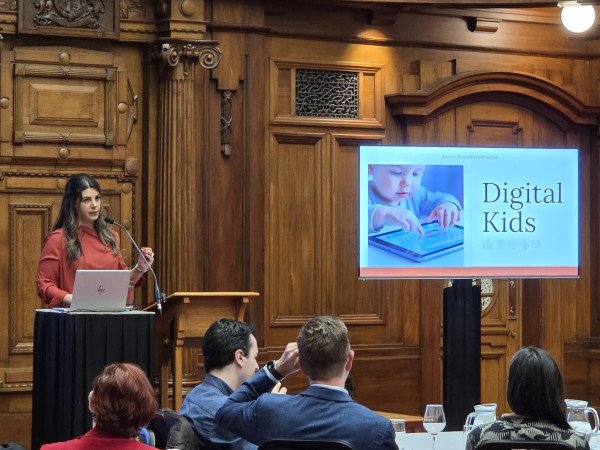
Dr McCauley presenting to MPs.