
Cities of the future: healthy cities
The Parliamentary Science Forum held in June focused on how to design cities to promote safety and health. Dr Rebecca Kiddle presented research on what Māori communities want in their neighbourhoods, and how to plan and build cities to promote social connection, green spaces, climate resilience, and shared decision-making. Professor Malcolm Campbell spoke about what a healthier, wealthier city of the future might look like, and how we might get there. He concluded that addressing the commercial and political determinants of health and wellbeing requires political trade-offs across housing, transport, and access.
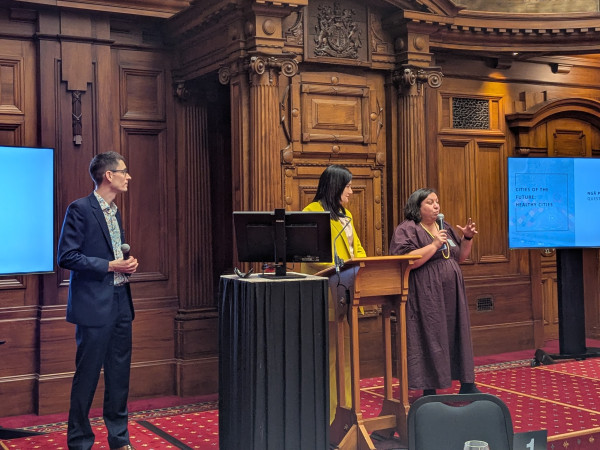
Prof Campbell and Dr Kiddle answering questions from Members of Parliament, with Dr Parmjeet Parmar MP.
Badly Designed Neighbourhoods Cost Us Our Health
Dr Rebecca Kiddle, Co-Director, Spatial Justice Aotearoa on behalf of the research team – Dr Kimiora Raerino, Dr James Berghan, Dr Marjorie Lipsham and Dr Morehu McDonald
"Streets are not usually framed as a health issue. The Māori Streets Project asked a simple question: what does a street that feels like home actually look like? We surveyed 288 Māori participants and ran co-design wānanga across the country. The headline finding was stark. Māori living in papakāinga rated their street ten out of ten for feeling like home, like a Māori street. Everyone else averaged two. That gap is not about decoration. In our data, the more your street feels like yours, the more connected you feel and the more your needs are met. We have been treating healthy cities as a problem of parks and cycleways. Māori told us it is a problem of belonging.
The dominant healthy-city model is physical: active transport, green space, clean air, walkability. These things matter, but they measure the body and forget the person. What our participants describe is a fuller model, one that encompasses hauora in its full sense: tinana, hinengaro (mental and emotional health), wairua (spiritual connection), and whānau.
Whanaungatanga ranked as the single most important feature of a Māori street, above any physical characteristic. Social connection is now understood as one of the strongest predictors of health and longevity, with loneliness carrying a mortality risk comparable to smoking. Our participants located the healthy city in relationships.
The physical priorities they did nominate are also worth noting. Native planting and birdsong ranked at 88%, functional stormwater infrastructure at 85%, and climate-resilient design at 78%. Bike lanes came last at 19%. The healthy-city toolkit has been narrow. This community is pointing at a broader, arguably more robust set of health determinants: food security, climate resilience, and contact with te taiao.
On safety, electronic surveillance ranked lowest of all safety features. What people wanted were maintained, well-lit streets where neighbours look out for each other – manaakitanga as the security system. One participant's whānau had stopped letting their tamariki play outside their own whare. The fear of crime is itself a health determinant, and a street designed for connection rather than surveillance addresses it while also delivering the physical activity and social contact that underpin health.
On decision-making, three in four participants wanted shared decision-making over streets, housing, and transport, with full Māori control reserved for cultural and identity features. This is not a special accommodation. It is the participatory governance that the healthy-city evidence base already says works. Partnership is the mechanism, not the concession.
Across 919 open-ended responses, the refrain returned again and again to what is good for Māori is good for everyone. The vocabulary participants reached for was wairua, mauri, hauora. One participant described a truly healthy street as somewhere kararehe (animals) would happily live if humans weren't around. They were describing a city measured by whether people and place are well, not whether traffic flows."
Imagining the healthy city: Creating places that generate better health and wellbeing for future populations
Professor Malcolm Campbell, Te Whare Wānanga o Waitaha | University of Canterbury
Prof Campbell’s presentation looked at a fundamental issue which impacts on all New Zealanders: how places where you live shape how long you might live and how healthy you might be. Drawing on more than two decades of work from Te Taiwhenua o te Hauora | The GeoHealth Laboratory with a team of colleagues, he presented evidence, examples, and maps of how patterns in the places around us unfold to explain variations in health. He talked through how variability in health inequalities scale from the national level down to the suburb level, and then looked ahead to digital futures for healthier cities.
The determinants of health
Prof Campbell discussed well-known social and economic determinants of health, such as low income, homelessness or deprivation. He went further and acknowledged that these factors are, in turn, determined by commercial and political determinants of health – the forces which create the societal structures that create the conditions for health inequity to emerge. The talk also highlighted the growing importance of social connections as an antidote to loneliness and creating opportunities for people to connect in person close to where they live.
Towards dynamic personal environmental exposure
He also introduced his research on dynamic exposures; how we might measure a person's cumulative lifetime environmental exposures with fine scale resolution (eg, mobile phone location data). This builds on GeoHealth Lab's methodological work, developing a more dynamic health geography using smartphone data and national movement patterns using mobile phone data to understand social and spatial inequalities.
Digital determinants of health
Digital tools and technology could reduce the tyranny of distance in healthcare, but digital divides closely follow existing socioeconomic inequalities (such as access to devices and internet connectivity). This means that we need to think carefully about how more online healthcare services could create additional barriers to healthcare access and how we might respond by eliminating digital deserts.
Conclusion
Prof Campbell concluded with the evidence that the social and economic determinants of health are well established, including the importance of geographical inequalities. The challenge is often the political trade-offs of changing the 'determinants of the determinants' and how we think about investments in housing, education, transport, food environments, social connection, or even digital access that will create a healthier and more equitable future.
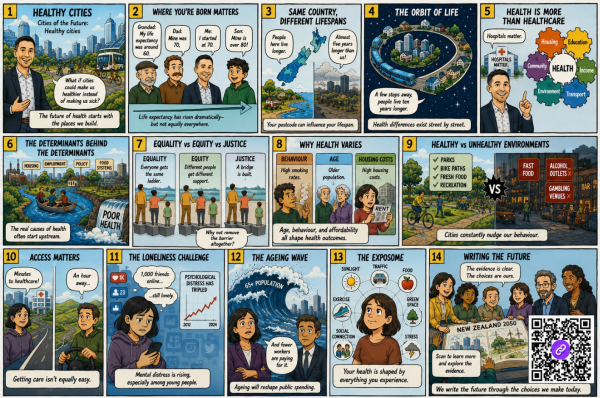
Graphical summary generated with AI tools by Prof Campbell.