
Cities of the future: sustainable cities
The Parliamentary Science Forum held in May focused on opportunities for better cities and buildings in Aotearoa New Zealand. Dr Katy Stokes spoke about how the building system can balance climate resilience and sustainability while building in our unique environment, and Dr Robyn Simcock talked about ‘tree interventions’ that could improve the health, productivity, and flood resilience of our cities.
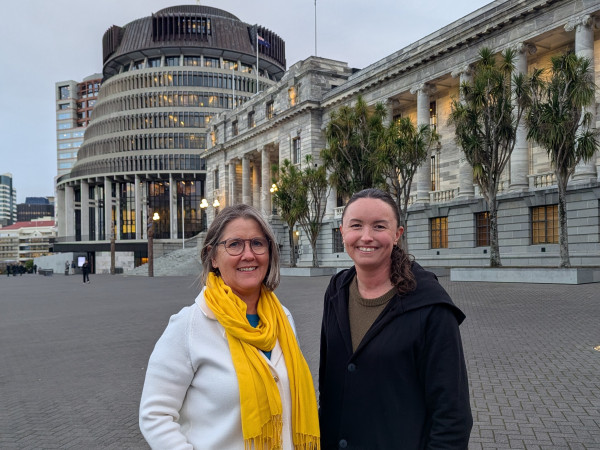
Dr Robyn Simcock and Dr Katy Stokes in front of the Beehive
Resilience and Sustainability in a Changing Climate
Dr Katy Stokes, BRANZ
Dr Stokes’ presentation discussed the careful balance between resilience and sustainability for buildings when considering climate adaptation. It was based on BRANZ research on building science, highlighting research on timber durability, water intrusion, and microbial contamination, particularly where climate-related flooding or dampness affects homes and other buildings. At its core, the presentation asked not only whether a building can withstand an event, but also how well it can recover afterward and what that means for occupant health, repairability, and whole-of-life impact.
The research findings presented emphasised the hidden, long-term consequences that may occur from inadequate drying, contamination, and the gradual degradation of materials if homes are not correctly repaired after an event, such as a flood. Microbial growth and indoor contamination were treated as major resilience concerns because they affect occupier health, remediation costs, and whether materials can realistically be retained or need to be replaced. Research into timber durability and other material performance supported more nuanced decisions about repair versus replacement versus ‘upgrade’. This knowledge is vital to allow industry or homeowners to use relevant hazard-risk models to allow a balance of resilience measures and justify sustainability trade-offs, such as embodied carbon considerations. Overall, Dr Stokes suggested that resilience and sustainability should be assessed across the full life of a building, including disruption, remediation burden, and post-event performance, rather than only initial construction efficiency.
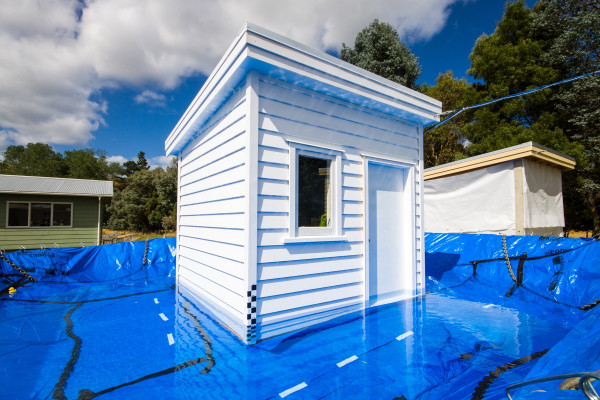
One of the "houses" that was flooded as a part of this research.
Dr Stokes ultimately recommended evidence-based adaptation decisions that account for both operational resilience and whole-of-life sustainability. Her practical implication is that front-end policy, design, and material specification should reflect local climate risk and the realities of post-disaster recovery, rather than relying on generic assumptions about what counts as either “green” or “resilient” construction. In this way, resilience and sustainability are presented not as fixed or automatically compatible goals, but as balanced trade-offs that will be unique for each building and the hazards it faces. More readily available hazard models across New Zealand, combined with stronger research, testing, and building science guidance, can provide applicable solutions for industry, homeowners, and occupiers.
The overall message is that better building decisions depend on sound evidence about relevant hazard, long-term performance, and understanding lifecycle consequences, including damage, remediation, health risk, and future climate exposure.
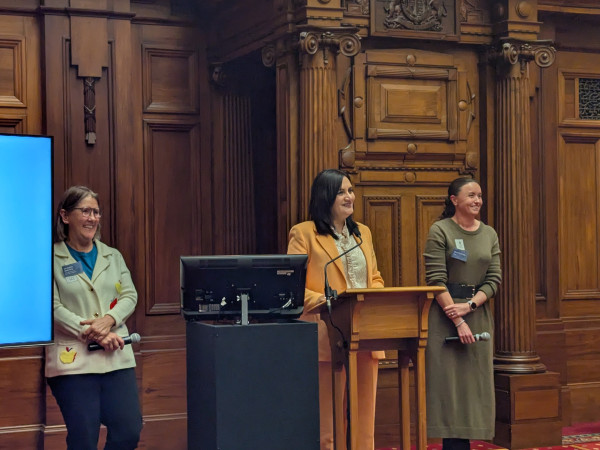
Dr Simcock and Dr Stokes answering questions from Members of Parliament, with Dr Parmjeet Parmar MP.
Boost health, productivity, flood resilience (and equity) with urban trees: essential (but underappreciated) city infrastructure
Dr Robyn Simcock, Bioeconomy Science Institute
This talk illustrated why and how trees are critical urban infrastructure that underpins city resilience to floods, people’s health and productivity. Research in Auckland built on Parliamentary Commissioner of the Environment's 2023 ‘Urban Ground Truths’, quantifying how water storage is reduced in earth-worked soils and the inability of these soils to support trees without costly remediation. Christchurch modelling showed how urban trees with their deep soils reduce runoff in large storms. Nature-based solutions such as raingardens and ‘room for rivers’ have strong local guidance and case studies developed over 15 to 20 years but are yet to be comprehensively applied. However, the majority of city greenspace is in grass, and many urban trees along conventional street and small parks are stressed. Both these features limit stormwater retention and contribution of greenspace to health and productivity.
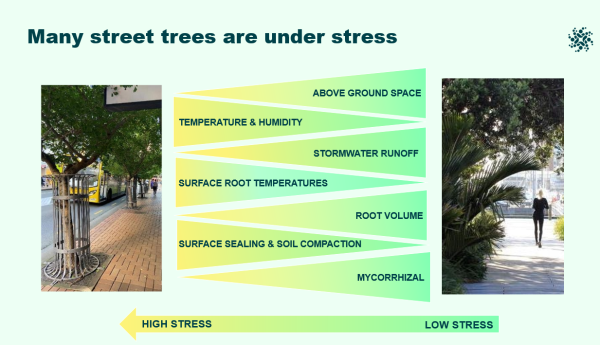
The links between greenspace quality and people’s health and productivity were outlined, using contrasting photos and reference to an internationally important study in Auckland testing ‘Nature Prescriptions’. Preliminary research is establishing the potential for 'Nature Prescriptions' (distinct from ‘Green Prescriptions’) and benefits from widespread use in comparable countries including Australia, Canada, and the United Kingdom. As for nature-based stormwater solutions, New Zealand has limited adoption of practices that enhance health benefits by deliberate design of landscapes in schools, educational facilities, and public green spaces, including mitigating harm from transport corridor air emissions and runoff. In all these green spaces, the inclusion and protection of trees (and the deep soils they require to be healthy) underpin health, productivity and resilience to flooding.
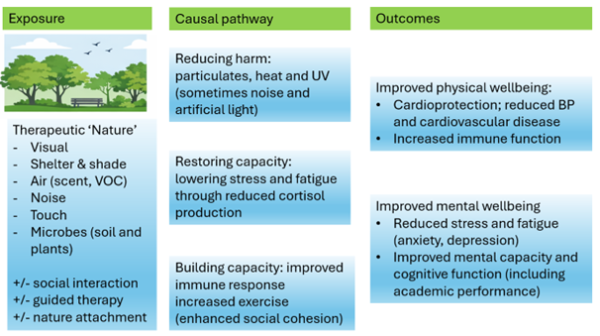
How nature (trees) influence physical health and productivity
Sources:
Podcasts and websites
- Sue Ira. Stormwater solutions could be lying in our soil | RNZ News The Detail 2026
- Professor Kathy Willis Nature makes us healthier: Kathy Willis | RNZ Nine to Noon 2024
- Wellington Urban Tree walk (30 trees) Wellington Urban Tree Walk
- National Health Service Forest Green space for health. NHS Forest tree-planting FAQs - NHS Forest and RSPB Nature Prescriptions Royal Society for the Protection of Birds (UK)
Books
- Dr Gayle Souter Brown. 2015. Landscape and urban design for health and wellbeing: using healing, sensory and therapeutic gardens. Routledge. Taylor and Francis Group. London and New York.
- Professor Kathy Willis. 2024. Good Nature. The new science of how nature improves our health. Bloomsbury Publishing
Papers and policy notes
- Marie Brown et al. 2015. Protecting the Urban Forest. Policy Brief 13. Policy briefing & guidance papers » Manaaki Whenua
- Peter Edwards et al 2024. Enhancing urban tree health in New Zealand’s urban areas. Policy Brief 30. Policy briefing & guidance papers » Manaaki Whenua
- Dan Richards et al Inequity in nature’s contributions to people in Ōtautahi/ Christchurch: A low-density post-earthquake city – ScienceDirect
- Gayle Souter-Brown et al. 2021. Landscape and Urban Planning 207 103997 Effects of a sensory garden on workplace wellbeing: A randomised control trial - ScienceDirect
- Simon Upton 2023. Are we building harder, hotter cities? The vital importance of urban green spaces | Parliamentary Commissioner of Environment
- Simon Upton 2024. Urban ground truths | Parliamentary Commissioner of Environment