News
Published 13 May 2026NZJCHS Call for Papers: Special Issue on Plant Biotechnology-based Interventions for Developing Climate Resilient Crops for Future Food Security
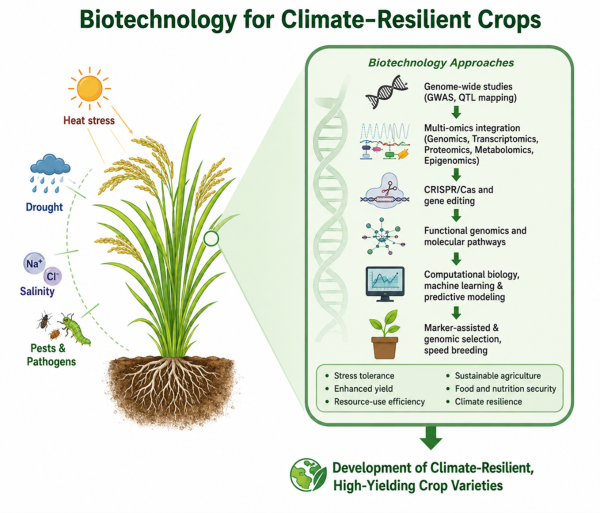
Climate change is increasingly recognised as a major constraint on global agricultural productivity, with rising temperatures, erratic precipitation patterns, soil salinisation, and the emergence of new pests and pathogens posing significant threats to crop yield and stability. These challenges are further intensified by a rapidly growing global population, projected to reach approximately 9.8 billion, placing unprecedented pressure on food production systems, particularly in developing regions. Conventional breeding approaches, while valuable, are often time-intensive and limited in their capacity to address complex, multigenic traits associated with climate resilience. In this context, this special issue focuses on the urgent need for precise, efficient, and scalable solutions to enhance crop adaptation under changing environmental conditions.
This special issue of the New Zealand Journal of Crop and Horticultural Science invites high-quality, hypothesis-driven, and translational research that leverages advanced plant biotechnology to mitigate the adverse impacts of climate change on crop productivity. We welcome studies employing a range of approaches, including (but not limited to) genome-wide association studies (GWAS), quantitative trait loci (QTL) mapping, multi-omics approaches, and CRISPR/Cas-based genome editing, to advance understanding of the genetic and molecular basis of stress tolerance. We are particularly interested in work that advances functional genomics, gene validation, and systems-level insights into plant responses to both abiotic stresses (such as drought, heat, and salinity) and biotic stresses (including pathogens and pests). Contributions integrating computational biology, bioinformatics, and predictive modelling to support genomic selection and climate-smart breeding are also encouraged.
Together, these approaches will help bridge molecular discovery and applied breeding, supporting the development of more resilient and productive crop systems under changing environmental conditions. The special issue aims to bring together cutting-edge research that advances both fundamental understanding and practical applications in crop improvement for climate resilience.
Topics of interest include but are not restricted to:
- Genome-wide association studies (GWAS), linkage mapping, and QTL analysis for complex stress-adaptive traits
- Functional genomics, gene discovery, and validation of stress-responsive loci
- Multi-omics integration (genomics, transcriptomics, proteomics, metabolomics, epigenomics) in crop stress biology
- CRISPR/Cas and next-generation genome editing technologies for precise trait engineering
- Molecular signaling networks and regulatory pathways governing abiotic stress tolerance (drought, heat, salinity)
- Plant-pathogen and plant-insect interactions, and molecular basis of biotic stress resistance
- Plant synthetic biology, metabolic pathway engineering, and regulatory circuit design
- Marker-assisted selection (MAS), genomic selection (GS), and speed breeding approaches
- Systems biology, machine learning, and predictive modeling in crop improvement
- Translational genomics and development of climate-resilient, high-yielding crop cultivars
- Biotechnology-enabled strategies for sustainable agriculture, resource-use efficiency, and food security under climate change.
Submission Information
Please send a preliminary title, indicative author list, and a short descriptive paragraph outlining the scope of your proposed manuscript to the Managing Guest Editors, Dr Habib Ali (habib_ali1417@yahoo.com) by 31 August 2026. Expressions of Interest will be considered by the guest editor team.
Authors will be notified of the result and formally invited for full submission by 31 September 2026. The anticipated manuscript submission deadline is 28 February 2027.
Acceptance for publication will depend on the outcome of the rigorous peer review process and authors meeting critical time schedules. It is important that manuscripts are prepared according to the Author Guidelines of the journal. Manuscripts should be submitted online through the journal’s submission system, and authors should select the relevant special issue title during the submission process.
If the corresponding author is affiliated with a growing range of global institutions covered by a transformative agreement with Wiley, they may be eligible to publish their articles Open Access at no cost. Otherwise, publishing under the traditional subscription model is completely free.
Guest Editors
Dr Habib Ali
Khwaja Fareed University of Engineering and Information Technology, Pakistan
Email: habib_ali1417@yahoo.com
Dr Taufiq Nawaz
South Dakota State University, United States
Email: Taufiq.nawaz@jacks.sdstate.edu
Prof. Soner Soylu
Hatay Mustafa Kemal University, Hatay, Türkiye
Email: soylu@mku.edu.tr