
News
Published 20 July 2026JRSNZ Call for Papers: Special Issue on Future Electrical Network Architecture: Hybrid AC/DC Systems for a Low-Carbon Energy Future
Rationale and Scope
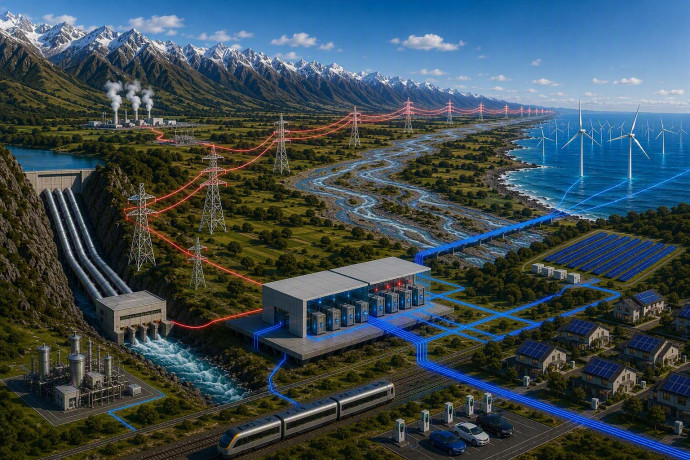
The transition to a low-carbon economy in Aotearoa New Zealand is driving a profound transformation of electrical power system. Increasing electrification, high penetrations of renewable generation, widespread deployment of power electronic converters, and more active consumer participation are reshaping the way electrical networks are planned, operated, and governed.
The Future Architecture of the Network (FAN) | Te Whatunga Hiko programme addresses these challenges by investigating electrical infrastructure that is efficient, reliable, resilient, and capable of supporting deep decarbonisation. A central focus is the development of future hybrid AC/DC transmission and distribution networks that can integrate renewable generation, electric vehicles, energy storage, and other emerging technologies while maintaining secure and flexible system operation.
This Special Issue of the Journal of the Royal Society of New Zealand will bring together high-quality interdisciplinary research on the future architecture of electrical power systems, spanning engineering, policy, economics, and socio-technical perspectives. Submissions are invited from researchers worldwide, particularly those offering international experience, comparative studies, and globally relevant insights.
Aims and Objectives
This Special Issue aims to:
- Advance understanding of future electrical network architectures, including hybrid AC/DC systems.
- Support the transition towards highly electrified, renewable-based energy systems.
- Present advances in modelling, planning, operation, control, stability, and resilience of future electrical networks.
- Explore policy, regulatory, market, and socio-technical frameworks that enable successful energy transitions.
- Encourage interdisciplinary research that incorporates Vision Mātauranga principles and recognises the contribution of mātauranga Māori and Māori participation in shaping future energy systems.
Themes
Submissions are invited in (but not limited to) the following thematic areas.
1. Future Network Architectures
- Hybrid AC/DC transmission and distribution systems
- Converter-dominated grids
- Future network planning and electrical infrastructure innovation
2. Renewable Integration, Storage, and Electrification
- Distributed energy resources
- Grid-edge technologies
- Electric vehicles
- Battery and other energy storage technologies
- Sector coupling and widespread electrification
3. System Stability, Control, and Resilience
- Stability and control of converter-dominated and low-inertia systems
- Protection and power quality
- System resilience under operational and environmental disturbances
4. Transition Pathways and Socio-Technical Systems
- Pathways towards net-zero electrical power systems
- Electricity market design and regulation
- Infrastructure investment and planning
- Workforce capability and community engagement
- Vision Mātauranga, mātauranga Māori, and Indigenous perspectives on energy futures
5. Digitalisation and Intelligent Energy Systems
- Digital twins
- Artificial intelligence and machine learning
- Advanced modelling and simulation
- Data-driven planning, operation, and asset management
Guest Editors
Prof. Neville Watson – University of Canterbury (Lead Guest Editor)
Prof. Nirmal-Kumar Nair – University of Auckland
Dr Ramesh Rayudu – Victoria University of Wellington
Article Types
The Special Issue welcomes original research articles, review papers, and viewpoints, with interdisciplinary and policy-focused studies particularly encouraged, especially industry-led and applied research that provides original findings.
Why Contribute?
This Special Issue will provide an international forum for presenting advances in the future architecture of electrical power systems and will:
- Showcase leading research on the transition to low-carbon electrical power systems.
- Promote collaboration between academia, industry, government, and Māori communities.
- Strengthen links between engineering, policy, economics, and Indigenous knowledge.
- Highlight international experience and best practice relevant to Aotearoa New Zealand and beyond.
- Create a lasting reference on the future architecture of low-carbon electrical power systems.
Timeline
Expression of Interest with a single page abstract: 1 September 2026
Submission deadline: 31 March 2027
Publication of themed issue: mid-2027
Submission Information
Authors are invited to submit an Expression of Interest (EOI) consisting of:
- a provisional title,
- indicative author list and affiliations, and
- a short paragraph describing the proposed manuscript.
EOIs should be sent to Professor Neville Watson (Lead Guest Editor) at neville.watson@canterbury.ac.nz as early as convenient.
Authors whose EOIs are invited to proceed must adhere to the journal’s scope and Author Guidelines when preparing their manuscripts, and submit via the journal’s online submission system, selecting the Special Issue option at submission.
Invitation to submit does not guarantee publication. Submissions will undergo the journal's standard peer-review process and must meet the required quality standards and publication deadlines. Accepted papers will be published online individually before being collected into the Special Issue.
If the corresponding author is affiliated with a growing range of global institutions covered by a transformative agreement with Wiley, they may be eligible to publish their articles Open Access at no cost. Otherwise, publishing under the traditional subscription model is completely free.