
News
Published 26 August 2026New Zealand captures carbon on land for climate change mitigation: what about in the ocean?
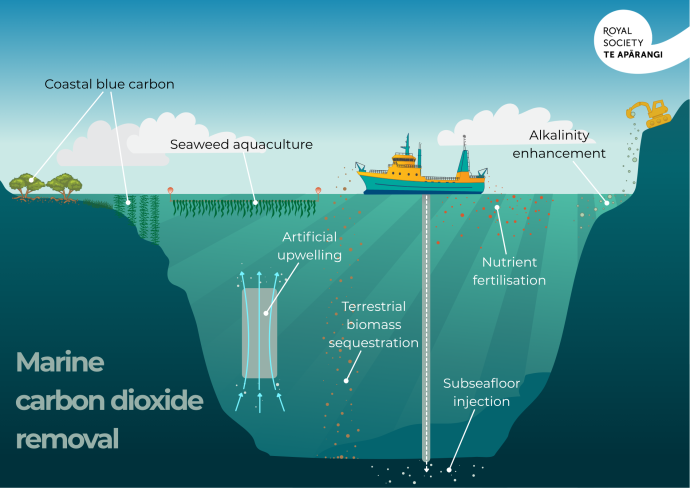
As the world grapples with the growing impacts of climate change, and explores new techniques to mitigate increasing levels of greenhouse gases, the Royal Society Te Apārangi has released a new evidence-based, peer-reviewed report: 'Marine carbon dioxide removal in Aotearoa New Zealand'.
The report provides an overview of marine carbon dioxide removal (mCDR) techniques and how they could potentially remove some of the carbon dioxide (CO2) already in our atmosphere, alongside established mitigation measures. Methods range from biological to chemical approaches, with feasibility, cost and efficacy varying widely across techniques.
The report is endorsed by the United Nations Decade of Ocean Science for Sustainable Development, which has the mission to transform ocean science solutions for sustainable development, while connecting people and our ocean.
“As global temperatures approach the 1.5°C warming threshold set by the Paris Agreement, global and national initiatives to decrease the amount of CO2 in the atmosphere must urgently ramp up and diversify if we are to limit the worst impacts of climate change,” says Justine Daw, Chief Executive of the Society.
“Reducing CO2 emissions is the most important action we can take to reduce levels of atmospheric CO2. However, globally and in New Zealand early conversations have begun about CO2 removal as another tool for climate change mitigation,” she said.
“In line with the goals of the Decade of Ocean Science for Sustainable Development, this report demystifies these early-stage techniques to help communities make informed decisions about whether mCDR is right for Aotearoa New Zealand. Each technique has unique social, environmental, and economic impacts that need to be understood if they are to become part of our future climate change mitigation strategies.”
The report, developed with guidance from experts in the field, presents an overview of a range of mCDR techniques that, if proven to be effective, could be possible in future in New Zealand waters:
- Boosting coastal blue carbon: increasing the carbon stored in coastal environments
- Seaweed aquaculture: sequestering carbon into seaweed
- Ocean nutrient fertilisation: encouraging the growth of phytoplankton to sequester carbon
- Artificial upwelling: bringing nutrient-rich waters to the ocean surface to encourage the growth of phytoplankton to sequester carbon
- Ocean alkalinity enhancement: altering the chemistry of the ocean to increase its ability to take up carbon dioxide from the atmosphere
- Terrestrial biomass sequestration: sinking organic matter to store carbon in the deep ocean
- Subseafloor injection: pumping liquid carbon dioxide below the seafloor for carbon storage.
“Research on mCDR is ongoing across New Zealand,” says Professor Cliff Law, of Earth Sciences New Zealand and Waipapa Taumata Rau, University of Auckland, who advised on the report.
“There are areas of active research into coastal blue carbon from Fiordland to the Tairua estuary in the Coromandel, and researchers are working in the Cook Strait to estimate natural carbon sequestration by kelp. Aotearoa was also the first country globally to conduct an iron fertilisation experiment in the Southern Ocean.” This research won the Prime Minister’s Science Prize in 2011.
“Using the ocean to help remove more CO2 from the atmosphere could be beneficial to mitigating climate change, as with the planting of trees on land. However, there are unknown risks to marine life and ecosystems, and the effectiveness of these techniques is difficult to determine in the ocean,” he said.
“In Aotearoa New Zealand, many communities have a strong cultural connection to the ocean, including Māori and Pacific communities,” says Linda Faulkner (Ngāti Rangi, Whanganui) of Earth Sciences New Zealand, who also advised on the report.
“Any mCDR development here would need to consider the customary and commercial rights and interests of Māori. The moana, ocean, is precious, and in te ao Māori it is not a resource, but a responsibility – a living being, an ancestor, a source of wellbeing.”
Distinguished Professor Dame Jane Harding DNZM FRACP FRSNZ, President of the Society, supports communities learning more about marine carbon dioxide removal techniques: “I invite all New Zealanders to use this evidence-based report to learn more about the possible role of our oceans in storing carbon. It is important that communities can make informed decisions about whether these approaches could, or should, be a part of New Zealand’s climate change response in future.”
View report:
View flipbook: Marine carbon dioxide removal in Aotearoa New Zealand.
Download report:
Marine carbon dioxide removal in Aotearoa New Zealand
Advisory group:
- Linda Faulkner (Ngāti Rangi, Whanganui), Earth Sciences New Zealand
- Professor Cliff Law, Earth Sciences New Zealand and Waipapa Taumata Rau, University of Auckland
- Dr Scott Nodder, Earth Sciences New Zealand
- Dr Adrienne Paul (Ngāti Awa, Ngāti Tūwharetoa ki Kawerau, Ngāi Tuhoe, Te Arawa ki Maketu), Mahi Ngātahi Law – Specialist Division of Halliwells Lawyers
The report was peer-reviewed by:
- Associate Professor Linn Hoffmann, University of Otago, Ōtākou Whakaihu Waka
- Professor Tim Naish FRSNZ, Te Herenga Waka—Victoria University of Wellington